
Published on - Jul 03rd, 2026
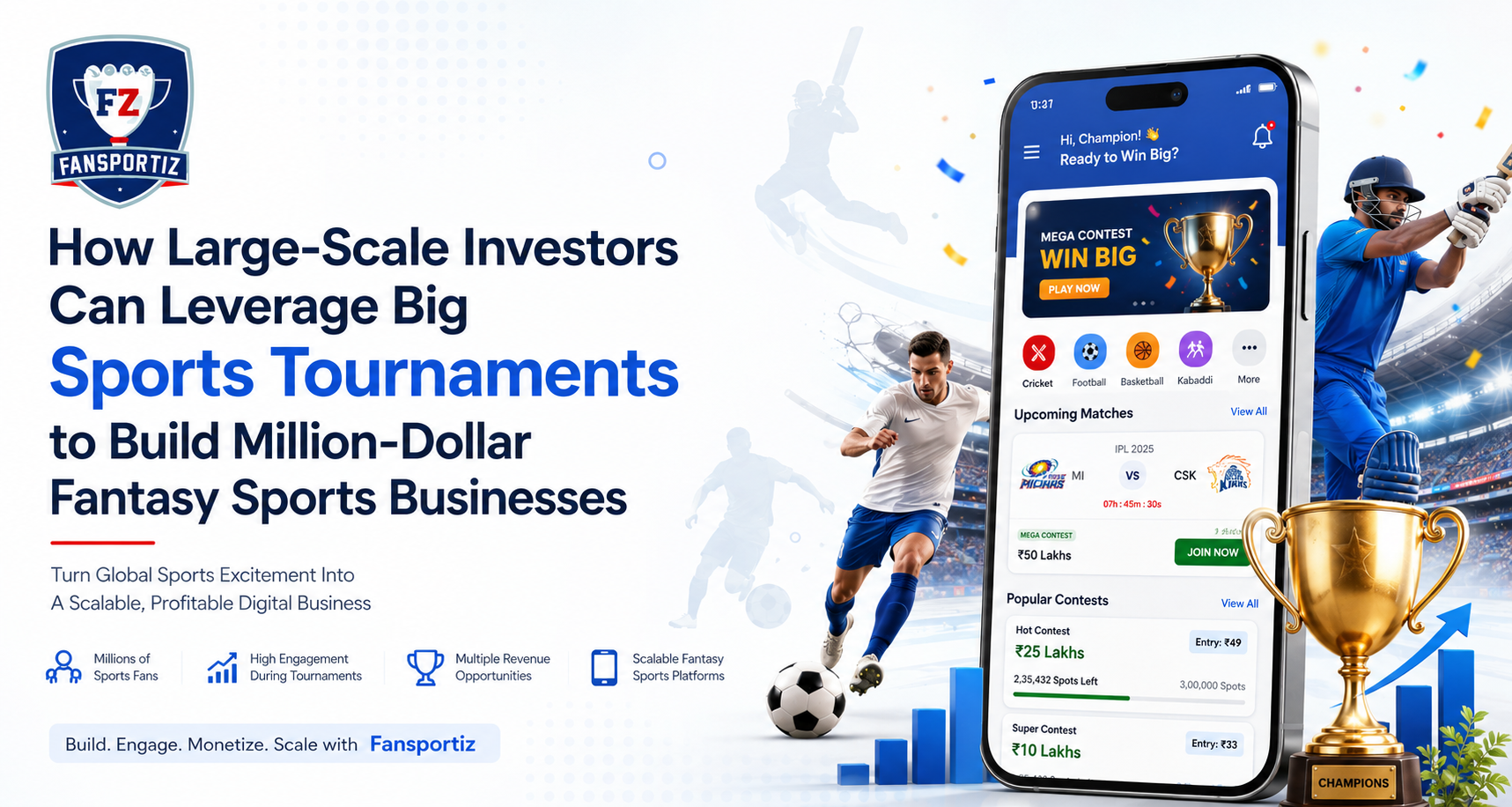
Investor Guide · Fantasy Sports Business
Every major sports tournament creates a billion-dollar digital opportunity. Are you ready to own a part of it?
picture the opening day of a FIFA World Cup. Stadiums are packed, jerseys fill the streets, and social media overflows with predictions and match-day banter. Offices grow quieter during kickoff, restaurants and bars see a rush of visitors, and every advertiser wants a piece of the moment. A few months later, the same energy returns when the Indian Premier League begins — cricket dominates every conversation in India, fans debate team combinations for hours, and millions open their fantasy apps several times a day. Different sport, different audience, same unmistakable pattern: a massive, recurring surge in attention.
While billions of fans simply watch, savvy investors see something else entirely — an enormous digital economy hiding in plain sight, one that resets and reignites with every new tournament. One of the fastest-growing businesses riding this wave is fantasy sports app development, and for entrepreneurs, gaming brands, and large-scale investors, that makes major tournaments far more than sporting spectacles. They are recurring, revenue-generating launch windows for platforms built to capture the attention of millions of already-engaged fans.
This guide breaks down why that opportunity exists, how the smartest fantasy sports businesses actually make money, and what it takes to build a platform ready to meet the moment when the next big tournament arrives — whether that’s a cricket season away or a football final away.
The Tournaments That Move Markets
Major tournaments are the sporting calendar’s biggest attention magnets — competitions like the ICC Cricket World Cup, the Indian Premier League, the FIFA World Cup, the UEFA Champions League, the English Premier League, Copa America, the NBA Finals, and the Pro Kabaddi League. Unlike a routine league match, these events spark excitement that spreads across entire countries almost overnight, turning casual viewers into fully invested fans who follow every score, statistic, and storyline for weeks at a stretch.
That emotional intensity is exactly what makes fantasy sports platforms so effective, because people aren’t just watching the game anymore — they’re emotionally invested in it, and every match matters just a little more when their own fantasy team is on the line. The scale of that shift shows up clearly in the numbers.
$24.9B
Global fantasy sports market size in 2024
$56B+
Projected market size by 2030
~15%
Expected annual growth rate (CAGR)
Cricket alone accounts for more than 87% of India’s fantasy sports activity, with mobile apps making up over three-quarters of all participation — a clear signal that this is no longer a niche hobby, but a rapidly maturing digital industry. What makes these numbers especially interesting for investors is where the growth is coming from: not just more people watching sport, but more people wanting to actively participate in it, on a device they already carry in their pocket.
Why Investors Are Paying Attention
Consider two entrepreneurs launching businesses around the same time. One opens a fashion e-commerce store; the other launches a fantasy cricket platform two months before the IPL. Both spend on marketing, both build polished apps, both want customers — but only one of them enters a market where the audience, the demand, and the conversation already exist. Millions of sports fans are already searching for match predictions, dream-team combinations, and player statistics; the investor simply has to give them somewhere to play. That is a very different starting line than convincing someone to shop.
Fantasy sports has also fundamentally changed how people experience a match. Years ago, fans simply watched; today, they participate — poring over player form, pitch reports, weather conditions, and captain choices before a ball is even bowled. Every run, goal, or assist directly affects their fantasy score, which means users return to the app before, during, and after every single game.
“Higher engagement isn’t just a nice side effect — it’s the entire business model.”
For investors, that translates into something a typical consumer app would spend years trying to earn: recurring, built-in engagement that shows up the moment the platform goes live.
How Fantasy Sports Apps Actually Make Money
The strongest fantasy platforms rarely rely on a single income stream. Instead, they layer several together, so revenue keeps compounding as tournaments and user bases scale. Contest entry fees remain the backbone for most platforms: users pay a small fee to join premium contests, and the platform retains a percentage of the prize pool. Layered on top of that are advertising placements, since sports brands, beverage companies, and fintech players are all eager to reach an audience this engaged.
Premium memberships add a second, recurring revenue line by offering advanced analytics, AI-powered team suggestions, and early access to contests, while brand partnerships and sponsored tournaments bring in additional income from companies chasing visibility during marquee events. Smaller in-app purchases — performance boosters, premium statistics, VIP contests — round out the model, quietly nudging up average revenue per user without requiring a single major feature launch.
Diversify across enough of these channels, and a platform’s revenue starts to look less like a single seasonal spike and more like a business that grows steadily with its user base — one where a quiet month between tournaments doesn’t mean a quiet month for the balance sheet, because subscriptions and partnerships keep the lights on until the next wave of matches arrives.
Timing Is Everything
Launching a fantasy sports app is a bit like opening a beach resort — nobody does it during the rainy season. Businesses that time their launch just before a major tournament get to ride a wave of organic search demand, lower customer education costs, and viral, referral-driven growth, because everyone already understands what a fantasy team is and just wants a reason to invite their friends along. Every match day during a multi-week tournament becomes another reason for users to come back, turning a seasonal spike into weeks of sustained engagement.
The flip side is just as real. Every tournament your platform misses is a tournament your competitors don’t. Users acquired elsewhere are harder to win back, referral networks solidify around whoever got there first, and market share becomes progressively more expensive to buy. In an industry growing this quickly, timing often matters just as much as the technology behind the product — and unlike technology, timing isn’t something you can fix retroactively once the tournament has already started.
What a Winning Platform Needs
Templates might get an app to market quickly, but they rarely survive contact with a major tournament’s traffic. When hundreds of thousands of users pile in during an IPL final, or millions of contest entries need processing within minutes, a platform’s architecture is put through a real stress test. That is why serious investors choose to build custom — it hands them full control over branding, contest formats, and monetization, along with the ability to scale without buckling exactly when the stakes are highest.
A handful of features tend to separate the platforms users stick with from the ones they abandon after one bad match day. It’s rarely the flashiest feature that wins loyalty — it’s the boring, reliable stuff working exactly as expected, match after match, contest after contest.
| Feature | Why It Matters |
|---|---|
| Real-time scoring & live stats | Keeps users glued to the app while a match is live |
| Secure wallet & payments | Makes deposits and withdrawals fast and worry-free |
| Referral tools & leaderboards | Turns existing users into your best acquisition channel |
| Multiple contest formats | Appeals to casual players and serious competitors alike |
| Admin analytics dashboard | Gives the business real visibility into what’s working |
None of this needs to be complicated. It simply needs to work reliably, every single match, without exception.
A Global Game — Cricket, Football, and Beyond
Cricket remains the biggest prize in markets like India, where the sport sits closer to a national religion than a pastime — a single IPL season is enough to keep a well-built fantasy cricket app busy for weeks, and tournaments like the ICC Cricket World Cup and Asia Cup add several more windows across the year. But cricket is only one route into this market. Football offers something cricket can’t: near-constant global relevance, with the FIFA World Cup, UEFA Champions League, Premier League, La Liga, and Copa America keeping fans across Europe, Asia, Africa, and the Americas engaged practically year-round.
The smartest platforms don’t choose one sport over the other — they build for both, and often add basketball, kabaddi, or baseball on top. A multi-sport platform never has to sit idle between cricket seasons; there is almost always another tournament, somewhere in the world, keeping the user base active and the revenue flowing. For an investor thinking beyond a single launch, that breadth is what turns a seasonal app into a genuine year-round business.
What It Costs — and What It’s Worth
The question every investor eventually asks is some version of, “what should I actually budget for this?” The honest answer is that it depends — on the number of sports supported, the complexity of the design, live-data integrations, payment infrastructure, and how much customization and analytics capability the platform needs. But framing this purely as a cost misses the bigger picture. A well-built fantasy sports platform isn’t an expense; it’s a scalable digital asset that keeps generating value long after the initial build is paid for.
| Investment Area | Long-Term Value |
|---|---|
| App development | A scalable digital product, not a one-off expense |
| Infrastructure | Handles user surges during peak tournament traffic |
| Marketing | Acquires high-intent users at the moment demand peaks |
| Premium features | Creates a recurring, compounding revenue line |
Looked at this way, the real question isn’t whether you can afford to build a fantasy sports platform — it’s whether you can afford to let the next major tournament pass without one.
Choosing the Right Technology Partner
At Fansportiz, we’ve spent years helping entrepreneurs and enterprise investors turn sports enthusiasm into scalable digital businesses. Our work spans custom fantasy cricket and football platforms, multi-sport ecosystems, and applications inspired by category leaders like Dream11 — each built around your own branding, contest formats, and monetization strategy rather than a one-size-fits-all template.
Beyond development, we handle the parts that are easy to underestimate: architecture that holds up under tournament-day traffic, secure payment integration, analytics dashboards that actually inform decisions, and ongoing support once the app is live and users start showing up. The goal isn’t just to ship a product. It’s to make sure that product is still standing — and still growing — three tournaments from now, long after the initial launch buzz has faded and what’s left is simply whether users keep coming back.
The Investors Who Move First
Every major tournament creates a brief, unmistakable window of opportunity, and the investors who prepare months in advance are the ones who capture it. They build brand awareness before kickoff, acquire users while search demand is climbing, and refine their platform based on real feedback before the traffic spike ever arrives. The investors who wait usually spend the tournament watching competitors do all of this instead, then spend the months afterward trying to buy back the market share they gave up by hesitating.
“It rarely comes down to luck. It comes down to preparation.”
Every major tournament creates excitement, every wave of excitement creates engagement, and every wave of engagement creates a business opportunity. The only real question is whether your platform will be ready to capture it when the next one begins.
Where the Industry Is Headed
Fantasy sports is still a young industry compared to the sports it’s built on top of, which means the platforms winning today won’t necessarily be the ones winning in five years unless they keep evolving. Artificial intelligence is already reshaping how users pick teams, with smarter recommendation engines analyzing form, matchups, and conditions far faster than any fan could manually. Real-time analytics are turning every match into a live data feed rather than a static scoreboard, and cloud infrastructure is quietly doing the unglamorous work of making sure none of this falls over the moment a tournament final kicks off.
None of these technologies matter in isolation, though. What actually determines whether a platform survives its second or third tournament is far simpler: does it feel effortless to use? A platform that loads quickly, processes payments without friction, and updates scores the instant something happens on the field earns a kind of trust that clever features alone never will. Users don’t compare your app only to other fantasy platforms — they compare it to every other polished digital product they use daily, and that bar keeps rising every year.
That’s ultimately the real advantage a strong technology partner brings to the table: not just the ability to add a new feature, but the discipline to make sure the fundamentals never slip, even as the platform adds sports, adds tournaments, and adds users far faster than most digital businesses ever get to.
Ready to Build the Next Big Fantasy Sports Platform?
The next major tournament is already on the calendar. The fans will be there, the excitement will be there, and the demand will be there — the only open question is whether your platform will be too.
Connect with Fansportiz today to start building a custom fantasy sports app designed to be ready when the world’s biggest sporting events begin.
Frequently Asked Questions (FAQs)
The following questions are designed to answer the most common investor queries while also improving visibility in AI-powered search engines and traditional search results.
01.What is a fantasy sports app?
A fantasy sports app is a digital platform where users create virtual teams using real-life players. Their teams earn points based on the actual performance of those players during live matches. Users can compete in public or private contests, making fantasy sports more interactive and engaging than simply watching a game.
02.Why do fantasy sports apps become more popular during major tournaments?
Major tournaments such as the IPL, ICC Cricket World Cup, FIFA World Cup, and UEFA Champions League create a surge in sports viewership and online engagement. Millions of fans actively search for fantasy contests, player statistics, and match predictions, resulting in significantly higher traffic for fantasy sports platforms.
03.Is fantasy sports a profitable business?
Yes. Fantasy sports has evolved into a multi-billion-dollar global industry. Businesses generate revenue through contest platform fees, premium subscriptions, advertising, sponsorships, referral programs, and strategic brand partnerships.
04.Which sports generate the highest engagement?
The most popular fantasy sports include:
- Cricket
- Football (Soccer)
- Basketball
- Baseball
- Kabaddi
- American Football
- Hockey
The ideal mix depends on your target audience and the regions you plan to serve.
05.Why should investors launch before a tournament begins?
Launching before a major tournament allows businesses to:
- Build brand awareness early
- Acquire users before competition intensifies
- Test the platform under real conditions
- Run pre-launch marketing campaigns
- Maximize user registrations when tournament excitement peaks
Preparation is one of the biggest competitive advantages in fantasy sports.
06.How does a fantasy sports app earn money?
Fantasy sports platforms typically monetize through:
- Contest platform fees
- Premium memberships
- Advertising
- Sponsored contests
- Brand partnerships
- In-app purchases
- Featured tournaments
- Data-driven premium services
Using multiple revenue streams helps create a more resilient and scalable business model.
07.How long does it take to develop a fantasy sports app?
Development timelines depend on project complexity, supported sports, feature requirements, integrations, and customization. A carefully planned custom solution generally requires several months, while enterprise-grade platforms with advanced features may take longer to ensure quality, security, and scalability.
08.Why choose custom fantasy sports app development?
Custom development gives investors full control over branding, features, monetization, user experience, and future scalability. Unlike ready-made templates, a custom platform can evolve alongside your business and adapt to changing market demands.
09.Can one app support multiple sports?
Absolutely. Modern fantasy sports platforms can support multiple sports, including:
- Cricket
- Football
- Basketball
- Baseball
- Kabaddi
- Rugby
- Hockey
Supporting multiple sports helps maintain user engagement throughout the year instead of relying on a single tournament.
10.What features should a successful fantasy sports app include?
Essential features include:
- Secure registration and login
- Live score integration
- Real-time player statistics
- Multiple contest formats
- Wallet and payment integration
- Push notifications
- Referral programs
- Leaderboards
- Admin dashboard
- Analytics and reporting
- Multi-language support
These features improve user satisfaction and encourage long-term engagement.
