
Published on - Oct 14th, 2026
Introduction: A Better Way to Manage a Fantasy League
Managing a fantasy sports league can quickly become complicated. League commissioners must organize drafts, set scoring rules, manage player trades, update lineups, and track weekly results. When these tasks are spread across spreadsheets, messaging apps, and separate tools, keeping everyone on the same page becomes difficult.
A dedicated platform brings these activities together in one place. It allows league managers to control competitions while giving participants a simple way to manage teams, follow scores, and compete throughout the season.
If you want to develop a fantasy sports app like MyFantasyLeague, start by understanding what makes a customizable league platform useful. Instead of copying an existing product, focus on building a solution around your audience, preferred sports, and competition formats.
This guide explains the essential features, development process, technology stack, estimated costs, sports data integrations, security requirements, and launch strategy.
With the right planning, you can create a flexible platform that supports private leagues, long-term fantasy competitions, and different scoring systems. Explore fantasy sports app development Company to understand the possibilities for building a custom solution.
What Is MyFantasyLeague, and Why Use It as a Reference?
MyFantasyLeague is a fantasy league management platform that provides tools for organizing competitions and customizing league rules. It is a useful reference for businesses that want to build software for dedicated fantasy sports communities.
A MyFantasyLeague-like fantasy sports app is a platform that lets users create leagues, draft players, manage teams, track scores, and customize league rules.
Rather than serving only casual players, this type of application can support commissioners who need more control over how their leagues operate.
For example, a commissioner running a dynasty football league may want to preserve player rosters across multiple seasons. Another league may use auction drafts, custom scoring, or specific rules for player positions. A flexible application should accommodate these differences without requiring a new software build for every league.
Features Worth Studying
Several capabilities are particularly valuable when planning your platform:
- Custom scoring and rosters: Allow commissioners to define scoring values, roster sizes, and position requirements.
- Draft management: Support live drafts, auction drafts, and other draft formats.
- Trades and waivers: Give participants tools to propose trades, manage free-agent pickups, and follow league policies.
- Lineup management: Let team owners set starters and substitutes according to league rules and deadlines.
- Standings and playoffs: Display results, league rankings, schedules, and postseason matchups.
- Commissioner controls: Provide authorized managers with tools to change settings, resolve disputes, and administer competitions.
You can review the official MyFantasyLeague features to understand the platform’s publicly described capabilities.
Build for the Same Needs, Not an Exact Copy
Use MyFantasyLeague as a functional reference, not a template to reproduce exactly. Your application should have its own branding, interface, codebase, and product strategy.
Consider what your target users need most. A platform for private football leagues may require deep roster customization, while a multi-sport application may need different player models, scoring rules, and data integrations.
The goal is to solve similar league management problems with a product designed for your intended audience.
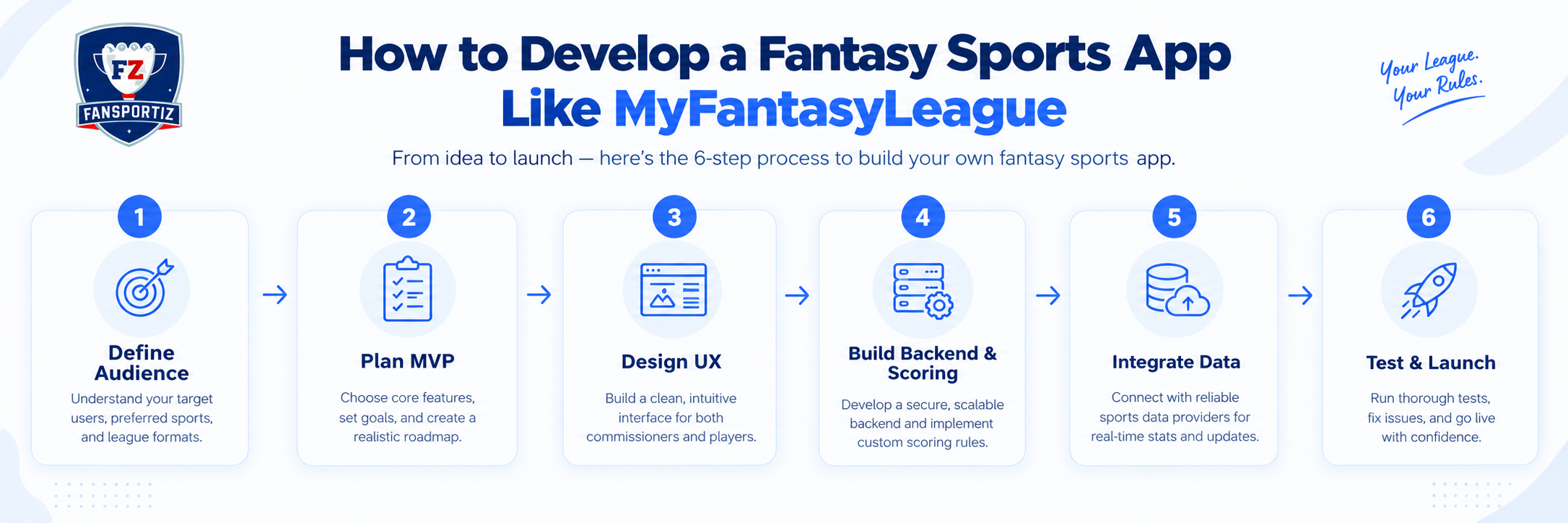
How to Develop a Fantasy Sports App Like MyFantasyLeague
Building a successful fantasy sports platform requires more than creating team profiles and displaying scores. You need a clear product plan, a reliable scoring system, suitable sports data, and a straightforward user experience.
Step 1: Define Your Audience and Business Model
Start by deciding who will use your application. Your audience could include private fantasy league commissioners, dynasty and keeper league communities, sports media businesses, or organizations seeking a branded league management platform.
Next, choose a suitable business model. Potential options include subscriptions, software licensing, league management fees, or business-to-business software services. The right approach depends on your audience, operating costs, and local regulations.
Define your target sport, market, and core user problem before investing in development. These decisions will help determine which features belong in the first release and which can be added later.
Step 2: Plan the Core Features and MVP
An MVP, or minimum viable product, is the first usable version of your application. It includes the essential features needed to test the product with real users.
For a MyFantasyLeague-like platform, the initial release could include:
- User registration, login, and role-based permissions
- League creation and invitation links
- Player databases and team rosters
- Draft management and configurable scoring
- Lineup changes, trades, and waiver management
- League standings and a commissioner dashboard
Avoid adding every possible feature at launch. Prioritize the workflows that commissioners and team owners use most often, then improve the product based on feedback.
A focused MVP helps you validate demand, identify usability problems, and manage the initial development budget.
Step 3: Design a Simple User Experience
Make the main journey easy to understand: sign up, join a league, draft a team, manage the roster, and follow results.
Use clear navigation, readable tables, accessible colors, and a mobile-friendly layout. Commissioners should be able to update scoring settings or manage league permissions without needing technical assistance.
A simple experience encourages users to return throughout the season and reduces confusion during important moments such as drafts and lineup deadlines.
Step 4: Build the Backend and Scoring Engine
The backend manages the application’s data, business rules, and communication between users and the system. For a fantasy sports platform, it must handle league settings, player rosters, drafts, transactions, scoring, and standings accurately.
Start with secure user authentication and role-based permissions. Team owners should manage their own rosters, while commissioners should have access to authorized league administration tools.
The scoring engine is especially important. Instead of hard-coding scoring rules, make them configurable for each league. One league might award six points for a touchdown, while another may use different values or bonuses for specific player achievements.
The system should also manage draft order, roster eligibility, lineup deadlines, trade approvals, and waiver rules. Keep an audit log of important changes so commissioners can investigate disputes and understand how a result was calculated.
A well-designed backend makes it easier to introduce new competition formats without rebuilding the core application.
Step 5: Integrate Sports Data and Live Updates
A fantasy platform needs reliable sports data to calculate scores and update matchups. Depending on the sport, this data may include player profiles, schedules, statistics, and scoring events.
Choose a suitable sports data provider based on coverage, licensing terms, update frequency, reliability, and cost. Confirm that the provider supports your intended sport and market before selecting a subscription.
The application should validate incoming data, record timestamps, and handle delayed or corrected statistics. If a provider does not offer instant updates, communicate that limitation rather than promising real-time scores.
For a custom fantasy football platform, the scoring service should connect player statistics to the rules of each league and update relevant matchups when new data arrives.
Step 6: Test, Launch, and Improve
Before launch, test the complete user journey, from account creation and league invitations to drafts, lineup changes, scoring, and playoffs.
Pay particular attention to situations where multiple users act at once. For example, two team owners might attempt transactions involving the same player, or a commissioner might change a scoring rule while a match is in progress.
Security testing, performance testing, and checks for scoring accuracy should be part of the release process. Run a pilot with real league commissioners to uncover confusing workflows and missing features.
After launch, track useful metrics such as:
- Number of leagues created and activated
- Draft completion rate
- Scoring accuracy and correction frequency
- Sports data API failure rate
- Application response times
- Active leagues and returning users
Use these findings to prioritize improvements. A successful launch is the beginning of ongoing product development, not the end.
Must-Have Features for a MyFantasyLeague-Like App
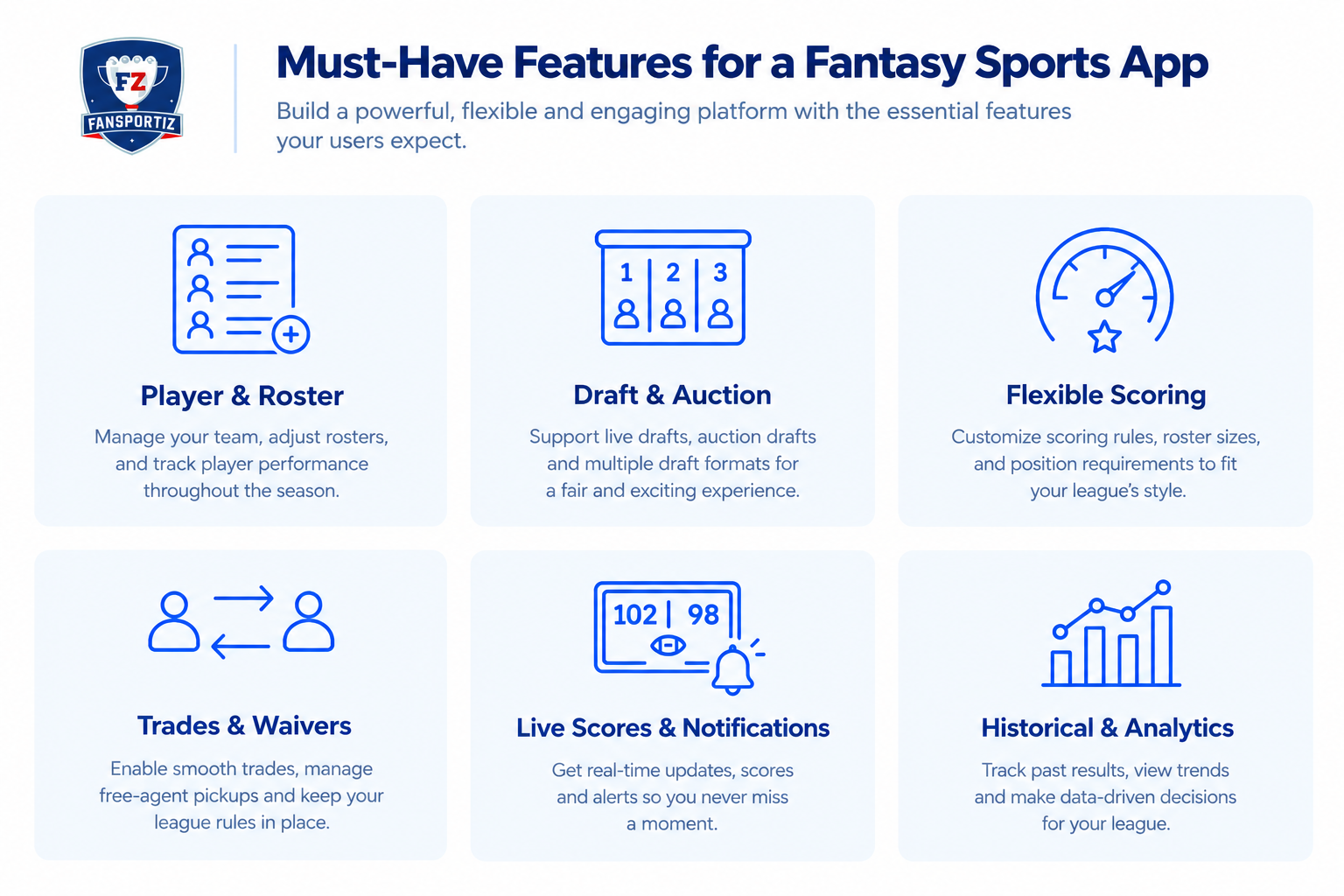
The best fantasy sports applications help users run competitions without confusion. Your feature set should support both everyday team management and the administrative work required to maintain a fair league.
1. Player and Roster Management
Provide searchable player profiles with relevant statistics, positions, and team information. Commissioners should be able to define roster limits, eligible positions, bench sizes, and injured reserve rules where applicable.
Team owners need a clear view of their starters, substitutes, and available players. The application must also enforce lineup deadlines and prevent invalid roster changes.
2. Draft and Auction Tools
Drafting is a central part of many fantasy leagues. Support formats such as snake drafts and auction drafts, depending on your target audience.
Useful tools include pick timers, draft history, automatic selections, and a live view of available players. Auction drafts may also require budgets, bid tracking, and rules for resolving competing bids.
The interface should remain responsive when many league members participate simultaneously.
3. Flexible Scoring and League Rules
Customizable scoring is one of the most important capabilities in a league management platform.
Allow commissioners to configure scoring values, roster formats, and competition structures. Depending on the sport, you may support head-to-head matchups, total-points leagues, dynasty leagues, keeper formats, and superflex rosters.
Changes to league settings should be validated carefully, especially when they affect existing scores or historical records.
4. Trades, Waivers, and Commissioner Controls
Team owners should be able to propose trades, review offers, and track transaction status. Waiver tools can support priority-based claims or free-agent acquisition budgets (FAAB), depending on the league’s rules.
Commissioners need controls for approvals, roster locks, deadlines, permissions, and dispute resolution. Every administrative action should follow clear authorization rules and be recorded where appropriate.
5. Live Scores, Standings, and Notifications
Display player scores, team totals, weekly matchups, league standings, and playoff brackets in an easy-to-read format.
Notifications can alert users about draft invitations, pending trades, lineup deadlines, and important score updates. Users should be able to control notification preferences so they receive relevant information without unnecessary interruptions.
For broader sport coverage, consider how the same design principles apply to fantasy cricket app development, where player statistics, match schedules, and scoring rules differ from football.
6. Historical Records and Analytics
Season archives allow users to review past champions, previous standings, player performance, and franchise records. Reports can also help commissioners understand participation and league activity.
Make sure historical data remains consistent when current league settings change. Each feature should account for permissions, unusual situations, and the effect of updates on existing records.
Technology Stack and Architecture
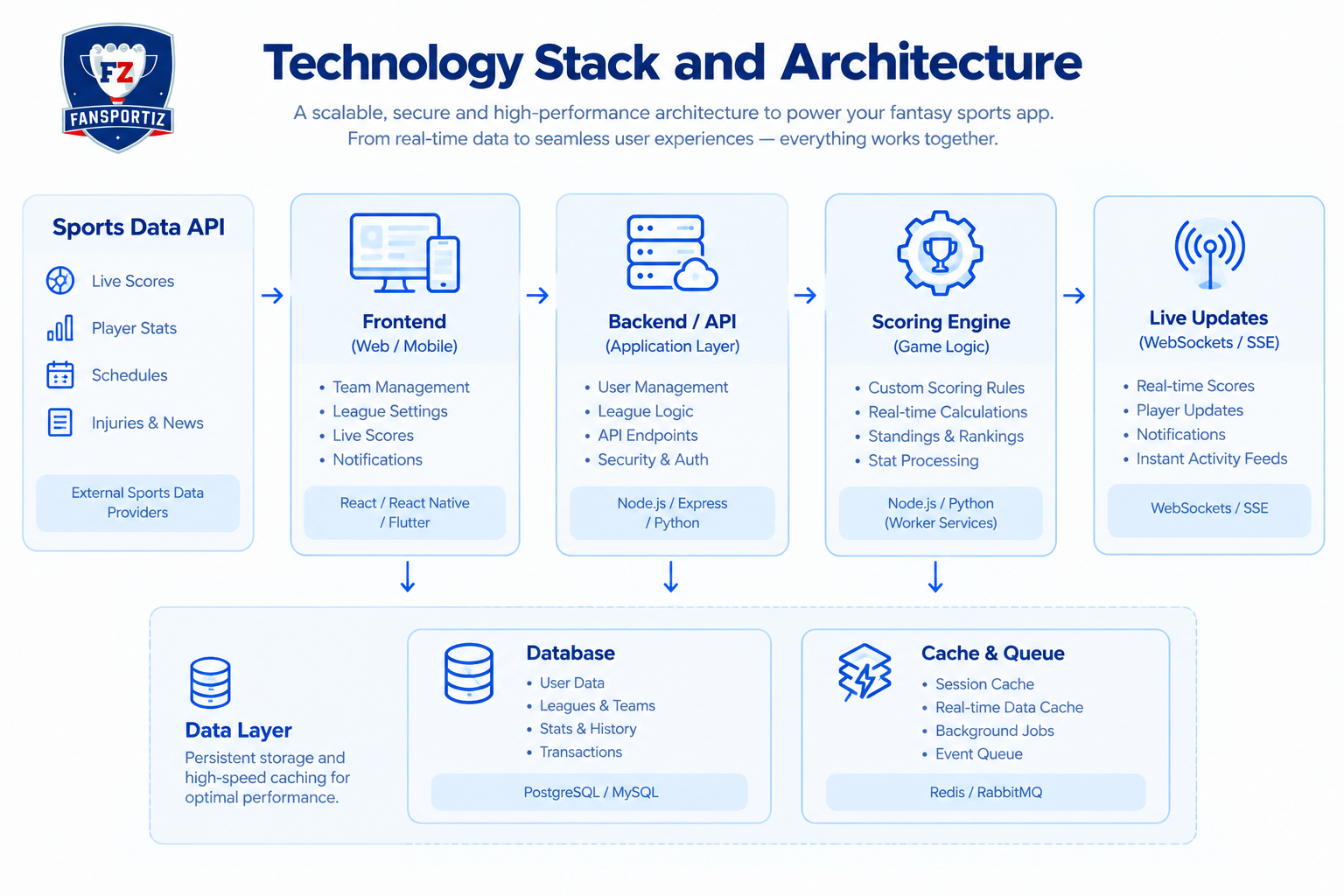
Your technology stack should reflect the project’s scope, expected traffic, available development skills, and required integrations. There is no single best stack for every fantasy sports application.
| Layer | Possible technologies | Purpose |
|---|---|---|
| Web frontend | React or Next.js | League dashboards and management tools |
| Mobile apps | Flutter or React Native | Cross-platform mobile experiences |
| Backend | Node.js/TypeScript, Java, or Python | Business rules and application APIs |
| Database | PostgreSQL | Users, leagues, rosters, and transactions |
| Cache and queues | Redis and a message queue | Fast reads and background processing |
| Live updates | WebSockets or server-sent events (SSE) | Refresh scores and matchups |
| Hosting | AWS, Google Cloud, or Azure | Hosting, monitoring, and scaling |
| Monitoring | Centralized logs and error tracking | Identify failures and performance issues |
How the Components Work Together
Consider a team owner changing a starting lineup. The backend checks whether the user has permission to make the change, verifies player eligibility, and confirms that the lineup deadline has not passed. It then saves the update and triggers any required scoring or standings recalculation.
The frontend can receive the updated results through WebSockets or server-sent events. However, these technologies only deliver updates; they do not provide the underlying sports statistics. A reliable data feed and scoring pipeline are still required.
Plan for database backups, access controls, API rate limits, error monitoring, and capacity increases as user activity grows. These foundations help the platform remain reliable during busy draft sessions and major match days.
For database implementation details, consult the official PostgreSQL documentation.
Fantasy Sports App Development Cost and Timeline
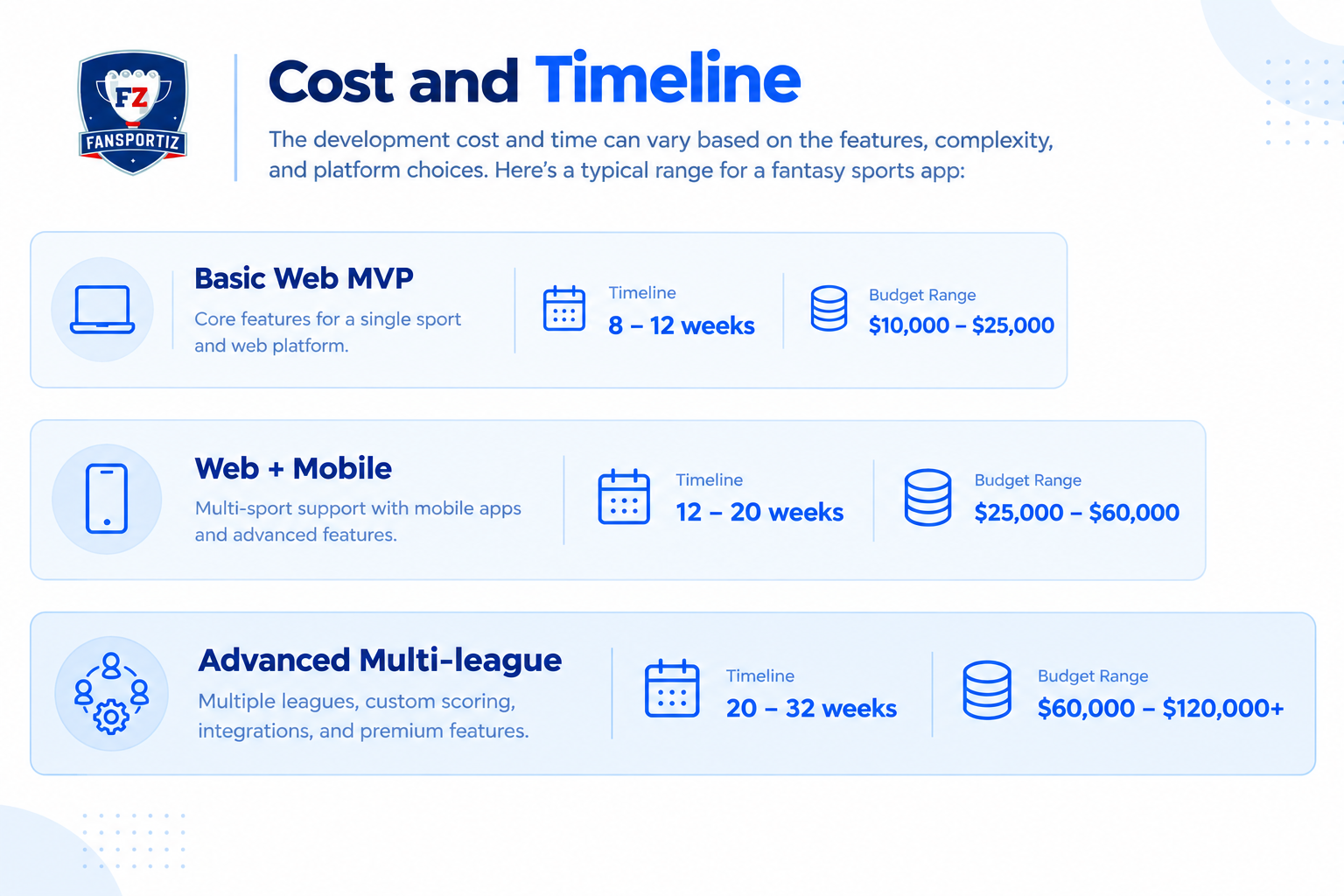
The cost to develop a fantasy sports app like MyFantasyLeague depends on the features you need, the number of sports supported, the complexity of league rules, and the platforms you plan to launch.
A basic web application with essential league management tools requires less development effort than a multi-sport platform with web and mobile apps, advanced analytics, and extensive data integrations.
The following figures are illustrative planning estimates, not verified industry averages or an official FanSportiz quote. Actual costs will depend on project requirements, team location, technology choices, and third-party service fees.
| Project scope | Estimated timeline | Illustrative budget |
|---|---|---|
| Basic web MVP | 8–12 weeks | US$15,000–$35,000 |
| Web and mobile apps | 3–6 months | US$35,000–$90,000 |
| Advanced multi-league platform | 6–9+ months | US$90,000–$200,000+ |
These estimates are starting points for planning. They do not guarantee a delivery date or include every possible ongoing operating expense.
What Affects the Total Cost?
Several factors influence the overall budget.
- Number of sports and formats: Each sport may require different player data, scoring rules, and competition workflows.
- Custom scoring and drafts: Advanced scoring engines, auction systems, and complex roster rules require additional design and testing.
- Web and mobile development: Supporting multiple platforms increases implementation and maintenance work.
- Sports data API fees: Pricing depends on the provider, coverage, usage limits, and licensing agreements.
- Security and compliance: Authentication, access controls, testing, privacy requirements, and legal reviews all contribute to the budget.
- Maintenance and upgrades: Hosting, monitoring, bug fixes, data provider changes, and new features create ongoing costs.
A practical approach is to launch with a focused MVP and expand after validating the product with real league managers.
If you are planning a project, you can request a fantasy sports app quote from FanSportiz. Share your target sports, preferred platforms, essential features, and expected launch date to help define the scope.
APIs, Live Scores, and Data Management
Reliable sports data is essential for accurate fantasy scoring. Even a well-designed interface will lose users’ trust if player statistics are delayed, duplicated, or incorrect.
What Data Does the App Need?
Depending on the sport and competition format, your platform may need:
- Player profiles, positions, and team affiliations
- Match schedules, fixtures, and results
- Player statistics and scoring events
- Historical performance data
- Injury information, where available and properly licensed
Choose a data provider that covers your target sports and permits your intended use. Before signing an agreement, review its supported competitions, update frequency, API limits, service reliability, and licensing conditions.
How to Manage Data Updates
A dependable data pipeline follows a clear process:
- Receive: Retrieve events and statistics from the sports data provider.
- Validate: Check the format, timestamps, identifiers, and expected values.
- Store: Save the data and preserve the information needed for reconciliation.
- Update scores: Apply the relevant league’s scoring rules.
- Notify: Refresh affected matchups, standings, and user notifications.
For example, imagine a provider sends the same touchdown event twice. If the system processes both messages as new events, a fantasy team could receive double the intended points.
To prevent this, use unique event identifiers, duplicate-event checks, and idempotent processing. This means processing the same event again should not award points twice. The platform should also support corrected statistics and reconcile final scores when providers update their records.
Cache frequently requested standings when useful, but ensure corrected or final results do not remain stale. Match refresh intervals to the provider’s capabilities, contractual terms, and your operating budget rather than promising updates the data source cannot deliver.
Explore the FanSportiz website for information about its publicly described sports technology and live-scoring capabilities.
Security, Testing, and Legal Considerations
Fantasy sports platforms manage user accounts, league histories, roster changes, and sometimes payment-related information. Security must therefore be part of the initial architecture, not something added immediately before launch.
Essential Security Measures
Implement secure authentication and role-based access control so users can perform only authorized actions. Protect data in transit and at rest, validate incoming inputs, apply API rate limits, and maintain audit logs for important administrative changes.
Create regular backups and test the recovery process. Monitoring and alerting can help identify unusual activity, service failures, and potential security issues.
The OWASP API Security Top 10 is a useful reference for reviewing common API risks, including broken authorization and unrestricted resource consumption.
Test Before Launch
Testing should cover more than whether individual screens work. Verify scoring calculations, draft conflicts, duplicate data events, simultaneous lineup changes, and peak match-day traffic.
Test how the application handles unavailable APIs, delayed statistics, interrupted connections, and corrected results. A pilot with real commissioners can expose problems that automated tests may miss.
Check Legal and Data Rights
Legal requirements vary by jurisdiction and business model. Before launch, review sports data licensing, privacy obligations, intellectual property rights, payment rules, and any age-related requirements that apply to your users.
Real-money contests may trigger additional restrictions or licensing obligations. Do not assume that a product permitted in one market is automatically lawful in another.
FanSportiz’s stated compliance position is that it does not develop or promote real-money games (RMG). Accordingly, this article focuses on fantasy league management and other compliant product models rather than presenting real-money gaming as a FanSportiz development offering. Confirm applicable laws with qualified local legal counsel before launching.
For content strategy, Google’s helpful content guidance also provides a useful reminder: create original, people-first information that answers readers’ questions clearly and accurately.
How FanSportiz Can Help Build Your Platform
Building a fantasy sports platform requires the right combination of product planning, software engineering, sports data integration, and ongoing technical support. Choosing a development partner that understands these requirements can help you turn your idea into a practical product.
FanSportiz provides fantasy sports app development services for businesses exploring custom sports platforms. Its publicly described capabilities include sports data feeds, live scoring, administrative tools, AI-powered analytics, and support for multiple sports. Confirm the current service scope, technical capabilities, and pricing directly with the company before finalizing your project requirements.
Depending on your business goals, your proposed platform may include:
- Custom league creation and management tools
- Web and mobile application experiences
- Configurable scoring systems and player roster management
- Sports data integrations and live-score updates
- Administrative dashboards and notification features
- Ongoing maintenance, performance improvements, and upgrades
The development process should begin with a clear understanding of your target audience, essential features, preferred sports, and launch timeline. This makes it easier to prioritize the MVP and estimate the resources required.
Whether you want a dedicated football league management platform or a solution supporting multiple sports, discuss your requirements with a fantasy sports app development company.
Ready to discuss your idea? Talk to the FanSportiz team to explore a development plan suited to your goals.
Frequently Asked Questions
1. How much does it cost to develop a fantasy sports app like MyFantasyLeague?
The cost depends on the features, supported sports, platforms, data integrations, and complexity of the scoring engine. As an illustrative planning estimate, a basic web MVP may cost US$15,000–$35,000, while an advanced multi-league platform may cost US$90,000–$200,000 or more. Obtain a project-specific estimate before setting your budget.
2. How long does it take to build a MyFantasyLeague-like app?
A basic web MVP may take approximately 8–12 weeks. A solution with web and mobile applications may require 3–6 months, while an advanced multi-league platform can take 6–9 months or longer. These are planning estimates, not guaranteed delivery schedules.
3. What are the most important features?
Start with league creation, invitations, player databases, roster management, drafts, configurable scoring, standings, and commissioner controls. Add trades, waivers, notifications, historical records, and advanced analytics according to your users’ needs and available budget.
4. Can I build a fantasy sports platform for multiple sports?
Yes. A multi-sport platform can support different sports through configurable scoring rules, sport-specific player data, and separate competition formats. However, each sport may require different integrations and workflows. For example, fantasy basketball app development involves different player statistics and scoring requirements from fantasy football.
5. Do I need a sports data API?
A sports data API is generally important when your application needs automated player statistics, match schedules, and score updates. Choose a provider based on coverage, licensing, update frequency, reliability, and cost. You must also handle delayed feeds, duplicate events, and corrected statistics to maintain accurate fantasy scores.
Conclusion: Build Around the Needs of League Managers
To develop a fantasy sports app like MyFantasyLeague, start with a clear audience, a manageable MVP, flexible scoring, reliable sports data, and strong security. Build around real league management needs, test with users, and expand features as your platform grows.
Build your custom fantasy sports platform with FanSportiz and discuss a development plan aligned with your business goals.
