
Published on - Sep 01st, 2026
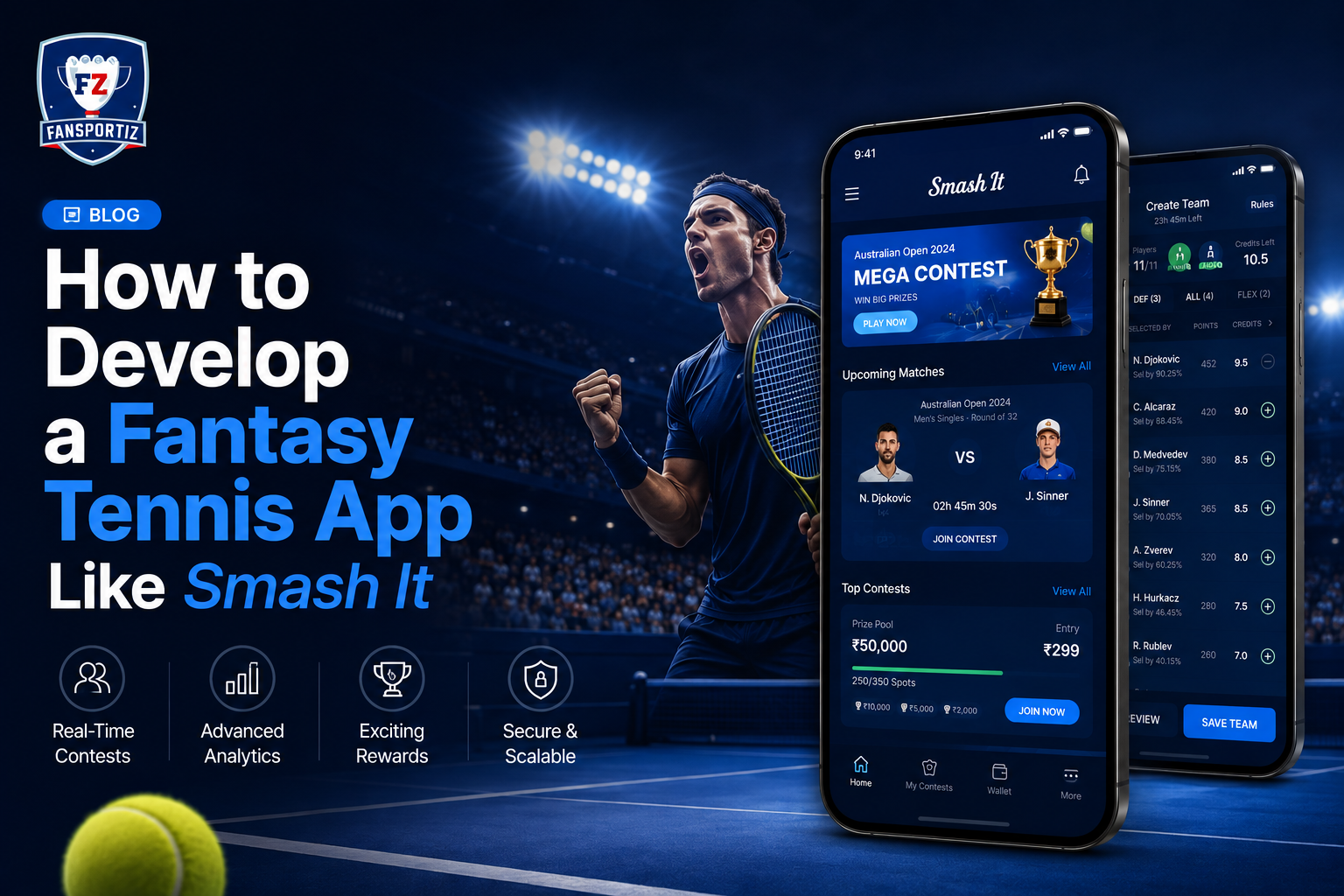
When tennis stops being just something you watch, and starts being something you play alongside.
Every year, tennis has a few moments when the entire sports conversation changes. The Australian Open arrives, then Roland-Garros, Wimbledon, and finally the US Open. Casual viewers suddenly become experts on rankings, form, draws, tie-breaks, and who might make a deep run. Fans don’t just want to know who won anymore. They want to predict what happens next, follow individual players, and feel involved while the match is unfolding.
That is exactly the space fantasy tennis apps are beginning to occupy.
At its simplest, a fantasy tennis app lets users build a virtual team using real ATP or WTA players. Those players then earn fantasy points according to their real-world performances. The more accurately a user predicts form and performance, the better their fantasy ranking can become.
Apps such as Smash It demonstrate why the model is interesting. Instead of treating fantasy as another scoreboard layered over tennis, the product gives players a strategic reason to follow tournaments more closely. Its market-value credit system and tournament tiers create an additional layer of decision-making around ATP 500, ATP 1000, and Grand Slam events.
For a founder, that raises a bigger question: how do you turn this idea into a scalable product?
This guide breaks down the opportunity, product mechanics, features, technology, live-data requirements, compliance considerations, monetization, and launch strategy involved in fantasy sports app development, with Fansportiz’s development process at the center of the journey.
Why fantasy tennis is an opportunity worth watching
The fantasy sports market is no longer a small experiment built around sports fans looking for something extra to do during a match. It has evolved into a substantial digital entertainment category, supported by smartphones, live sports data, payments, social competition, and increasingly sophisticated personalization.
Industry research puts the global fantasy sports market at a significant and growing scale, with continued expansion expected as more fans interact with sports digitally.
There is another interesting part of the story: regional growth and mobile adoption are expanding the addressable audience. The fantasy sports market share by region shows why businesses looking beyond traditional fantasy-sports markets should pay attention to emerging regions and mobile-first users.
Yet much of the fantasy-sports conversation still revolves around football, cricket, and basketball.
Tennis is different.
There are no 11-player lineups to manage. There is no need to calculate how several teammates affect one another. A tennis fantasy product can focus almost entirely on individual athlete performance. That makes the underlying product easier for fans to understand while still giving experienced users considerable strategic depth.
Tournament-based engagement is another advantage.
A Grand Slam can create a natural fantasy cycle: users prepare their teams, monitor player performance, react to results, and compete throughout the tournament. Between majors, ATP and WTA events can keep the product active rather than forcing users to wait for the next major sporting season.
Then there is personalization.
Fantasy users increasingly expect platforms to help them make smarter decisions rather than simply display statistics. AI-driven tools can potentially surface player trends, identify interesting matchups, summarize form, or provide recommendations based on historical and current performance. The broader industry discussion around AI-powered player recommendations reflects this shift toward more intelligent fantasy experiences.
For a founder, the opportunity is therefore not simply to create another fantasy app. It is to build a tennis product that makes watching tennis more interactive.
And that is where studying existing products becomes useful.
What Smash It gets right, and what Tweener shows you
The easiest way to understand a fantasy tennis product is to stop thinking about it as a list of features and instead look at the decisions a player makes.
Smash It provides a useful example. Its product uses a credit-based team-building approach in which users work within a defined budget while selecting real tennis players. Player values can change from tournament to tournament, meaning the best decision isn’t necessarily to select the biggest name every time. Users have to think about value, form, tournament conditions, and expected performance.
You can explore Smash It on Google Play to see how the product is positioned for users.
The concept is reinforced through Smash It’s tournament structure. Different levels of competition, including ATP 500, ATP 1000, and Grand Slam events, can create different fantasy contexts and give users reasons to return throughout the tennis calendar.
Its own product presence also provides a useful reference point for understanding Smash It’s official website and its market-value approach.
The underlying lesson is important: fantasy mechanics can make tennis itself feel like a strategy game.
A user isn’t merely asking, “Who will win?”
They are asking, “Who gives me the best value?”
That distinction creates engagement.
For a deeper third-party explanation, this overview of how Smash It’s market-value system works is another useful reference.
Tweener demonstrates another possible direction. Rather than relying on exactly the same structure, it brings elements such as real-money entry, public and private leagues, and trading mechanics into the fantasy-tennis experience. Founders considering fantasy tennis app development like Tweener can therefore see how league-based competition can sit alongside player selection and performance.
You can also look at Tweener: Fantasy Tennis as a second product reference.
The point isn’t to copy either product. It is to understand the product patterns behind them.
Whether you’re modeling your app after Smash It’s market-value system or Tweener’s league-and-trade format, the underlying development process is the same: define the game mechanics, connect them to reliable live sports data, build the right user experience, establish the technical architecture, and make sure the product can operate legally in its target markets. That is where a specialist development partner can save a founder considerable time.
The non-negotiable features of a fantasy tennis app
Once the product concept is clear, the next question is straightforward: what actually needs to be inside the app? For a modern fantasy tennis platform, these are the core building blocks.
Player draft and team building
Users need an intuitive way to select players. This could be a credit-based system like Smash It, an auction model, or another configurable mechanism. The interface should make player value, availability, form, and selection limits easy to understand.
Live tennis scoring
Fantasy points need to respond to real ATP and WTA matches. Ideally, users should be able to see scoring updates as matches progress, with point-by-point information where the underlying data provider supports it.
Public and private leagues
Fantasy becomes more compelling when users have someone to beat. Public leagues can create large-scale competition, while private leagues let friends, communities, influencers, or sports organizations create their own competitions.
Player value and market mechanics
Dynamic player values can introduce another layer of strategy. A player’s fantasy value can change based on tournament performance, predefined rules, or other product logic.
Leaderboards
Give users several ways to compete:
- Global rankings
- Weekly rankings
- Tournament rankings
- Seasonal rankings
- Private league rankings
Push notifications
A fantasy user shouldn’t have to keep opening the app to discover that their player has started a match. Notifications can cover match starts, selection deadlines, major score changes, player results, and leaderboard movements.
News and statistics
A built-in news and stats feed can turn the app into a daily tennis destination rather than something users open only to check fantasy points.
Payments
If the product uses paid contests or another real-money format, secure payment-gateway integration becomes essential, alongside the necessary compliance controls.
Administration
Behind every polished fantasy app is an administrative system. Your team needs to be able to configure tournaments, player data, scoring rules, contests, promotions, users, payments, and other operational settings without requiring developers to make every small change.
Fansportiz can build these capabilities as configurable modules, allowing the product architecture to adapt to the business model rather than forcing every fantasy tennis app into one fixed template.
The objective isn’t to launch with every possible feature. It is to launch with the right combination of mechanics that makes the first tournament experience genuinely enjoyable.
How the product is actually built
Once the feature list is on paper, founders usually ask the less glamorous but more important question: how does all of this work underneath the interface?
For an MVP, cross-platform development using technologies such as React Native or Flutter can be a practical choice. Instead of maintaining completely separate applications for iOS and Android from day one, a cross-platform approach can help teams move faster while maintaining a consistent experience.
The decision between native and cross-platform development depends on the product’s requirements. This guide on choosing between native, cross-platform, and hybrid approaches provides additional context.
The backend is where fantasy tennis becomes more demanding. Live scoring requires an architecture capable of receiving data continuously and distributing updates to users without noticeable delays. Technologies such as WebSockets or Socket.IO can support real-time communication.
The database architecture should also reflect the difference between permanent business information and rapidly changing game information. A relational database can handle areas such as:
- User accounts
- Transactions
- Contest records
- Player information
- Team selections
Meanwhile, an in-memory database or caching layer can help manage frequently changing data such as live leaderboards and match states.
A practical recommended tech stack for fantasy sports apps can include the frontend, backend, database, cloud infrastructure, and real-time technologies required for this environment.
Then comes the cloud. Tournament traffic isn’t predictable in the same way as ordinary app traffic. A quiet afternoon can suddenly become a high-load environment when a major match begins. AWS or Google Cloud infrastructure can provide the scalability needed to handle those peaks.
Latency matters, too. When a player wins a crucial point and the fantasy score changes, users expect the app to reflect that quickly. Technical guidance around sub-100ms latency during live-game events illustrates why real-time architecture deserves attention from the beginning.
Cost naturally follows architecture. The final budget depends on features, platforms, integrations, design complexity, compliance requirements, data licensing, and development approach. A useful reference for a fantasy sports app development cost breakdown can help founders understand the major cost categories before finalizing a scope.
This is one reason Fansportiz’s white-label plus custom-development approach can be practical. Instead of assembling a frontend developer, backend team, UI designer, data specialist, cloud engineer, and other vendors separately, a founder can work with one fantasy-sports development partner and customize the foundation around the intended product.
Live tennis data and the compliance questions founders can’t ignore
If there is one technical area that can make or break a fantasy tennis application, it is data.
Tennis isn’t simply about knowing whether a player won or lost. Fantasy scoring may depend on sets, games, points, tie-breaks, retirements, walkovers, match suspensions, rain delays, tournament stages, rankings, and player profiles. A data error can therefore become a fantasy-score error, and once users stop trusting the scoring, the product loses its foundation.
A dedicated sports-data provider is consequently not an optional add-on.
For example, developers can review Sportradar’s Tennis API for information about tennis data coverage and integration capabilities.
Sportradar also highlights real-time coverage across 4,000+ tennis competitions, illustrating the scale of data that specialist providers can make available.
Sportradar isn’t the only option, either. Founders can start comparing tennis data API providers before deciding which provider best matches their geography, tournament coverage, latency requirements, licensing terms, and budget.
Fansportiz can support this part of the development journey by helping evaluate data requirements and integrate the selected provider into the product architecture.
Then comes the issue that can be even more expensive to get wrong: compliance.
A fantasy product involving real-money contests cannot simply launch first and investigate the rules later.
Founders need to understand whether their particular product is treated as a game of skill, a game of chance, gambling, or another regulated category in each target jurisdiction. In the United States, for example, the federal framework and the applicable state-level rules need to be considered carefully; resources discussing UIGEA carve-out conditions for daily fantasy sports provide useful background.
A broader legal requirements for launching a fantasy sports app checklist is also useful when mapping the product before development.
Depending on the business model and jurisdiction, founders may need age verification, KYC/AML controls, responsible-gaming measures, payment safeguards, geographic restrictions, and appropriate terms and disclosures. Guidance on DFS compliance and age verification requirements provides further context.
And because regulations can vary by jurisdiction and change over time, founders should examine state-by-state fantasy sports legislation rather than assuming that one compliance strategy works everywhere.
Real player names, images, likenesses, statistics, and other intellectual-property considerations also deserve careful review.
In short: compliance isn’t the final checkbox before launch. It belongs in the product plan from day one.
Monetization, Fansportiz, and the moment to launch
Once the product works, the next question is how it earns revenue. The most suitable model depends on the market, regulatory environment, audience, and product positioning.
Common fantasy tennis monetization models
Paid contests and entry fees. Where legally permitted, users can pay to enter specific competitions.
Freemium. Keep the core experience free while offering premium features, additional insights, reduced advertising, or cosmetic upgrades.
Subscriptions. Create monthly or annual tiers for advanced statistics, analytics, personalized recommendations, or premium leagues.
Sponsorships. Grand Slams and major tournaments create natural opportunities for partnerships with brands seeking highly engaged sports audiences.
Advertising. A free-to-play audience can be monetized through carefully integrated advertising without making the product dependent on entry fees.
But monetization is only one side of the founder’s decision. The bigger question is: who should build the platform?
You could build everything internally. You could hire several freelancers. Or you could work with a specialist that already understands fantasy sports architecture.
This is where Fansportiz is positioned to fit.
Fansportiz is a fantasy sports app development company offering both ready-to-customize white-label solutions and fully custom fantasy-sports development. Instead of limiting a founder to a generic fantasy template, the development approach can be adapted around the sport, contest mechanics, audience, geography, and monetization strategy.
The experience also extends beyond one sport. Fansportiz works across fantasy categories including cricket, football, basketball, kabaddi, baseball, hockey, and esports, making tennis a natural extension of its broader fantasy-sports expertise.
For a fantasy tennis founder, the technical strengths are particularly relevant. The platform can incorporate AI-driven analytics and predictive-performance models, real-time player statistics, AWS-backed infrastructure designed for high-traffic periods, secure payment integrations, and compatibility across web, mobile, and tablet experiences.
Fansportiz also operates under Yudiz Solutions, bringing more than 14 years of experience into the wider technology and development ecosystem.
Most importantly, the development process can bring together the different pieces discussed throughout this guide: product features, technology architecture, live sports-data integration, scalability, payments, and compliance groundwork.
That matters because founders rarely struggle with having one idea. They struggle with coordinating ten moving parts at once.
The real opportunity is timing
Tennis already gives a fantasy product something many new digital products have to manufacture: recurring moments of attention.
Four Grand Slams create four major engagement peaks every year. Between them, the broader ATP and WTA calendars provide opportunities to keep users active.
The checklist is straightforward:
Market opportunity. Is there a clear audience for the product?
Features. Does the game mechanic make watching tennis more engaging?
Technology. Can the architecture handle live scoring and tournament traffic?
Data. Is the information accurate, fast, and properly licensed?
Compliance. Can the product legally operate in every intended market?
Get those pieces right and fantasy tennis becomes more than an interesting app idea. It becomes a product built around an existing global sports habit.
The opportunity cost is simple: tennis fans will be watching the next major whether your app is ready or not.
The question is whether your fantasy experience will be ready when they are.
Frequently asked questions
How is fantasy tennis different from fantasy football or cricket?
There’s no lineup of 11 or 15 players to balance, and no teammate interactions to model. Fantasy tennis scores individual athlete performance directly, so the product design can stay simple for casual fans while still giving experienced users real strategic depth through value-based team building.
Do we need a live sports-data provider from day one?
Yes. Fantasy scoring depends on sets, games, points, tie-breaks, retirements, walkovers, and suspensions, so a data error becomes a scoring error. A dedicated provider such as Sportradar should be part of the architecture from the first build, not added after launch.
Is a real-money fantasy tennis app legal to launch everywhere?
It depends on the jurisdiction. Whether the product counts as a game of skill, a game of chance, or a regulated gambling category varies by market, and rules can change over time, so compliance, age verification, and KYC/AML controls need to be mapped before development starts, not just before launch.
Should we build native apps or go cross-platform first?
For an MVP, cross-platform frameworks such as React Native or Flutter are usually the practical choice, since they let a team maintain one codebase for iOS and Android instead of two separate builds. The right call still depends on the product’s specific performance and platform requirements.
How does a market-value credit system decide what a player is worth?
Player values sit inside a defined team-building budget and can shift from tournament to tournament based on form and performance, similar to the model Smash It uses. That means the biggest name isn’t always the best pick, which is what turns team selection into an ongoing strategic decision rather than a one-time choice.
What does Fansportiz’s white-label option include?
Fansportiz offers both a ready-to-customize white-label foundation and fully custom development, covering product features, AI-driven analytics, real-time player statistics, AWS-backed infrastructure, payment integrations, and web, mobile, and tablet compatibility, adapted around the sport, audience, and monetization model.
If you’re considering fantasy sports app development and want to turn a Smash It-inspired concept, or an entirely original fantasy tennis idea, into a scalable product, Fansportiz can help take it from product strategy and architecture through development, data integration, and launch planning.
Talk to the Fansportiz team about your fantasy tennis app idea
Fansportiz — a Yudiz Solutions company
