
Published on - Nov 05th, 2026
Introduction
Fantasy sports has evolved into a data-driven digital entertainment industry where users build virtual teams, follow live matches, analyze player performance, and compete based on real-world sporting events. For businesses entering this market, delivering a reliable and engaging experience requires more than an attractive mobile app. It requires a robust technology infrastructure capable of processing accurate sports data in near real time.
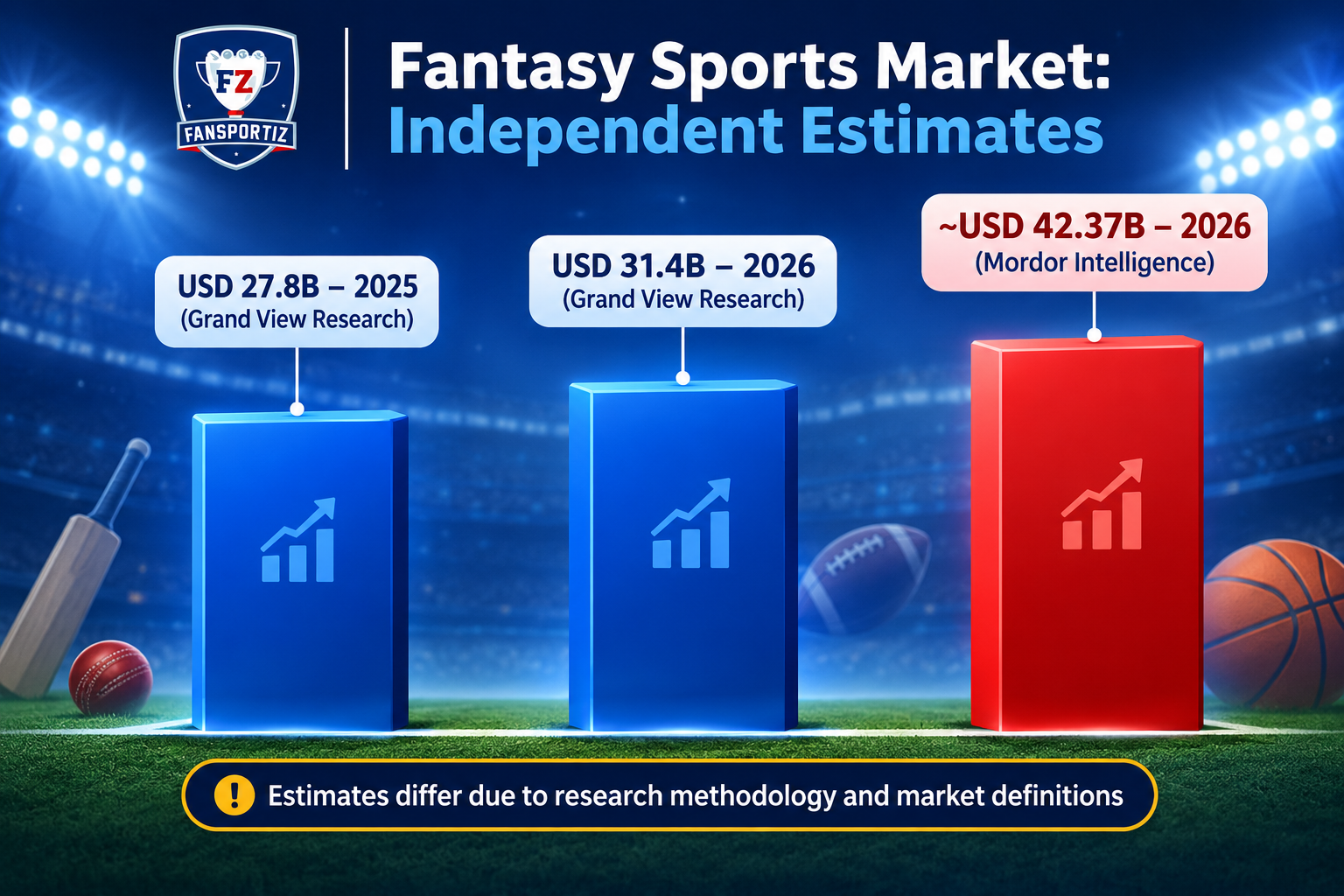
Market research indicates that the industry continues to expand. Grand View Research valued the global fantasy sports market at USD 27.8 billion in 2025 and estimated it would reach USD 31.4 billion in 2026. Mordor Intelligence offers a higher 2026 estimate of approximately USD 42.37 billion, reflecting differences in research methodologies and market definitions. These figures should be understood as independent estimates rather than directly interchangeable measurements.
As competition increases, sports data becomes a critical differentiator. Delayed score updates, incorrect player statistics, or inconsistent fantasy-point calculations can undermine user trust. Conversely, accurate data, responsive live leaderboards, and dependable match updates help create a more engaging experience.
This is where fantasy sports API integration becomes essential. Application programming interfaces (APIs) connect a fantasy platform with external services that supply sports statistics, player information, payment processing, identity verification, notifications, and analytics.
This guide explains how fantasy sports APIs work, which integrations businesses should prioritize, how to evaluate sports data providers, and what it takes to build a secure, scalable platform. It also examines integration costs, common technical challenges, regulatory considerations, and the advantages of working with a specialist fantasy sports app development company.
2. What Is a Fantasy Sports API?
A fantasy sports API is an interface that allows an application to retrieve or exchange data with an external service. Rather than collecting every match statistic manually, developers can integrate licensed data feeds that deliver structured information about sporting events, teams, players, and performance.
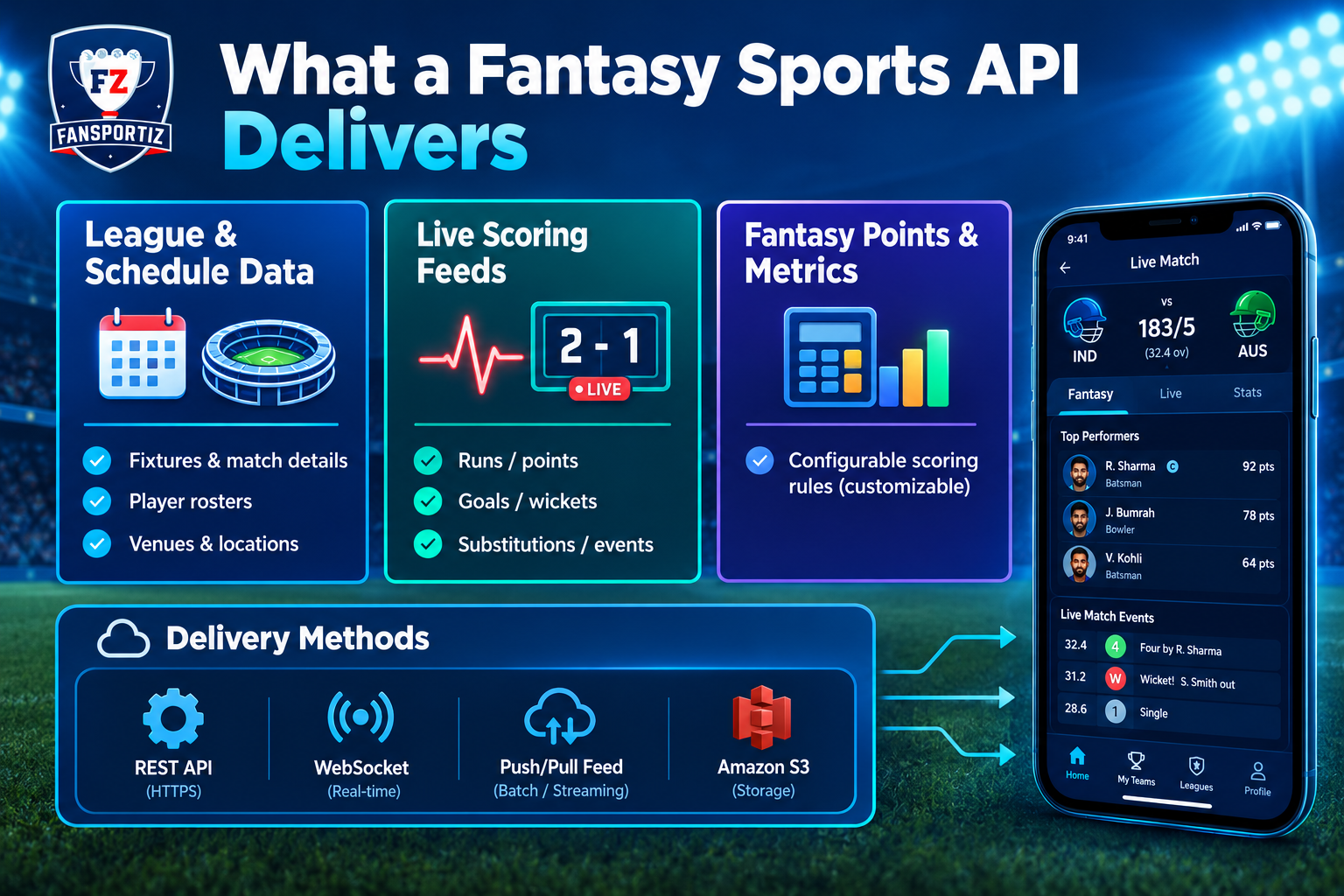
For a fantasy platform, three categories of data are particularly important.
League and schedule data
This information establishes the foundation of the platform. It includes competitions, fixtures, match dates, venues, team rosters, player profiles, and participation status. Accurate schedules help operators create contests, manage team selection deadlines, and display relevant matches.
Live sports data and scoring feeds
Live feeds provide updates as matches unfold. Depending on the sport and the provider, these can include goals, wickets, runs, assists, player substitutions, ball-by-ball events, and other performance statistics.
The quality and delivery speed of this information directly affect live scoreboards and user-facing match updates.
Fantasy points and performance metrics
Sports statistics must be translated into fantasy points according to the platform’s scoring rules. Some providers offer pre-calculated fantasy scores or advanced performance metrics, while others primarily supply raw sporting data.
A platform may calculate its own points using configurable rules, such as awarding points for runs, wickets, goals, assists, rebounds, or defensive actions. Separating the scoring engine from the data provider makes it easier to modify rules without rebuilding the entire integration.
How are fantasy sports APIs delivered?
REST APIs typically allow applications to request specific data, such as player profiles or upcoming fixtures. WebSocket connections can deliver continuous updates over an established connection, making them useful for live leaderboards and match-centre experiences. Providers may also support push feeds, scheduled data transfers, or pull-based delivery.
For example, Stats Perform’s API and data delivery documentation describes RESTful APIs, WebSockets, push and pull feeds, and Amazon S3 delivery, with data available in formats including JSON and XML.
The right delivery method depends on the sport, the provider’s service-level commitments, the expected traffic, and the level of real-time responsiveness required.
Ultimately, a well-designed fantasy sports API integration transforms external sports information into reliable, actionable data that powers the entire user experience.
3. Why API Integration Matters for Your Fantasy Sports Business
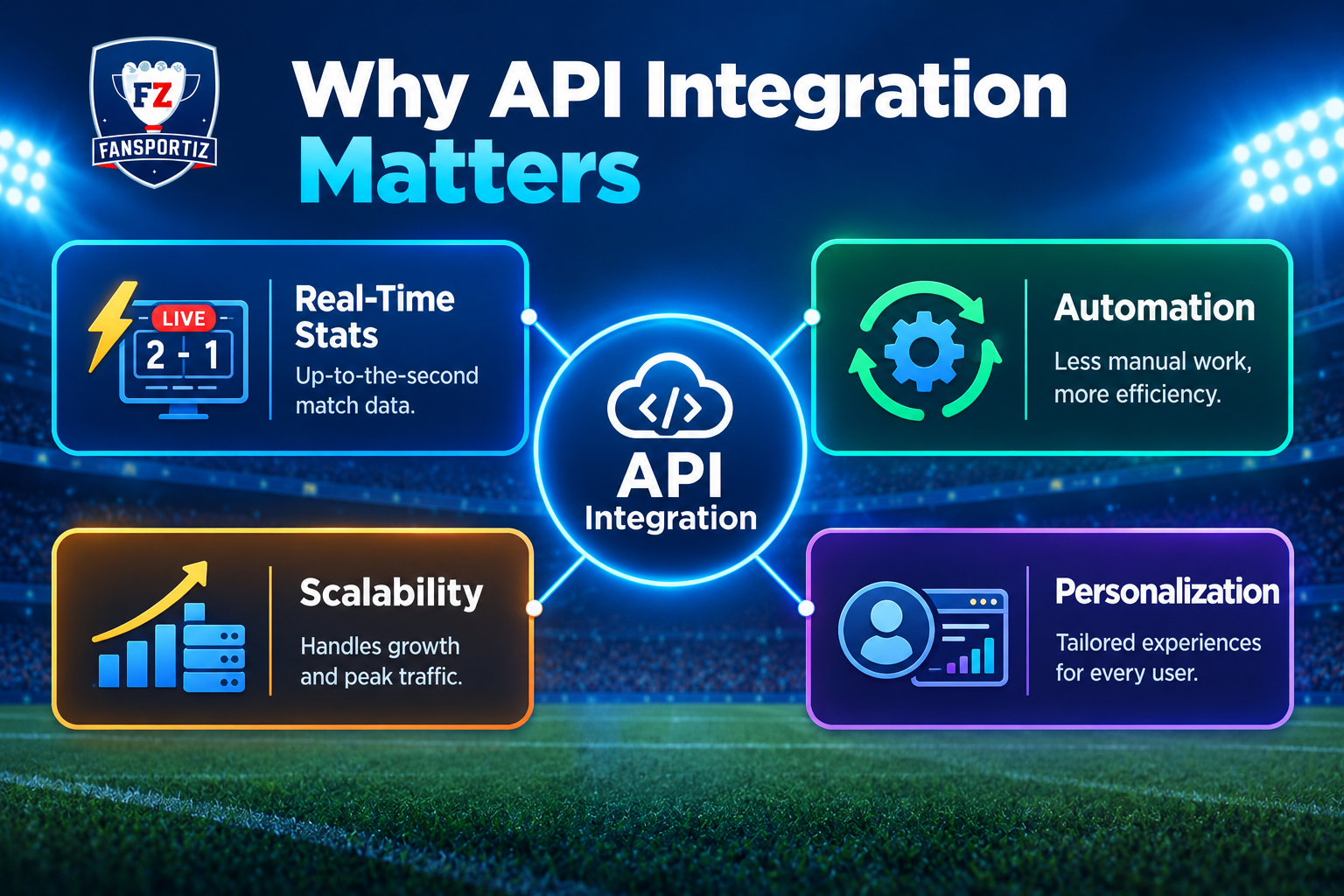
A fantasy sports platform depends on timely, accurate, and consistent information. API integration helps businesses deliver that information efficiently while reducing manual work and supporting a more engaging user experience.
The opportunity is significant, but market statistics must be interpreted carefully. Industry surveys use different definitions of fantasy sports participation, while app analytics measure activity within particular products. Businesses should therefore evaluate both market demand and their own audience’s behavior when planning a platform.
Real-time statistics improve user engagement
Live sports statistics are central to the fantasy experience. Users want to know how their selected players are performing, how points are accumulating, and whether their teams are moving up or down the leaderboard.
A reliable real-time fantasy sports data feed can support:
- Live scoreboards that update as match events are processed.
- Player performance dashboards with current statistics.
- Leaderboards that reflect changes in fantasy points.
- Match notifications that keep users informed about important events.
- Historical statistics that help users evaluate players and make informed selections.
These capabilities make the platform more responsive and give users reasons to return throughout a sporting event.
Automation reduces operational complexity
Without API integrations, teams may need to manage fixtures, player records, statistics, and match updates through manual processes. This approach becomes increasingly difficult as the number of sports, leagues, and simultaneous events grows.
Automated feeds reduce repetitive data-entry work and help standardize information across the application. They also allow operators to focus on product development, customer experience, and business strategy rather than manually updating match information.
Scalability supports business growth
Major tournaments can generate sharp increases in concurrent users and data requests. An appropriately designed integration architecture can process incoming sporting events, calculate scores, and distribute updates without requiring every user request to contact the original provider.
Caching, event queues, and scalable delivery services help absorb traffic spikes and improve response times.
Data creates opportunities for personalization
Historical performance data and analytics can support player comparisons, personalized dashboards, performance trends, and recommendations. When implemented responsibly, these features help users understand the information available to them and navigate the platform more effectively.
For operators, the business case is straightforward: reliable sports data supports engagement, automation, product differentiation, and scalable operations. However, actual retention and revenue improvements depend on execution, audience demand, and the overall product experience.
For industry context and survey information, businesses can consult the Fantasy Sports & Gaming Association. Any participation figures or app-growth statistics used in the published article should be accompanied by their original report, survey period, and methodology.
4. Core API Integrations Every Fantasy Sports Platform Needs
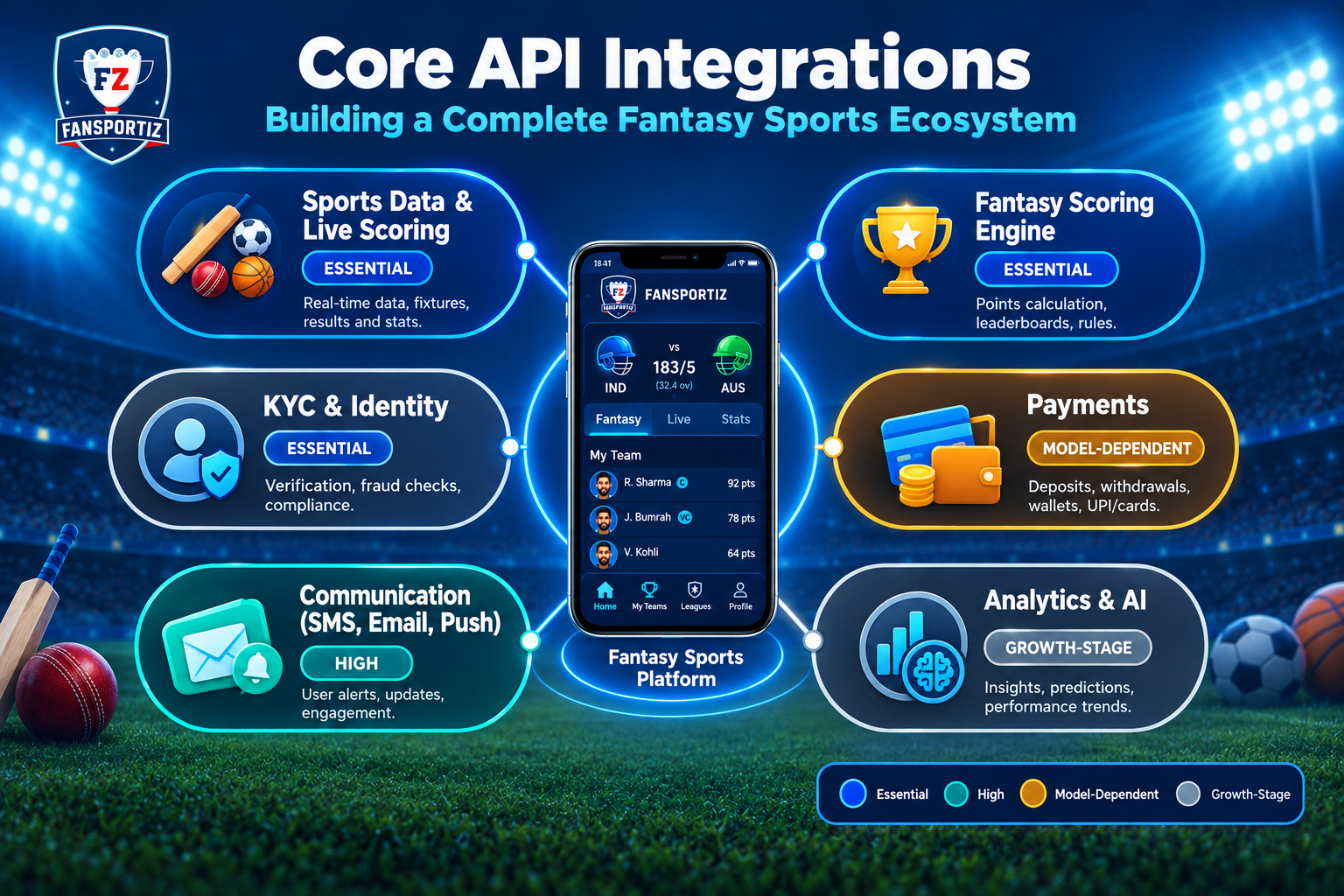
A successful fantasy platform requires more than a sports data feed. It needs an ecosystem of connected services that work together to support onboarding, live gameplay, transactions where legally permitted, communication, and performance analysis.
The following six integration categories form a practical foundation for most fantasy sports app development projects.
4.1 Sports Data and Live Scoring APIs
Sports data APIs provide the information that powers match centres, player profiles, fixtures, scoreboards, and leaderboards. Depending on the provider and sport, available data may include live match events, player statistics, team lineups, standings, and historical performance.
For example, a fantasy cricket platform may process runs, wickets, overs, and player dismissals, while a football platform may track goals, assists, saves, and cards.
When selecting a feed, evaluate its coverage, update frequency, historical depth, licensing rights, and correction procedures. The cheapest feed is not necessarily the best choice if it lacks the statistics your scoring system requires.
Explore fantasy cricket app development and fantasy football app development for sport-specific platform requirements.
4.2 Fantasy Points and Player Projection APIs
Raw sporting statistics must be converted into fantasy points using predefined rules. Businesses can build this functionality into their own scoring engine or use a provider that offers pre-calculated fantasy scores and related analytics.
A custom scoring engine provides greater control over point allocations, bonuses, penalties, captain multipliers, and contest-specific rules. Projection services can supplement this functionality with estimated player performance, expected goals (xG), and other predictive metrics when supported by the data provider.
Keep projections separate from confirmed match statistics. Predictions are estimates, not guaranteed outcomes, and should be clearly identified in the user interface.
4.3 Payment Gateway APIs
For platforms operating a legally permitted paid-entry or subscription model, payment gateway integrations can support checkout, transaction verification, refunds, and payment-status notifications.
The appropriate provider depends on the target market, currency, business model, and applicable regulations. Options identified in the Fansportiz brief include Cashfree, Paytm, PayPal, Stripe, and Bambora; confirm current availability and contractual support with the development team and each payment provider before publication or implementation.
A secure integration should verify transactions on the server, validate provider callbacks, prevent duplicate processing, and reconcile transaction records. Sensitive payment details should be handled through appropriately certified payment infrastructure rather than stored unnecessarily by the fantasy application.
4.4 KYC and Identity Verification APIs
Know Your Customer (KYC) and identity verification services help businesses establish user identity and, where required, verify age and eligibility.
Depending on the jurisdiction and platform model, these integrations may involve identity-document checks, verification codes, address validation, or other screening procedures.
Design the onboarding process to collect only the information required for the applicable legal and operational requirements. Verification results should be securely stored, access-controlled, and retained according to the relevant data protection obligations.
4.5 Communication APIs
Communication services keep users informed about fixtures, match starts, lineup deadlines, player updates, and important account events.
Common integration options include SMS gateways, email delivery platforms, and mobile push notification services. Notification preferences should be configurable, and messages should be relevant rather than excessive.
For example, a fantasy cricket application could notify a user when a selected match begins or when a lineup deadline is approaching. Delivery tracking and failure handling help operators identify messages that were not successfully sent.
4.6 Analytics and AI APIs
Analytics integrations help operators understand user behavior, application performance, and engagement patterns. AI-powered services can support player comparisons, statistical summaries, personalized content, and performance forecasting.
Businesses should establish clear boundaries between descriptive statistics and predictive recommendations. Models should be evaluated for accuracy, data quality, and bias, and AI-generated information should be presented transparently.
These capabilities can be relevant across fantasy kabaddi app development, fantasy basketball app development, and esports app development.
How to prioritize integrations
Not every platform needs every integration on day one. Start with the services necessary to deliver the core experience, then expand according to business requirements.
| Integration | Primary purpose | Priority |
|---|---|---|
| Sports data and live scoring | Match information and statistics | Essential |
| Fantasy scoring engine | Calculate and validate fantasy points | Essential |
| Authentication and identity | Secure onboarding and eligibility | Essential |
| Payments | Process permitted transactions | Model-dependent |
| Communication | Alerts and user updates | High |
| Analytics and AI | Insights and personalization | Growth-stage or use-case dependent |
A modular integration strategy helps businesses add services without tightly coupling every feature to a single vendor.
5. Choosing a Sports Data Provider: Comparison of Leading APIs
Selecting the right sports data provider is one of the most consequential decisions in fantasy sports app development. The provider determines which competitions you can cover, how frequently statistics update, which historical records are available, and what licensing obligations your business must meet.
There is no universal best provider. The right choice depends on your target sports, geography, scoring requirements, budget, and expected traffic.
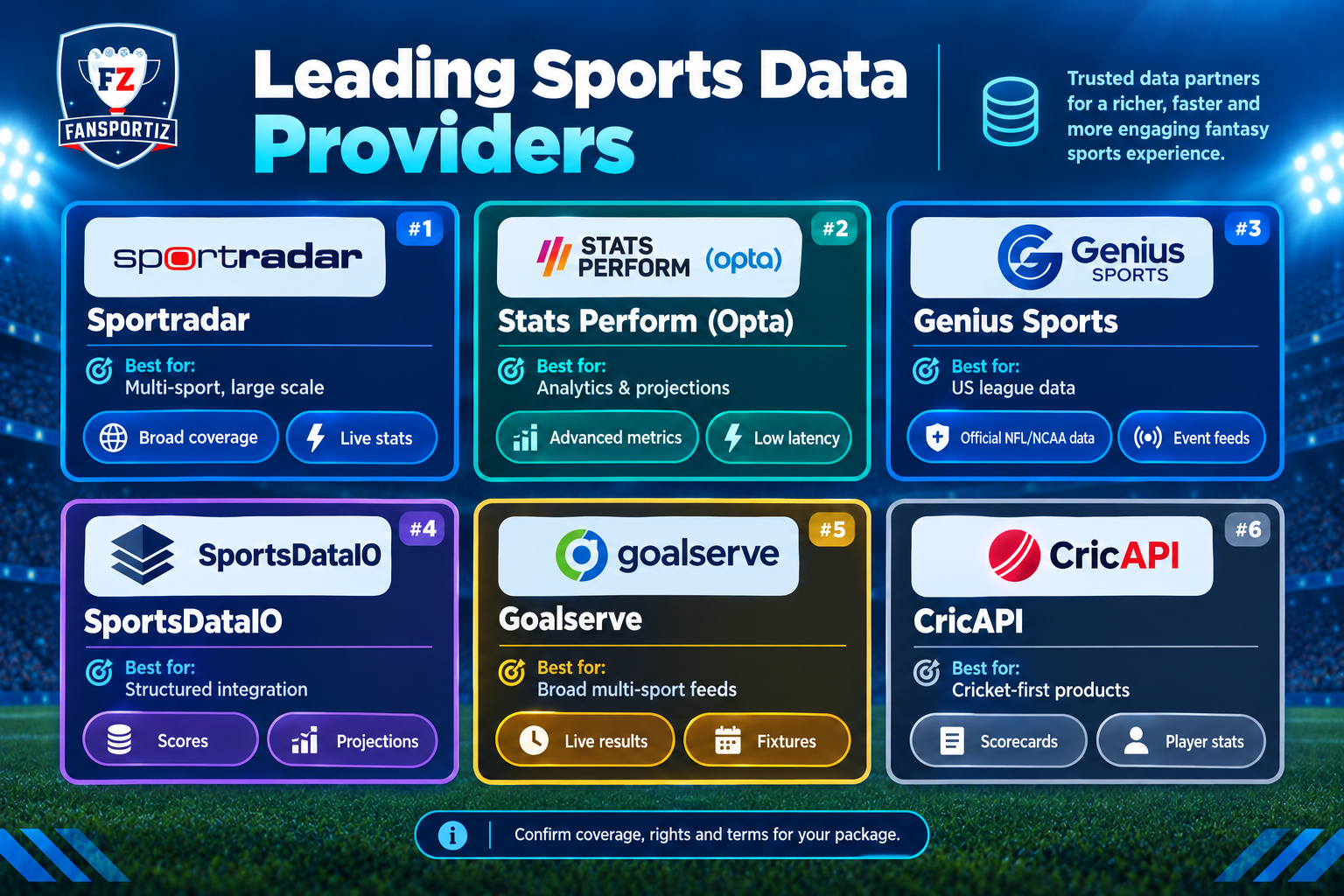
Leading fantasy sports data API providers
| Provider | Main strengths | Best suited for |
|---|---|---|
| Sportradar | Broad international coverage, live statistics, historical data, and multiple API delivery options | Multi-sport platforms and large-scale operators |
| Stats Perform (Opta) | Detailed historical datasets, live match data, advanced metrics, and fantasy projections | Analytics-heavy and projection-focused platforms |
| Genius Sports | Official league data partnerships, real-time statistics, and detailed event feeds | Platforms focused on leagues such as the NFL and NCAA |
| SportsDataIO | Sports APIs covering scores, statistics, projections, and other sport-specific datasets | Teams seeking structured APIs and a streamlined integration workflow |
| Goalserve | Multi-sport feeds covering live results, fixtures, and statistics | Businesses comparing broad sports-data coverage and commercial packages |
| Cricket-focused providers, including CricAPI | Cricket fixtures, scorecards, match updates, and player statistics, depending on the package | India-focused fantasy cricket platforms and cricket-first products |
The table describes general provider positioning, not a guarantee that every product includes every feature. Confirm the current coverage, data rights, service levels, and commercial terms for the specific API package you intend to use.
5.1 Sportradar: Broad sports coverage
Sportradar offers sports data APIs covering more than 80 sports and 500 leagues, according to its published product information. Its feeds include live statistics, historical information, and sport-specific datasets in formats such as JSON and XML.
This breadth makes Sportradar worth evaluating when a business intends to support several sports or expand into additional markets. However, available data and request limits depend on the selected package and competition.
5.2 Stats Perform (Opta): Detailed statistics and analytics
Stats Perform provides live and historical sports data, advanced metrics, and fantasy-specific projections. Its documented delivery options include REST APIs, WebSockets, and push and pull feeds. The company also states that its live data feeds can deliver sub-second latency.
These capabilities can be useful for platforms that need detailed performance analysis, sophisticated scoring models, or real-time updates. Actual latency depends on the feed, competition, infrastructure, and service arrangement.
5.3 Genius Sports: Official league data
Genius Sports provides official sports data products and live statistics for supported competitions. Its published offerings include official NFL data and services for NCAA sports, alongside broader sports data and fan-engagement solutions.
Businesses targeting US sports should evaluate Genius Sports when official league data, granular event statistics, and reliable historical records are important to their product.
5.4 SportsDataIO: Structured API integration
SportsDataIO is another provider to evaluate when comparing sport-specific feeds, statistics, projections, and developer integration requirements. Businesses should assess its documentation, available endpoints, trial access, request limits, and pricing against their actual implementation needs.
5.5 Goalserve: Multi-sport data feeds
Goalserve offers sports data products that businesses can investigate for live scores, fixtures, and statistics across supported sports. Its suitability depends on the depth of coverage required, update frequency, data licensing, and commercial terms for the target competitions.
5.6 Cricket-specific providers
For a cricket-first platform, specialist providers such as CricAPI may be worth evaluating alongside larger international vendors.
Before choosing a provider, confirm that its feed covers the relevant domestic and international tournaments, player identifiers, scorecards, ball-by-ball events, and correction procedures required by your scoring engine. Do not assume that a cricket API automatically grants rights to redistribute every available statistic or use it commercially in fantasy contests.
How to evaluate providers before committing
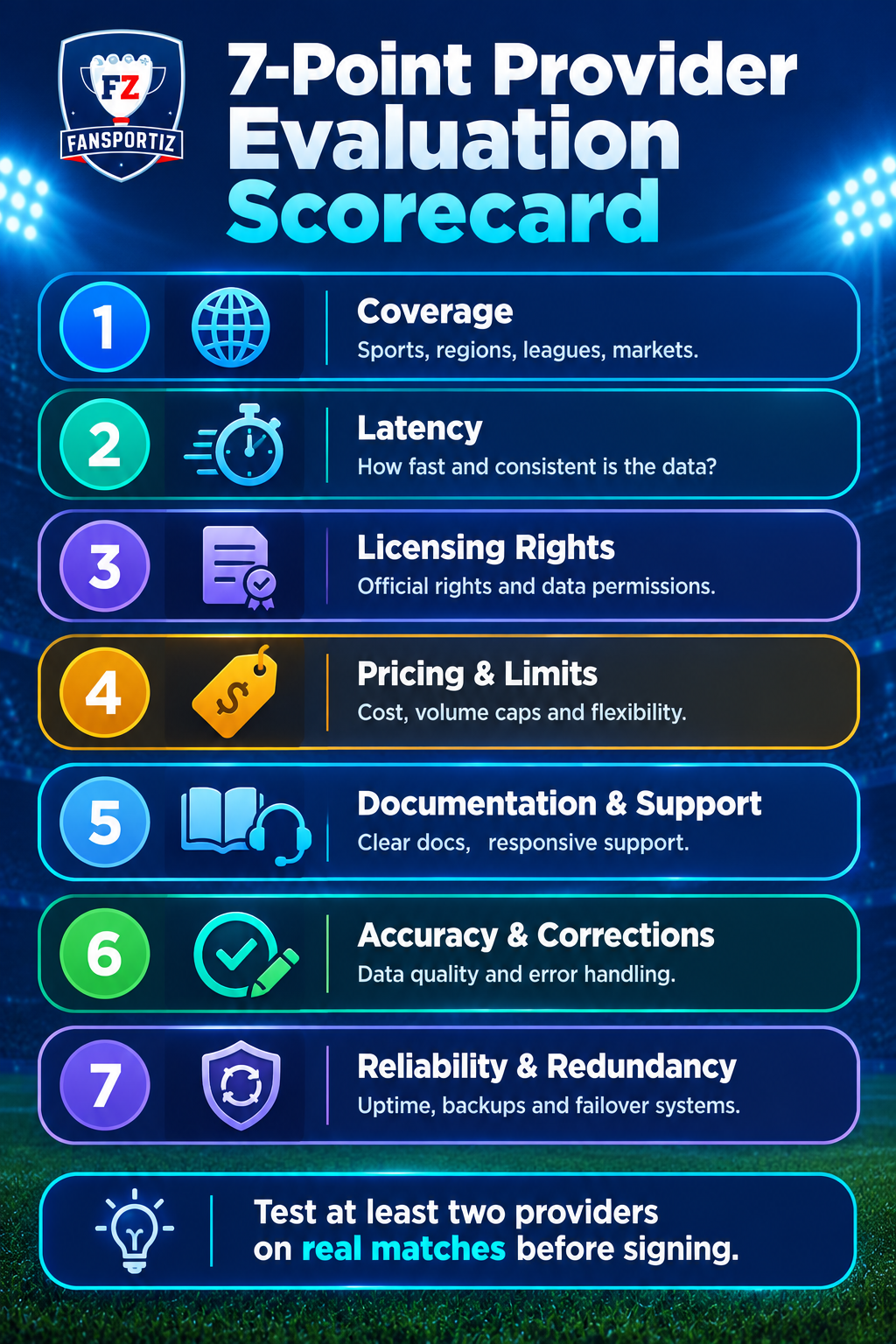
Use the following criteria to compare vendors objectively:
- Sport and league coverage: Confirm that the provider supports the exact competitions, seasons, and statistics your platform requires.
- Latency and update frequency: Establish the expected delivery speed for live events, along with documented service-level commitments.
- Licensing and redistribution rights: Verify that your intended application, audience, territory, and commercial model are permitted.
- Pricing and rate limits: Compare subscription fees, request quotas, overage charges, and the cost of supporting peak match-day traffic.
- Documentation and support: Review authentication methods, sample responses, error handling, sandbox availability, and technical support arrangements.
- Data accuracy and corrections: Ask how the provider handles disputed events, revised player statistics, postponed fixtures, and historical corrections.
- Reliability and redundancy: Evaluate uptime commitments, incident communication, and whether a secondary data source is practical.
Practical recommendation: Test at least two suitable providers against a representative set of matches before signing a long-term contract. Measure data completeness, update delays, identifier consistency, and correction handling. This provides a more meaningful basis for selection than comparing advertised features alone.
6. How a Fantasy Sports API Integration Actually Works
A fantasy sports API integration involves more than connecting an application to an external data provider. It requires a structured pipeline that receives sports data, validates incoming events, maps them to internal records, calculates fantasy points, and distributes updates to users.
A well-designed architecture helps maintain scoring accuracy, minimize delays, and support traffic spikes during major tournaments.
6.1 The end-to-end data flow
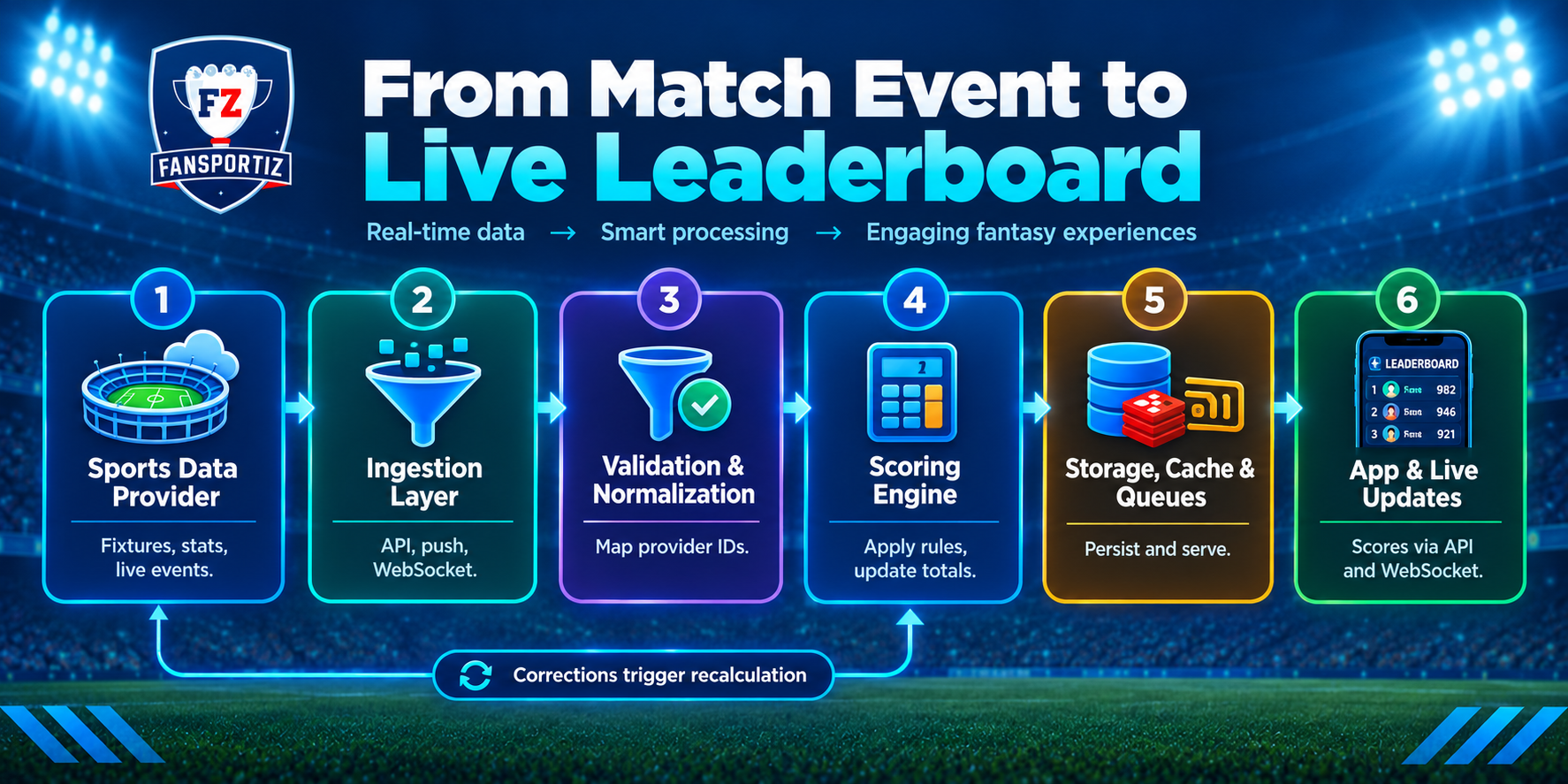
A typical fantasy sports platform processes information through the following stages.
- Sports data provider
Fixtures, player statistics, and live match events - Data ingestion layer
Receives API responses, push feeds, or WebSocket messages - Validation and normalization
Validates events and maps provider IDs to internal records - Fantasy scoring engine
Applies scoring rules and recalculates affected player totals - Storage, caching, and event queues
Persists results, coordinates processing, and serves frequent reads - Application and live updates
APIs and WebSockets deliver refreshed scores and leaderboards
6.2 Data ingestion and normalization
The ingestion layer connects to the provider through the supported delivery method. Some systems periodically request updates through REST endpoints, while others receive events through push feeds or persistent WebSocket connections.
Incoming data should then be normalized into a consistent internal format. This is particularly important when a platform supports multiple sports or data providers, because vendors may use different player identifiers, event names, timestamp formats, and statistical conventions.
For example, the internal system should map a provider’s player identifier to the correct player record before calculating points. Otherwise, an event could be assigned to the wrong player or omitted from a fantasy team’s total.
A normalization layer also makes it easier to replace a provider or introduce a backup feed without rewriting the entire scoring engine.
6.3 Fantasy-point calculation and score distribution
Once the data is validated, the scoring engine applies the platform’s configured rules to the relevant match events.
Consider a fantasy cricket platform that awards points for runs, wickets, catches, and other match contributions. When a new event arrives, the engine determines which players are affected, applies the appropriate rules, and updates their fantasy totals.
The engine should support configurable scoring rules, clearly defined rounding behavior, and the ability to recalculate scores when official statistics change. Keeping scoring logic separate from provider-specific code allows the business to introduce new contest formats without rebuilding its data pipeline.
6.4 Caching and event queues
Live sporting events can generate large numbers of requests for the same information. Redis can cache frequently requested data, such as match summaries, player statistics, and leaderboard snapshots, reducing repeated database queries.
Message queues help separate incoming data from downstream processing. Rather than forcing every incoming event to complete all processing immediately, the system can place events into a queue and process them using scalable workers.
This approach improves resilience during traffic spikes, but queues must be monitored for growing backlogs and delayed processing. Cache expiration and invalidation policies must also be designed carefully so that performance improvements do not cause users to see stale scores.
6.5 Preventing duplicate scoring and handling corrections
Sports data feeds may resend events, retry delivery, or publish corrections. Without suitable safeguards, the same event could be processed more than once, resulting in incorrect fantasy points.
Use idempotent processing: assign each event a stable identifier where available, record its processing state, and ensure that retries do not apply the same scoring change repeatedly.
Corrections require special attention. If an official statistic changes after initial publication, the system should update the affected player’s score and recalculate dependent contest totals when necessary. Leaderboards should reflect the corrected results according to the platform’s published rules.
6.6 Choosing a suitable technology stack
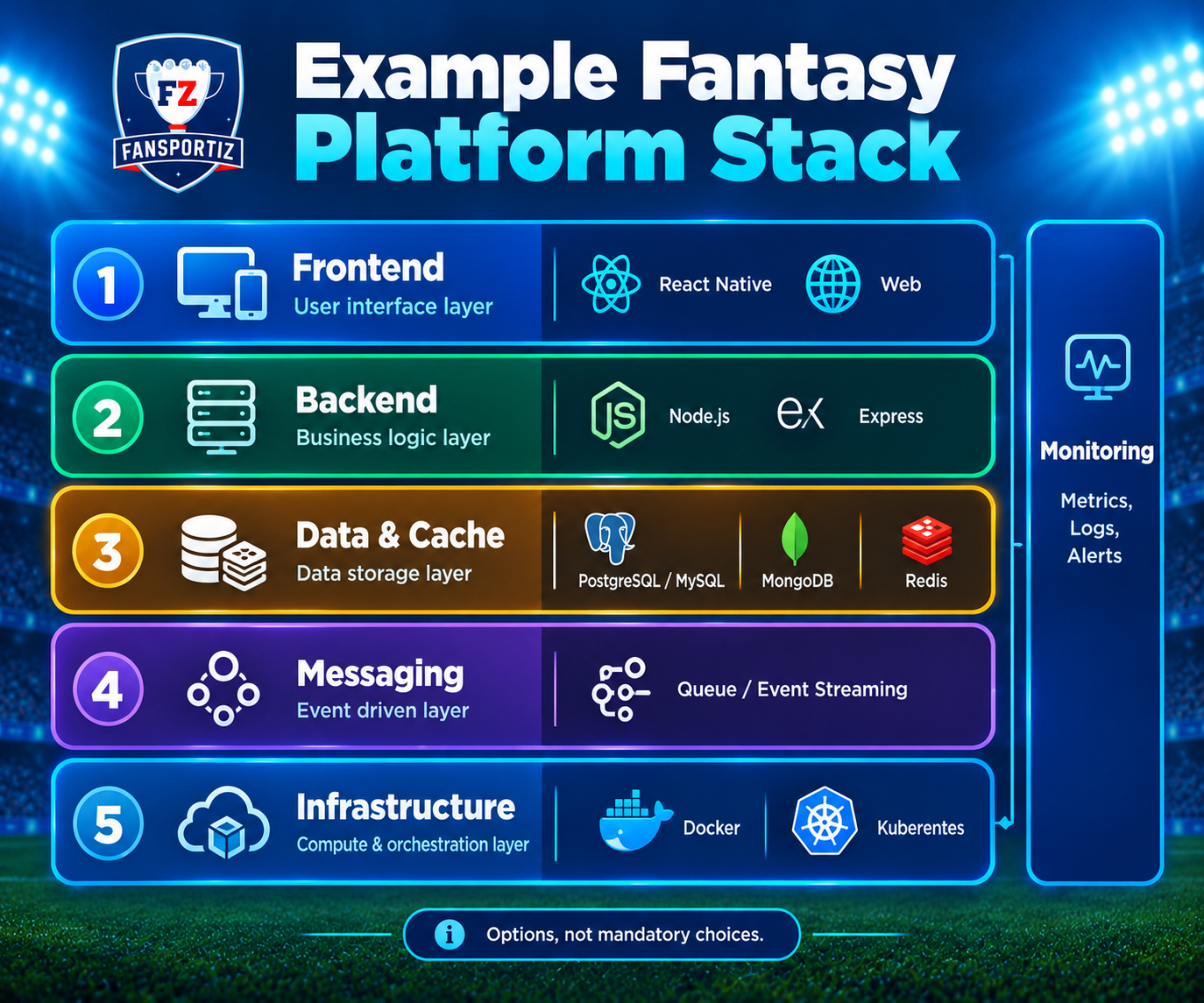
The appropriate stack depends on expected traffic, engineering expertise, integration requirements, and operational budget. A typical implementation may include:
- Frontend: React Native for cross-platform mobile applications, with a suitable web framework for browser-based access.
- Backend: Node.js and Express for application APIs and integration services.
- Database: PostgreSQL or MySQL for structured transactional records, with MongoDB where document-oriented storage is appropriate.
- Caching: Redis for frequently accessed data and selected real-time workloads.
- Messaging: A durable queue or event-streaming platform for asynchronous processing.
- Infrastructure: Docker and Kubernetes where container orchestration and automated scaling justify their operational complexity.
- Monitoring: Metrics, structured logs, tracing, and alerts to detect data delays, failed jobs, and scoring discrepancies.
These are implementation options, not mandatory technologies. The architecture should fit the platform’s actual requirements rather than adding infrastructure simply because it is popular.
For businesses seeking a scalable fantasy sports platform, the key is to select a technology stack that supports accurate scoring, predictable performance, and future expansion.
7. Key Challenges and Best Practices in Fantasy Sports API Integration
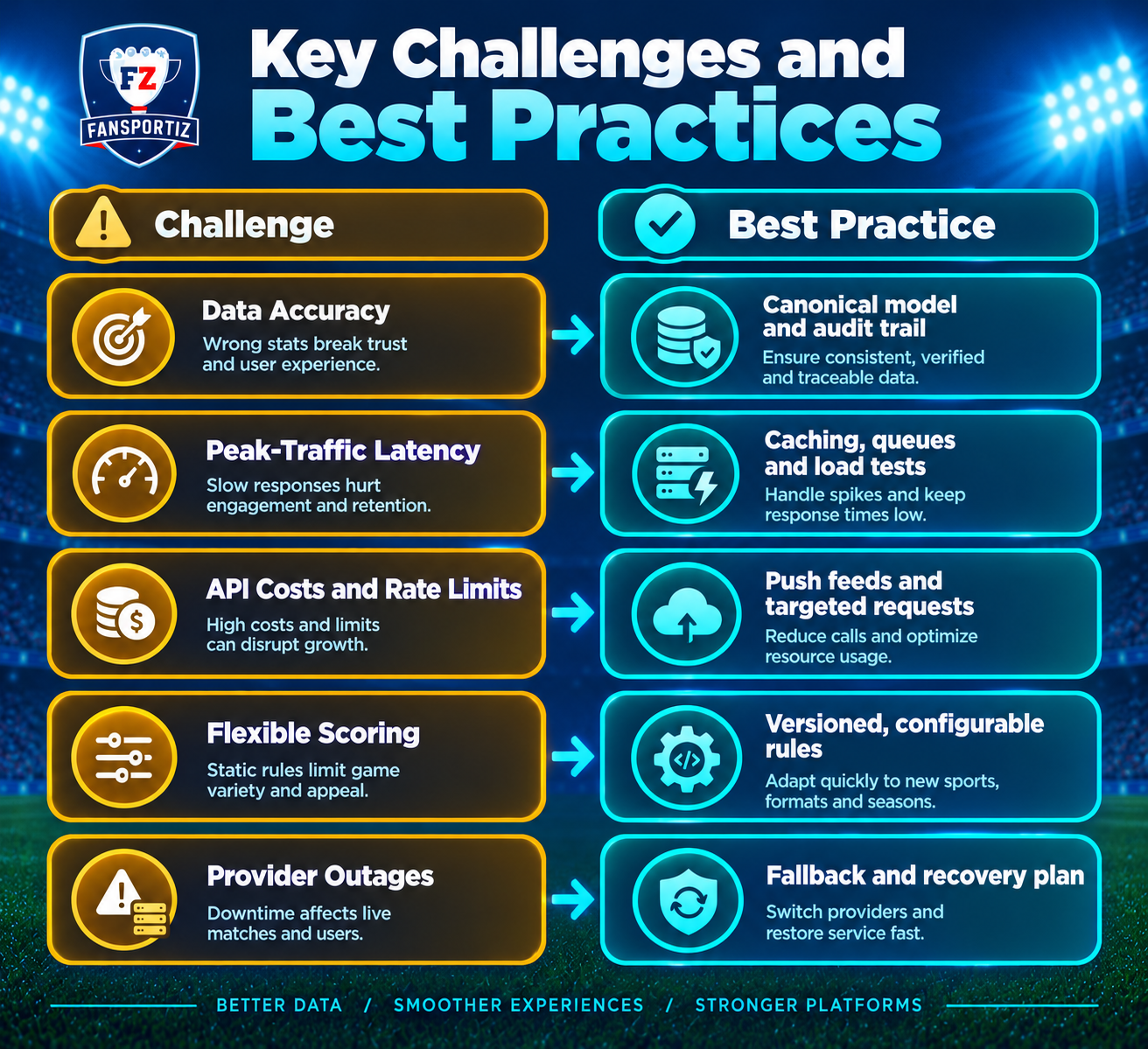
Even a well-designed API integration can encounter operational problems. Live sports environments are unpredictable, and a platform must remain dependable when data changes rapidly or user activity increases sharply.
7.1 Maintaining data accuracy
Different feeds may report events at different times or represent statistics differently. Providers may also revise scores after reviewing an event.
Best practice: Establish a canonical internal data model, validate incoming events, record data provenance, and define how conflicting information is resolved. Use authorized official sources where appropriate and retain an auditable history of corrections.
7.2 Managing latency during peak traffic
Major tournaments, finals, and popular fixtures can trigger sudden increases in simultaneous users. Slow database queries or excessive provider requests may delay leaderboard updates.
Best practice: Use caching, asynchronous processing, horizontally scalable workers, and efficient client update mechanisms. Conduct load tests using realistic event rates and concurrent-user estimates before major launches.
Measure end-to-end latency—from event receipt through score calculation to client delivery—rather than relying only on the provider’s advertised feed speed.
7.3 Controlling API costs and rate limits
Some providers impose request quotas, concurrent-connection limits, or additional fees for premium data. Excessive polling can increase costs without materially improving freshness.
Best practice: Use push-based delivery where available and appropriate, request only necessary fields, cache reusable responses, and schedule lower-priority historical updates separately from live match processing.
Monitor request volume and establish alerts before reaching contractual limits.
7.4 Supporting flexible scoring systems
Different sports and contest formats use different rules. A hard-coded scoring implementation becomes difficult to maintain as the product expands.
Best practice: Keep scoring rules configurable, version them, and test changes against known match scenarios. Maintain separate rule sets where competitions require different calculations.
7.5 Building redundancy and recovery
A provider outage can interrupt match updates or leave users with outdated statistics.
Best practice: Define fallback behavior, monitor feed health, and maintain recovery procedures. A secondary provider may improve resilience, but it should only be used after resolving differences in identifiers, event definitions, licensing, and data quality.
The system should clearly distinguish temporarily unavailable data from confirmed zero scores or completed events.
7.6 Operational checklist for reliable integrations
Before launching a fantasy sports platform, engineering teams should verify the following:
Pre-launch integration checklist
- Validate incoming sports events and player identifiers.
- Use idempotent processing to prevent duplicate scoring.
- Monitor feed latency, queue backlogs, and API errors.
- Cache frequent reads without serving stale scores indefinitely.
- Test scoring corrections and leaderboard recalculation.
- Load-test peak match-day traffic and concurrent connections.
- Document provider outage, recovery, and fallback procedures.
- Audit API permissions, credentials, and data licensing rights.
Ultimately, dependable fantasy sports API integration requires a combination of quality data, robust processing, transparent scoring rules, and continuous monitoring. Businesses that address these fundamentals early are better positioned to expand their platform without sacrificing accuracy or user experience.
8. Security and Regulatory Compliance in Fantasy Sports API Integration
Security and regulatory compliance should be built into a fantasy sports platform from the beginning. Integrating third-party APIs introduces additional data flows, credentials, service dependencies, and potential security risks. Businesses must protect their users while ensuring that the platform operates within the laws and contractual requirements applicable to its markets.
8.1 Protecting data and API credentials
Fantasy sports applications may process personal information, account credentials, identity verification records, and transaction details. Weak access controls or poorly managed API keys can expose sensitive information and disrupt platform operations.
Essential security practices include:
- Encryption: Protect data in transit using HTTPS and appropriate TLS configurations. Encrypt sensitive information at rest where required by the security architecture and applicable regulations.
- Secure credential management: Store API keys and secrets in a dedicated secrets-management system rather than embedding them in application code or mobile apps.
- Access control: Apply least-privilege permissions, restrict administrative access, and rotate credentials according to a documented policy.
- API protection: Validate incoming requests, authenticate users, enforce rate limits, and protect endpoints against unauthorized access and abuse.
- Monitoring and auditing: Log relevant security events, monitor unusual traffic, and maintain an incident-response process.
Cloud infrastructure can support these controls, but using a major cloud provider alone does not guarantee that an application is secure. Security depends on configuration, implementation, monitoring, and operational discipline.
8.2 Secure payment processing
Where a fantasy platform supports legally permitted paid services, payment integrations should be designed to minimize exposure to financial information.
Use established payment providers, verify transaction status on the server, validate webhook signatures, and implement idempotency to prevent duplicate charges or refunds. Follow the applicable payment security requirements, including relevant PCI DSS obligations where cardholder data is involved.
Payment records should also be reconciled regularly so that the application, payment provider, and accounting records remain consistent.
8.3 KYC, age verification, and responsible onboarding
Identity verification requirements vary by jurisdiction and business model. Depending on the applicable rules, an operator may need to verify a user’s identity, age, location, or eligibility before allowing access to particular features.
Integrating a specialist KYC provider can automate parts of this process. However, the operator remains responsible for establishing the appropriate verification requirements, protecting collected information, and handling failed or disputed checks.
A privacy-conscious implementation should collect only necessary information, restrict access to verification records, and define appropriate retention and deletion procedures.
8.4 Data privacy and third-party risk
An API integration may transfer information between the fantasy platform and external providers. Businesses should determine what information is shared, where it is processed, how long it is retained, and which parties can access it.
Review provider contracts, data-processing terms, breach notification procedures, and cross-border data transfer arrangements. Privacy notices should accurately explain relevant data collection and sharing practices.
Security reviews should also cover third-party dependencies, software updates, backup procedures, and vendor access to production systems.
8.5 Understanding jurisdiction-specific gaming regulations
Fantasy sports regulations differ across countries and, in some cases, between states or provinces within the same country. Legal requirements may depend on the platform’s contest structure, payment model, user eligibility, and the nature of the services offered.
Businesses should evaluate these requirements before deciding which features to launch. Depending on the target market, this may involve restrictions on paid contests, licensing obligations, age verification, consumer protection, taxation, advertising, and responsible gaming safeguards.
For India-focused projects, the original Fansportiz brief specifically directs the article to avoid promoting real-money gaming in the Indian market. The article should therefore focus on fantasy platform technology, sports data integrations, and compliant product architecture rather than encouraging real-money contests.
Important: The legal position and applicability of gaming legislation can change. Before publication, have qualified legal counsel verify the current Indian law, relevant commencement notifications, and any applicable rules. Do not treat this article as legal advice.
9. Why Build Your Fantasy Sports Platform with Fansportiz?
Choosing a development partner is an important decision for businesses entering the fantasy sports market. Beyond the user interface, a successful platform requires dependable data integrations, configurable scoring logic, secure infrastructure, reliable performance, and an architecture that can accommodate future growth.
Fansportiz positions itself as a white-label fantasy sports app development company powered by Yudiz Solutions. Its offering is aimed at businesses that want to establish a fantasy sports platform without building every technical component from scratch.
9.1 Integrated development and data infrastructure
A white-label solution can help reduce the amount of custom engineering required to launch a platform. Instead of independently assembling every application component, a business can work with a development partner to configure the product around its requirements.
For fantasy sports applications, relevant capabilities include:
- Sports data feed integration and live scoring functionality.
- Third-party integrations for communication, identity verification, and other services.
- Configurable fantasy scoring systems and contest functionality, where applicable.
- Mobile application and web delivery.
- Infrastructure and technical support aligned with the selected service package.
Fansportiz’s brief also identifies its sports data feed as an included offering. Businesses should confirm which sports, competitions, update frequencies, licensing rights, and usage limits are included in their proposed package before signing an agreement.
9.2 Multi-sport development capabilities
Different sports require different scoring rules, event models, and player statistics. A cricket platform, for example, may need ball-by-ball updates and wicket-related calculations, while a basketball platform must account for points, rebounds, assists, steals, and other game statistics.
A development partner with multi-sport experience can help establish reusable platform components while preserving sport-specific requirements.
Explore the relevant Fansportiz solutions:
- Fantasy cricket app development
- Fantasy football app development
- Fantasy kabaddi app development
- Fantasy basketball app development
- Esports app development
These options provide a starting point for discussing the sports, features, and deployment requirements of a proposed platform.
9.3 Third-party integrations and platform customization
A fantasy sports platform relies on multiple services working together. Fansportiz’s proposed capabilities include integrations for SMS, email, KYC, and payment gateways, along with AI-powered analytics and augmented reality (AR) experiences.
The value of these capabilities depends on how well they support the business’s intended product. For example, communication integrations can automate match alerts, analytics can help operators understand user activity, and AR features may offer additional ways to present sports-related information.
The brief also identifies a CricTracker tips partnership. Businesses interested in incorporating sports insights or editorial content should confirm the current partnership terms, content rights, and available integration options directly with Fansportiz.
9.4 Flexible launch options and technical support
Development budgets, launch timelines, and operational requirements vary substantially between startups and established operators. Fansportiz identifies Startup, Professional, and Enterprise pricing tiers, with Android, iOS, and web delivery options.
Before selecting a package, evaluate the following:
- Scope: Which features and sports are included in the proposed solution?
- Integration costs: Are sports data, third-party services, and required licenses included, or billed separately?
- Customization: Can the scoring rules, interface, and workflows be adapted to your business?
- Deployment: Which platforms are delivered, and what infrastructure is included?
- Support: What bug-fix periods, response times, maintenance arrangements, and service-level commitments apply?
- Scalability: How will the system handle growth in users, competitions, and live data volume?
Review the available Fansportiz pricing plans and request a breakdown of the costs that apply to your intended business model.
9.5 How to evaluate whether Fansportiz is the right fit
A development partnership should be evaluated on more than its feature list. Request a product demonstration, review representative integration workflows, and discuss how the platform handles delayed feeds, scoring corrections, provider outages, and peak traffic.
It is also worth establishing ownership of application code and data, third-party licensing responsibilities, deployment access, and the process for migrating to another provider if business requirements change.
A clear agreement helps both parties understand the expected deliverables and reduces uncertainty during implementation.
If you are planning a fantasy sports platform, you can contact Fansportiz to discuss a demo and explore which solution aligns with your requirements.
10. Conclusion: Build a More Reliable Fantasy Sports Platform with the Right API Integrations
Fantasy sports API integration is a foundational investment for businesses seeking to develop a reliable, scalable, and engaging platform. From live match statistics and fantasy-point calculations to identity verification, notifications, and analytics, each integration contributes to the overall product experience.
Choosing the right sports data provider is equally important. Businesses should evaluate data accuracy, update frequency, competition coverage, licensing rights, pricing, and technical support before committing to a provider. A well-designed architecture—with data validation, configurable scoring rules, caching, event processing, and monitoring—helps maintain performance during high-traffic sporting events.
Security and regulatory compliance must remain central to the development process. Requirements vary across jurisdictions, so businesses should confirm their obligations before launching specific features or monetization models.
For organizations looking to accelerate development, a white-label solution can provide a practical starting point. Fansportiz offers fantasy sports development services and integration capabilities that businesses can explore according to their requirements.
Ready to plan your project? Get your free demo from Fansportiz and discuss your sports coverage, integration requirements, and launch objectives with the team.
11. Frequently Asked Questions About Fantasy Sports API Integration
1. What is a fantasy sports API?
A fantasy sports API connects an application to external data sources and services. It can provide fixtures, player information, live match statistics, historical records, and other information used to calculate fantasy points and update leaderboards. Additional APIs may support payments, identity verification, notifications, and analytics.
2. Which API is best for fantasy cricket versus US sports?
The best option depends on the competitions and features your platform needs. Cricket-focused providers such as CricAPI may be suitable for cricket-first applications, while Sportradar, Stats Perform, Genius Sports, and SportsDataIO are worth evaluating for broader or US-focused sports coverage. Compare data depth, licensing, latency, pricing, and support before choosing.
3. How much does fantasy sports API integration cost?
Costs depend on the sports data provider, licensing arrangements, number of sports and competitions, request volume, real-time requirements, and complexity of the integration. Other expenses may include backend development, infrastructure, monitoring, security, and ongoing maintenance. Request a detailed estimate that separates setup costs from recurring fees. You can also review Fansportiz pricing options.
4. How fast is real-time fantasy sports scoring data?
Update speed varies by provider, sport, delivery method, and service agreement. Some premium feeds advertise sub-second delivery under supported conditions, but this does not guarantee that every update will reach the user’s screen within one second. End-to-end performance also depends on ingestion, scoring calculations, infrastructure, and client delivery.
5. Can fantasy sports scoring systems be customized?
Yes. A platform can use a configurable scoring engine to assign points for sport-specific events, apply bonuses or penalties, and support different contest formats. The implementation should also handle duplicate events, corrected statistics, and score recalculations. Custom rules must be consistent with the platform’s published terms and applicable regulations.
6. Is fantasy sports app development legal?
The legal position depends on the jurisdiction, product structure, and applicable legislation. Requirements may cover user eligibility, identity verification, data protection, contest formats, advertising, and payment processing. Businesses should obtain jurisdiction-specific legal advice before launching. For India-focused projects, verify the current legislation and its commencement status rather than relying on outdated descriptions of the regulatory framework.
