
Published on - Nov 05th, 2026
Introduction
The fantasy sports industry has transformed how fans experience their favorite games. Instead of simply watching matches, users can now create virtual teams, select real-life players, track live performances, compete with friends, and test their sports knowledge through interactive digital platforms. This growing demand has created exciting opportunities for startups, sports entrepreneurs, and established businesses looking to launch their own fantasy sports applications.
Platforms like TopFan Fantasy represent the type of engaging, user-focused experience that modern sports fans increasingly expect. From intuitive team selection to real-time match updates and competitive leaderboards, fantasy sports apps combine entertainment, strategy, and community participation in one convenient digital environment.
If you are planning to build a similar platform, understanding the development process is essential. You need more than an attractive interface; your app requires a reliable technology stack, accurate sports data, engaging features, secure user accounts, and a scalable backend capable of handling traffic during major sporting events.
This is where choosing the right technology partner becomes important. Fansportiz can be considered as a development partner for businesses looking to explore fantasy sports app solutions, customize their product vision, and create engaging digital sports experiences.
In this guide, we will explain how to develop your own fantasy sports app like TopFan Fantasy, explore essential features, discuss technology considerations, and outline the steps needed to turn your idea into a market-ready application.
1. Understand the Fantasy Sports App Business Model
Before beginning fantasy sports app development, define what your application will offer and how it will serve its target audience. Studying platforms like TopFan Fantasy can help you understand common user expectations, but your product should have its own unique positioning.
Fantasy sports applications allow users to create virtual teams using real athletes from professional sporting events. Depending on the platform’s format, users may earn points based on actual player performances, compete in private leagues, participate in public contests, or engage with other sports fans.
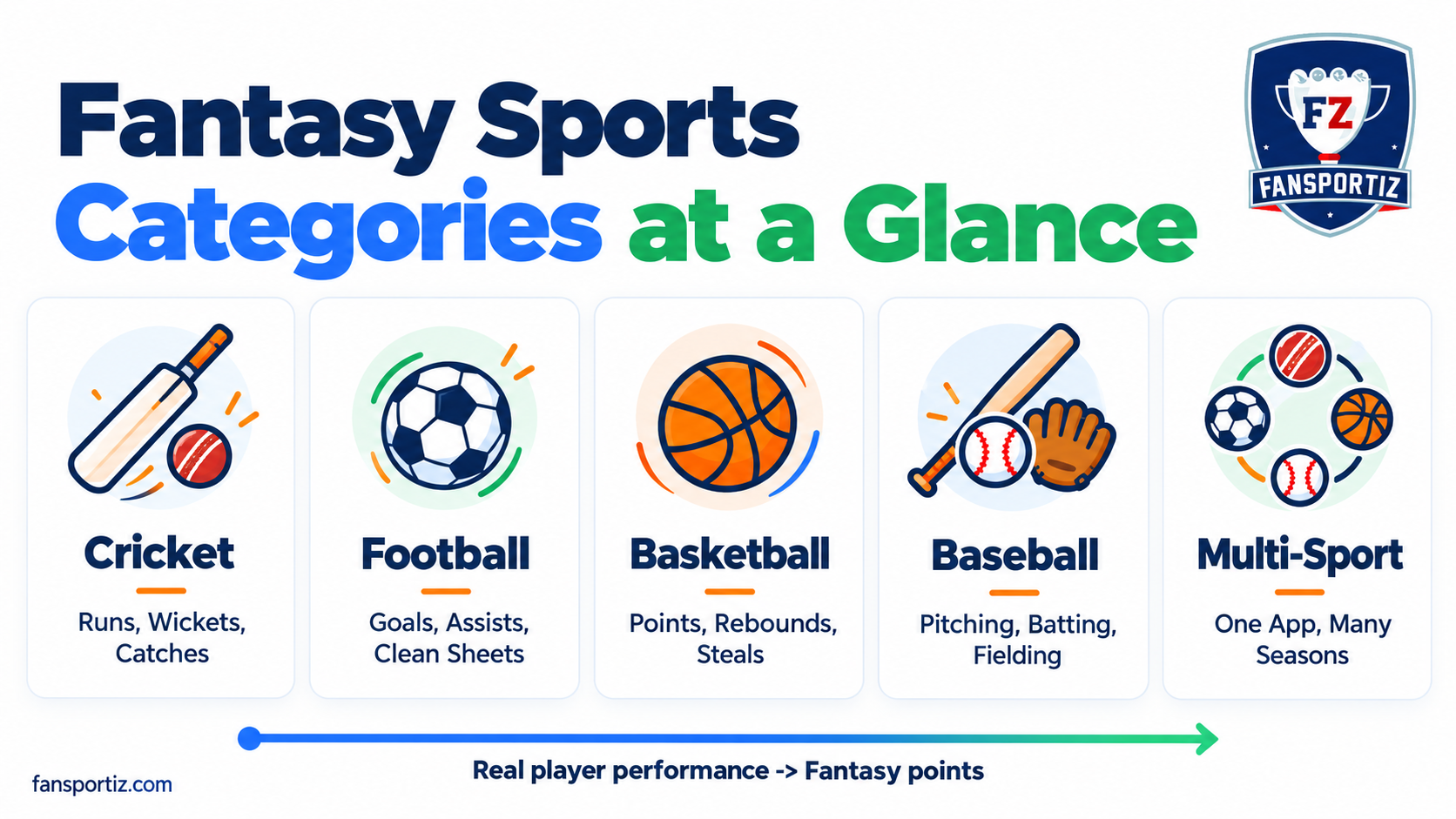
Popular fantasy sports categories include:
- Fantasy cricket: Users select players from competing cricket teams and earn points based on batting, bowling, and fielding performances.
- Fantasy football: Participants create teams using football players and accumulate points from goals, assists, clean sheets, and other match statistics.
- Fantasy basketball: Users build virtual rosters and compete based on points, rebounds, assists, steals, and blocks.
- Fantasy baseball: Players create teams using baseball athletes and score points through pitching, batting, and defensive performances.
- Multi-sport fantasy platforms: Users can access multiple sports through one application, expanding engagement across different seasons and tournaments, including emerging formats such as esports.
When developing your platform, decide whether you want to focus on a single sport or support several sports from launch.
A single-sport app can simplify the initial product scope and help you target a specific community. A multi-sport platform may appeal to a broader audience but typically requires additional data integrations, scoring rules, and operational resources.
You should also decide whether the platform will offer free-to-play contests, subscription-based features, advertising, or other permitted revenue models. If you intend to introduce paid contests or prize-based competitions, assess applicable laws and platform policies before implementation.
2. Research Your Target Audience and Competitors
A successful fantasy sports application starts with a clear understanding of its users. Before investing in development, research the sports communities you want to serve and identify the problems your app can solve.
Consider questions such as:
- Which sports are most popular among your intended audience?
- Are users looking for casual competitions or advanced fantasy analytics?
- Do they prefer private leagues with friends or larger public contests?
- Which features make existing apps engaging or frustrating?
- What would encourage users to return throughout a sporting season?
Analyze competing platforms, including the user journeys and features associated with products such as TopFan Fantasy. Pay attention to onboarding, team creation, contest discovery, scoring transparency, notifications, and the overall match-day experience.
However, avoid simply copying another app’s design or functionality. Your objective should be to understand established user expectations and identify opportunities to differentiate your product. For a practical example of how a competitor-inspired concept can be positioned, see Fansportiz’s guide on how to develop a fantasy sports app like MyFantasyLeague.
For example, your app could offer beginner-friendly tutorials, customizable private leagues, detailed player statistics, multilingual interfaces, or personalized match notifications.
Create a clear value proposition before moving forward. This will guide product design, development priorities, marketing campaigns, and future feature updates.
3. Define the Core Features of Your Fantasy Sports App
Features play a major role in determining whether users find your platform useful and enjoyable. Rather than adding every possible functionality at launch, prioritize the features required to deliver a complete and reliable fantasy sports experience.
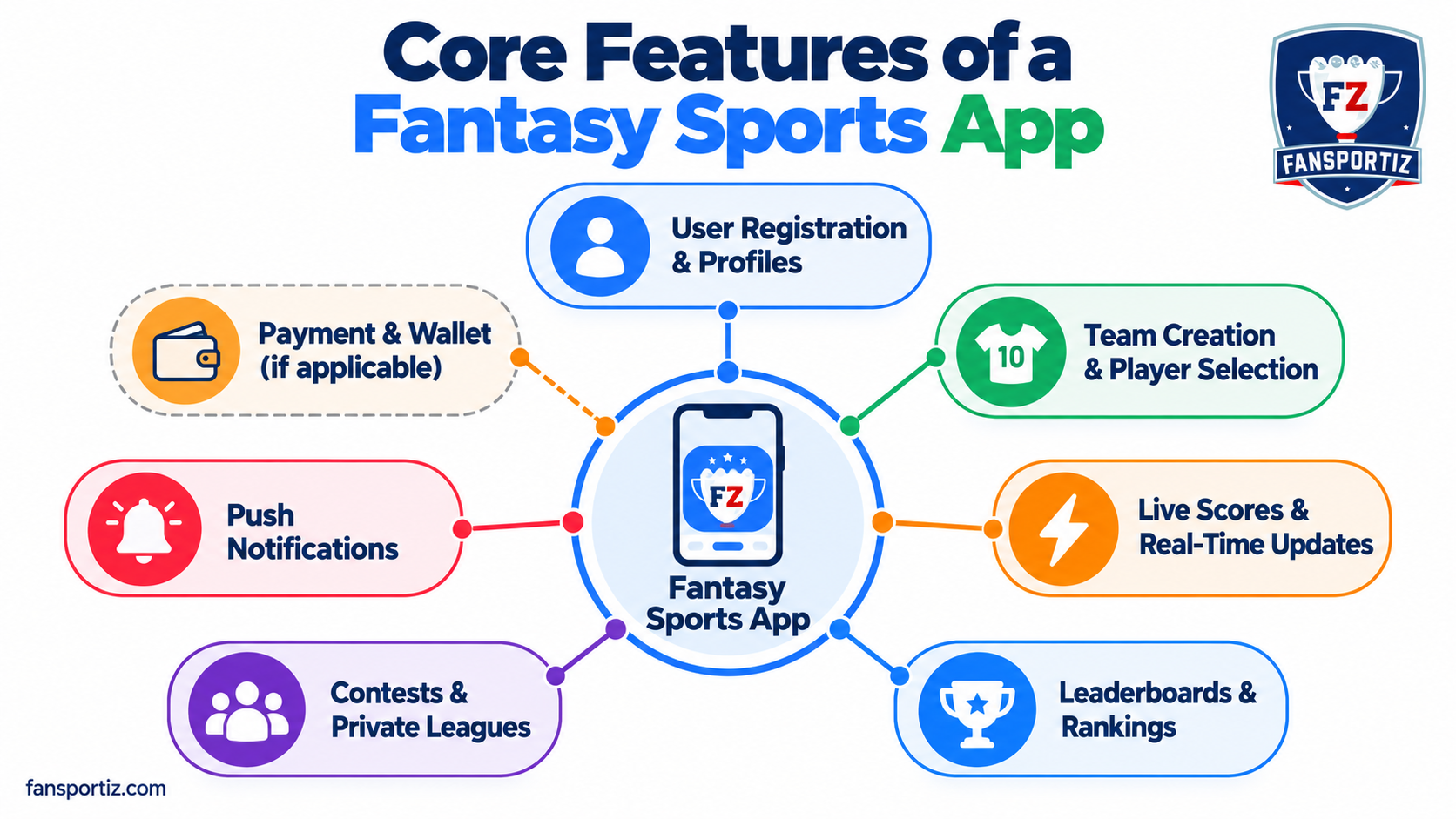
User registration and profiles
Make onboarding simple through email registration, phone verification, or supported social sign-in methods. Users should be able to manage their profiles, favorite sports, notification preferences, and account settings.
Strong authentication and account recovery processes are essential for protecting user information.
Team creation and player selection
Team creation is the heart of a fantasy sports app. Users should be able to browse available athletes, review statistics, and select players according to the rules of each contest.
Your application should clearly display team composition limits, player credits or salary caps, role restrictions, and any captain or multiplier selections.
An intuitive interface can help users complete these tasks quickly, especially when they are building teams close to a match deadline.
Live scores and real-time updates
Real-time information keeps users connected to ongoing matches. Integrate a dependable sports data provider to display live scores, player statistics, match status, and fantasy points.
The app should update important information efficiently without requiring users to refresh the screen repeatedly.
Data accuracy is particularly important because incorrect statistics can affect rankings, user confidence, and contest outcomes.
Leaderboards and rankings
Leaderboards introduce competition and give users a clear view of their performance. Display contest rankings, points earned, team positions, and relevant tie-breaking information. Where appropriate, provide filters for private leagues, public contests, and tournament-wide rankings.
Transparent scoring calculations help users understand why their teams move up or down the leaderboard.
Contests and private leagues
Allow users to discover available contests and create private leagues with friends. Depending on your business model, contests may have different entry requirements, scoring formats, and participant limits.
Private leagues can encourage social interaction and repeat engagement, while public contests can help users discover new competitors.
Push notifications
Notifications can inform users about match start times, team selection deadlines, score updates, contest results, and important account activity.
Give users control over notification categories and frequency. Relevant, timely messages are generally more useful than excessive promotional alerts.
Payment and wallet functionality
If your business model requires payments, subscriptions, or permitted prize distribution, implement appropriate payment processing and transaction records. Depending on your operating regions and product structure, you may also need identity verification, age checks, fraud monitoring, withdrawal controls, and responsible-play safeguards.
For free-to-play applications, a payment wallet may not be necessary in the initial release.
4. Choose the Right Technology Stack
The technology stack determines how efficiently your fantasy sports app operates, how well it handles traffic, and how easily it can evolve as your business grows.
The right choice depends on your budget, target platforms, expected audience, development expertise, and integration requirements.
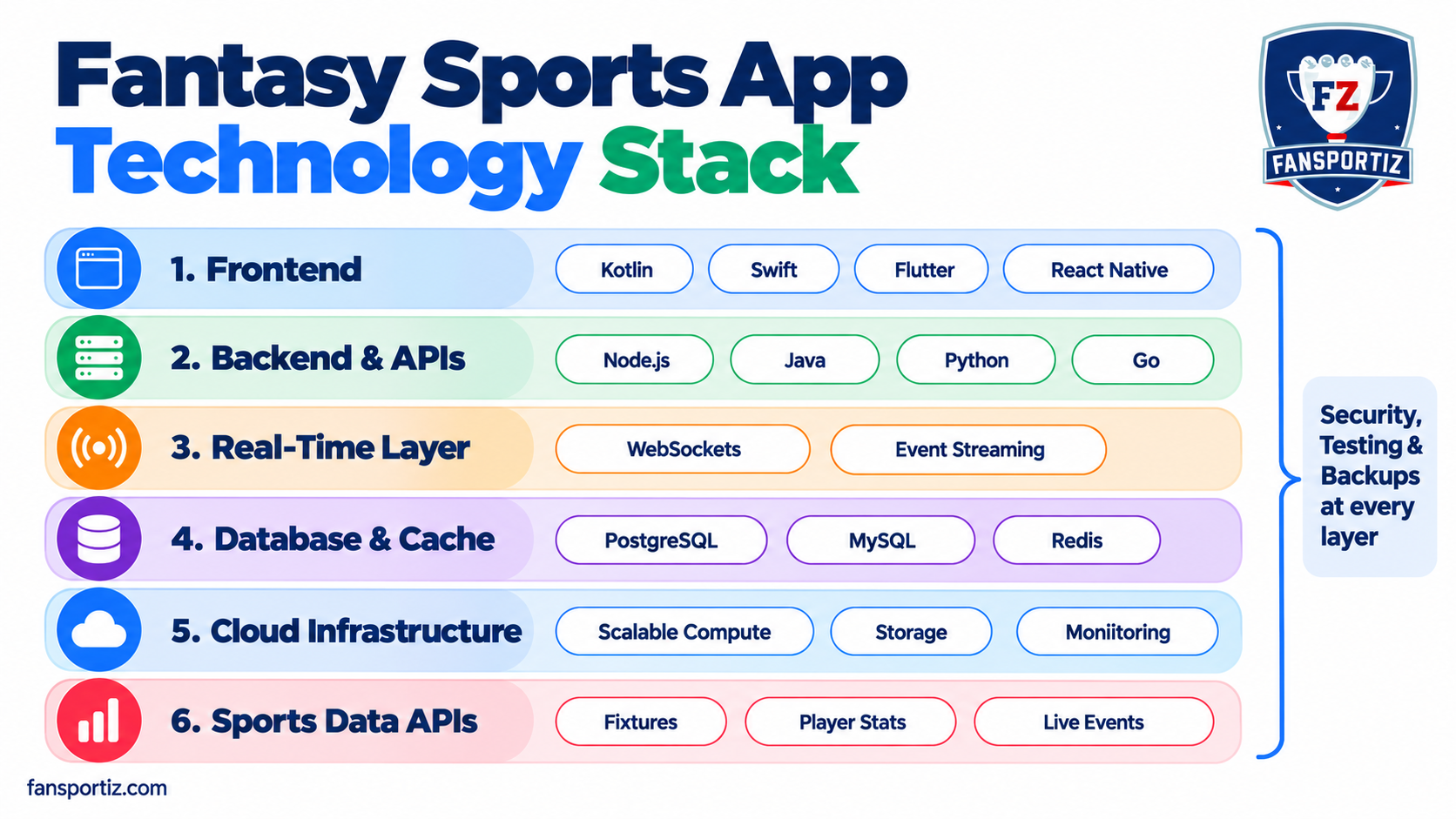
Frontend development: For native mobile applications, developers may choose Kotlin for Android and Swift for iOS. Cross-platform frameworks such as Flutter or React Native can help businesses maintain a shared codebase across mobile platforms.
Backend development: Technologies such as Node.js, Java, Python, or Go can support authentication, contest management, scoring calculations, APIs, and other business logic.
Database management: PostgreSQL or MySQL can store structured information such as user profiles, teams, contests, and transactions. Redis can support caching, sessions, and frequently accessed live data.
Cloud infrastructure: Cloud platforms such as AWS can provide scalable computing, storage, monitoring, and deployment services. Infrastructure should be designed to handle traffic spikes during major matches.
Real-time communication: WebSockets, event-driven systems, or suitable streaming technologies can deliver timely score and leaderboard updates.
Sports data integration: Reliable third-party APIs, such as those offered by Sportradar, provide schedules, player information, match events, and statistics needed for fantasy scoring.
Security, performance monitoring, automated testing, and backup procedures should be part of the architecture from the beginning rather than added after launch.
5. Design an Engaging and User-Friendly Interface
Fantasy sports users often interact with an application under time pressure. They may need to select players, compare statistics, make last-minute adjustments, or review rankings before a match begins.
A confusing interface can quickly discourage users, even when the underlying technology is strong.
Start by creating wireframes for the primary user journey, including registration, sport selection, match discovery, team creation, contest participation, and leaderboard viewing.
Use clear navigation, readable typography, recognizable icons, and consistent visual elements. Player cards should present essential statistics without overwhelming users with unnecessary information.
Pay particular attention to the team-building screen. Users should be able to identify available players, understand selection constraints, monitor their remaining credits, and review their completed team.
A dashboard can highlight upcoming matches, active contests, favorite teams, and recent performance. However, avoid overcrowding the screen with promotional banners and unrelated information.
Accessibility also matters. Ensure sufficient color contrast, readable text, accessible controls, and support for common screen sizes by following the Web Content Accessibility Guidelines (WCAG).
Before finalizing the design, conduct usability testing with people who match your intended audience. Observe where they hesitate, which features they misunderstand, and how quickly they can complete common tasks.
These findings can help refine the interface before expensive development changes become necessary.
6. Build a Reliable Fantasy Scoring Engine
The scoring engine is one of the most important technical components of a fantasy sports platform. It converts real-world sporting performances into fantasy points according to predefined rules.
For example, a fantasy cricket application may award points for runs, boundaries, wickets, catches, and other match events. A football platform may calculate points for goals, assists, saves, and defensive contributions.
Your scoring engine should support configurable rules rather than relying on scattered, hard-coded calculations.
A typical scoring workflow includes:
- Receive match events and statistics from the sports data provider.
- Validate incoming information and identify updates or corrections.
- Map each event to the relevant fantasy scoring rule.
- Calculate points for affected players and teams.
- Update contest standings and leaderboard positions.
- Reconcile results when a match is completed.
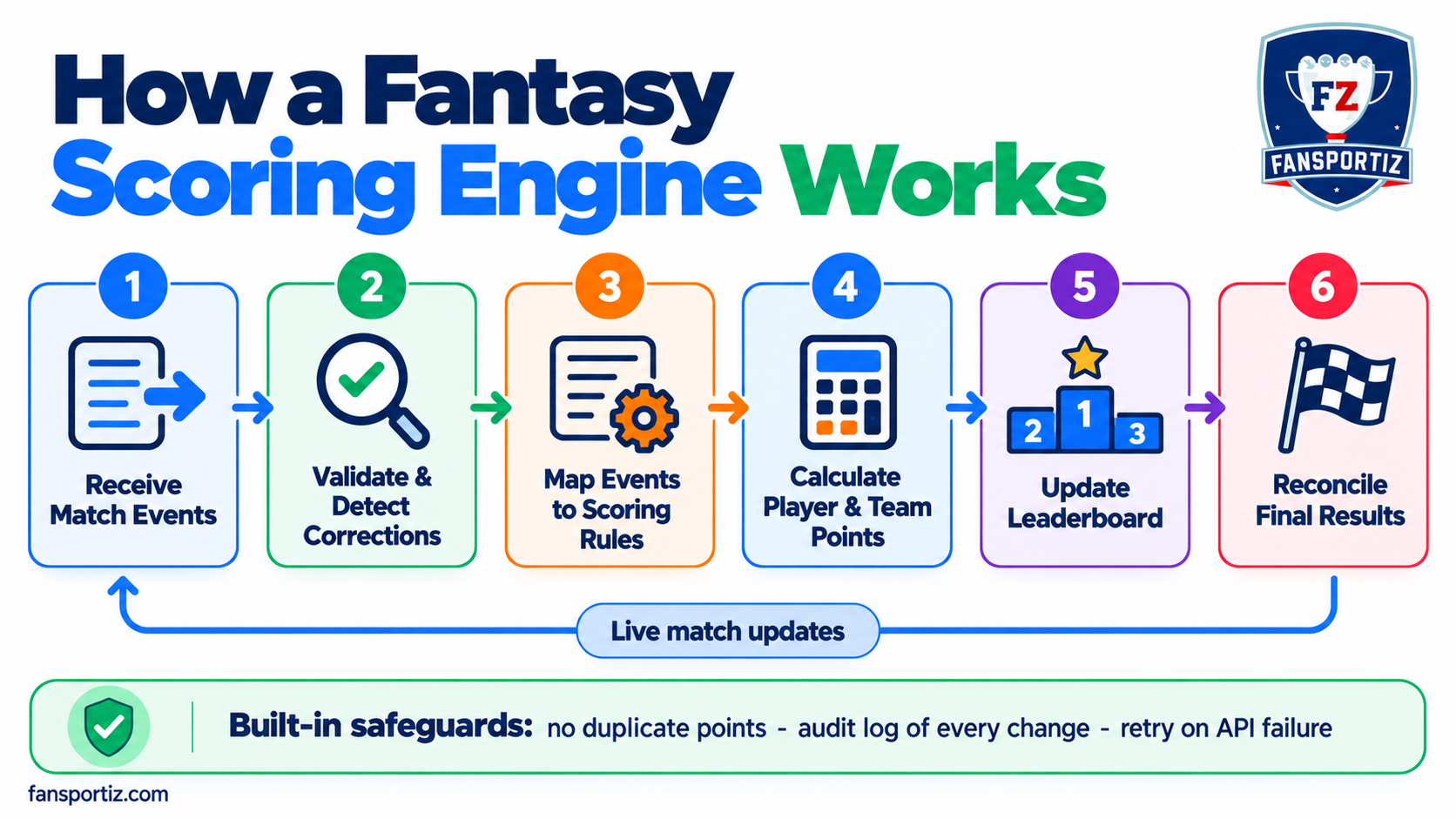
The system should handle duplicate events, delayed updates, data corrections, and temporary API failures. Reprocessing the same event should not accidentally award points twice.
Maintain an auditable record of scoring changes so that administrators can investigate disputes and explain final results.
You should also publish contest rules clearly before participation begins. Transparent scoring is essential to building user trust and maintaining a fair competitive environment.
7. Integrate Sports Data APIs and Live Match Information
A fantasy sports application depends heavily on timely and accurate sports information. Building an in-house data collection system can be expensive, so many businesses integrate licensed third-party sports data APIs.
Before selecting a provider, evaluate its supported sports, tournament coverage, data freshness, historical statistics, service reliability, pricing, and licensing conditions.
Some providers offer basic fixtures and scores, while others supply detailed player statistics, ball-by-ball cricket information, event timelines, and advanced analytics.
Make sure your selected provider permits your intended commercial use and that its contract covers the specific data displayed within your application.
Your engineering team should implement caching, retries, monitoring, and fallback procedures to reduce the impact of temporary API outages.
For live contests, latency matters. A delay in player statistics or score updates can create a frustrating experience, particularly during high-profile matches.
You should also define how the application handles postponed matches, abandoned games, incomplete data, and corrected results.
Reliable data integration, combined with a well-tested scoring engine, creates the foundation for a dependable fantasy sports experience.
8. Develop an Admin Panel for Platform Management
A fantasy sports application needs an effective administrative system behind the user-facing interface. An admin panel helps your operations team manage content, monitor platform activity, and resolve issues without requiring direct database changes.
Important administrative features include:
- User account management and support tools.
- Match, tournament, and contest configuration.
- Player information and scoring-rule management.
- Data synchronization and integration monitoring.
- Contest result verification and leaderboard reconciliation.
- Transaction records and payment status monitoring, where applicable.
- Promotional campaign and notification management.
- Fraud alerts, audit logs, and access permissions.
- Analytics dashboards for engagement and platform performance.
Different staff members should have different access levels. For example, customer support agents may need account-related tools but should not automatically have permission to modify financial records or scoring configurations.
Record sensitive administrative actions in audit logs to improve accountability.
An effective admin panel reduces operational workload and helps your business respond quickly when match schedules change, data providers experience disruptions, or users raise concerns.
9. Prioritize Security, Compliance, and Fair Play
Security and compliance should be considered throughout development, not only before launch.
Fantasy sports applications may process personal information, authentication credentials, behavioral data, and, depending on their business model, financial transactions. Protecting this information is essential for user confidence.
Use encrypted connections, secure password storage, appropriate session management, rate limiting, and robust access controls. Conduct regular vulnerability assessments against well-known risk lists such as the OWASP Top 10, and maintain an incident-response plan.
If payments are supported, use reputable payment processors and follow applicable payment security requirements. Avoid storing sensitive payment information unnecessarily.
Fair-play mechanisms are also important. Depending on your platform, these may include duplicate-account detection, suspicious activity monitoring, eligibility checks, contest-entry limits, and systems for reviewing suspected manipulation.
Legal requirements vary across jurisdictions and may depend on whether your application offers free contests, subscriptions, paid entry, cash prizes, or other rewards. In India, for example, businesses should obtain qualified legal advice on applicable central and state laws, current online gaming requirements, advertising restrictions, taxation, and payment-related obligations before launching relevant features.
App store policies and local consumer protection requirements should also be reviewed, including the Apple App Store Review Guidelines and the Google Play Developer Policy Center.
A compliant, transparent platform is better positioned to build long-term relationships with users, partners, and potential investors.
10. Test the Application Before Launch
Testing helps identify defects that could undermine the user experience or compromise contest integrity.
Begin with unit testing for scoring calculations, team restrictions, authentication, and other core functions. Integration testing should verify that the app communicates correctly with sports data providers, payment services, notification systems, and backend APIs.
Conduct functional testing across different devices, operating systems, screen sizes, and network conditions.
Performance testing is particularly important because fantasy sports apps may experience sudden traffic increases during major tournaments. Simulate realistic workloads to identify slow database queries, API bottlenecks, and infrastructure limitations.
Security testing should assess authentication, authorization, data exposure, and potential abuse scenarios.
You should also test unusual match situations, including delayed starts, interrupted games, corrected player statistics, and postponed fixtures.
Before the public release, conduct a beta launch with a limited group of users. Gather feedback on onboarding, team creation, live updates, and overall usability.
Resolve high-priority issues before expanding access. A stable initial experience is more valuable than launching with an excessive number of unfinished features.
11. Estimate the Cost of Developing a Fantasy Sports App
The cost of building an app like TopFan Fantasy depends on its functionality, technical complexity, supported platforms, design requirements, and development team’s location and experience. You can review Fansportiz pricing and plans for white-label options.
A basic MVP with user registration, one sport, team creation, standard scoring, and simple leaderboards will generally cost less than a sophisticated multi-sport application with live analytics, extensive administration tools, advanced fraud prevention, and complex integrations.
Your budget should account for:
- Product research and technical planning.
- UI/UX design and prototyping.
- Mobile or web application development.
- Backend development and database architecture.
- Sports data API subscriptions and licensing.
- Cloud infrastructure and monitoring.
- Testing, security, and compliance reviews.
- Launch marketing and ongoing maintenance.
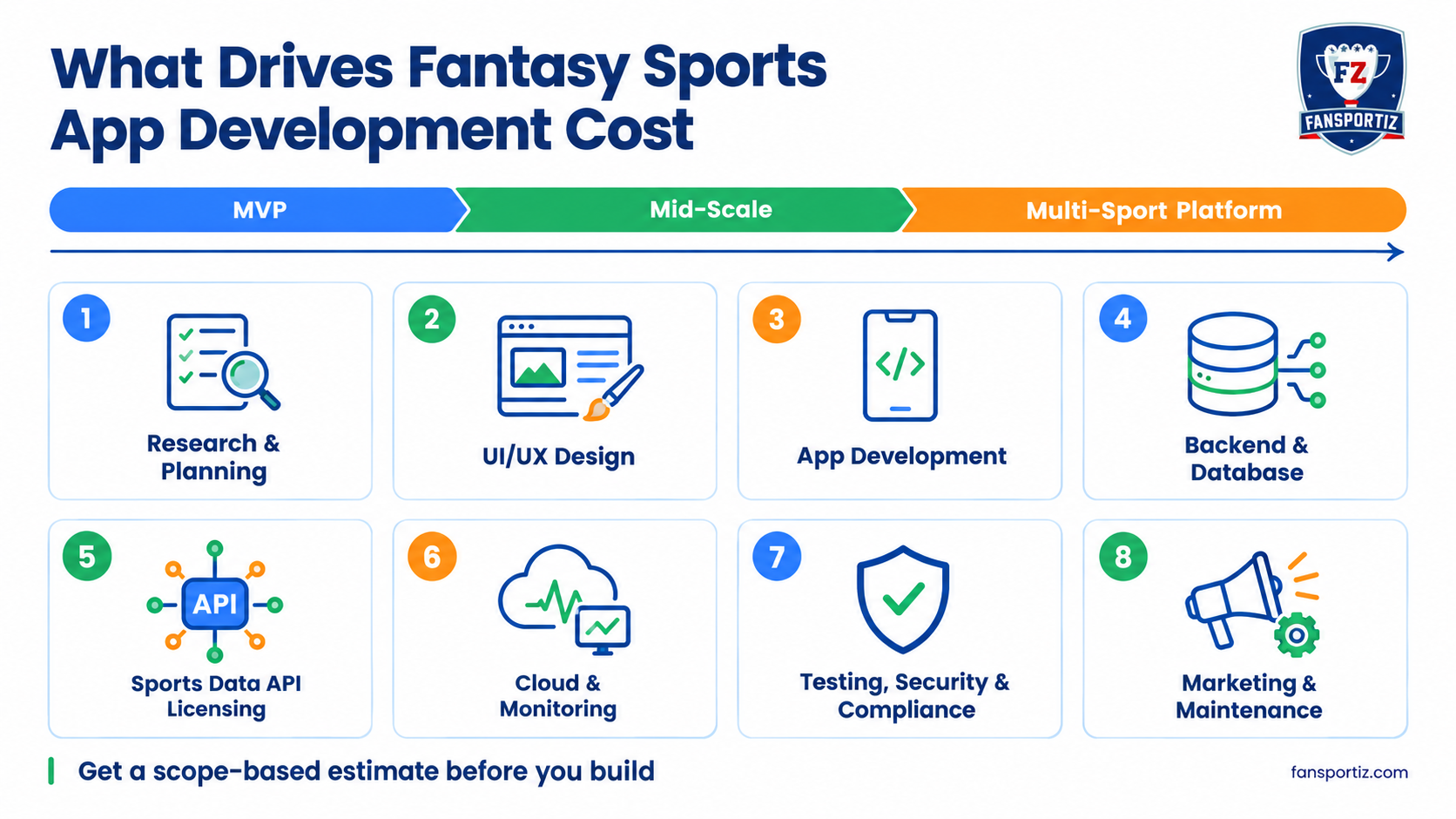
There is no universally accurate price for every fantasy sports project. The most practical approach is to define your requirements and obtain a scope-based estimate from an experienced development team.
Consider launching with a minimum viable product (MVP). Start with the features necessary to deliver a reliable experience, measure actual user behavior, and prioritize improvements based on feedback.
After launch, allocate resources for bug fixes, operating costs, API subscriptions, security updates, and new features. The total cost of ownership extends well beyond the initial development phase.
12. How Fansportiz Can Help You Develop Your Fantasy Sports App
Choosing the right development partner can simplify the journey from concept to launch. Businesses need a team that understands their product goals, translates requirements into technical specifications, and builds a platform that can evolve with changing user expectations.
Fansportiz is a name to consider when exploring fantasy sports app development solutions for your business. If you are planning to create an app inspired by the experience of TopFan Fantasy, use your initial discussions with Fansportiz to define your feature requirements, target audience, preferred platforms, and long-term growth strategy. Depending on your focus, you can also explore sport-specific offerings such as fantasy cricket app development, fantasy basketball app development, and esports tournament app development.
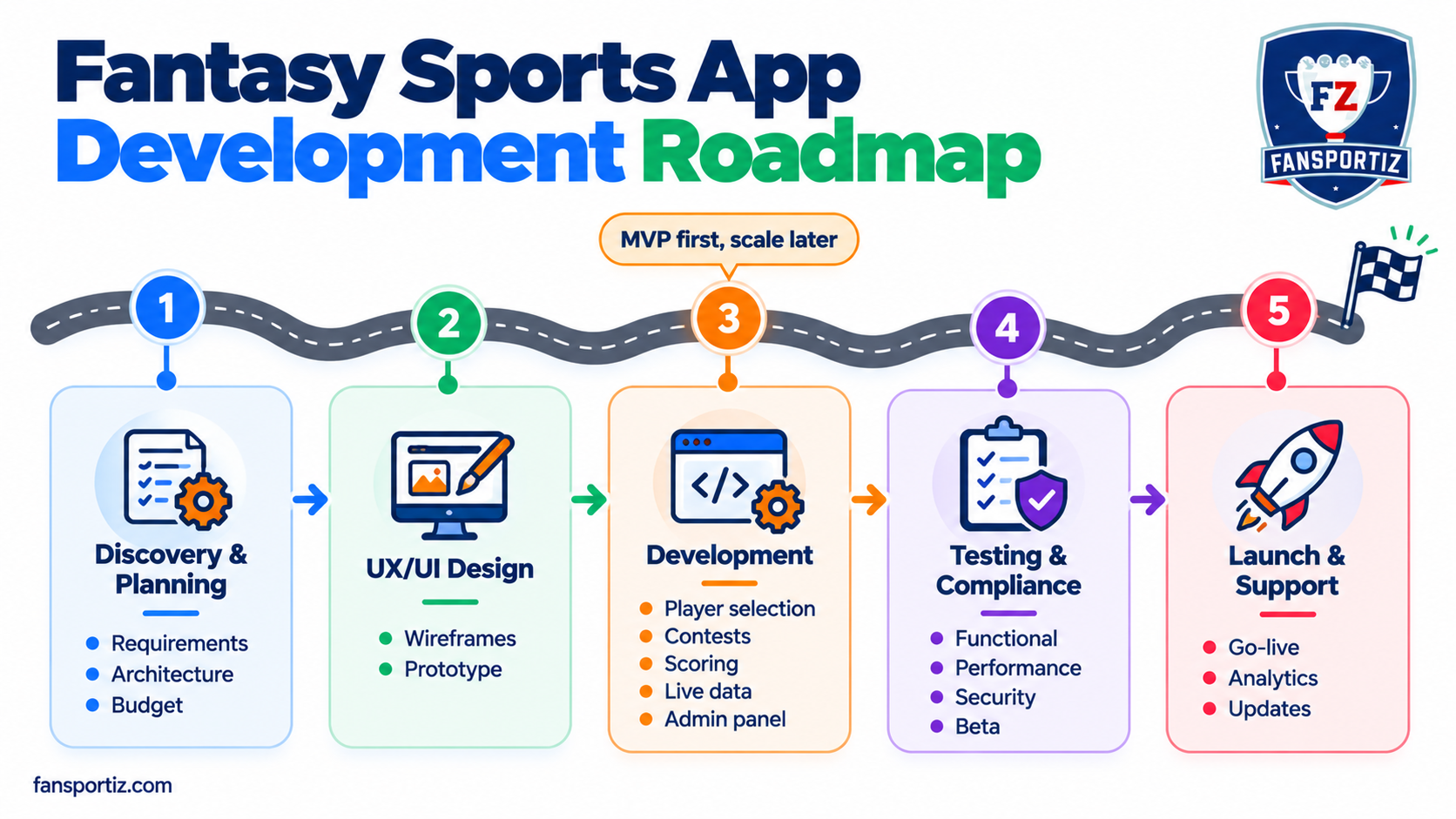
A suitable development engagement should begin with product discovery and technical planning. This stage helps establish the application architecture, core features, integrations, delivery milestones, and estimated budget.
The next step is to design the user experience and develop the essential application components. These may include player selection, contest management, scoring calculations, live match information, leaderboards, and an administrative dashboard.
Testing and deployment preparation should follow, with particular attention to data accuracy, security, application performance, and compliance requirements.
When evaluating Fansportiz or any other development provider, ask about its relevant project experience, technical capabilities, development methodology, testing procedures, maintenance arrangements, and post-launch support. Request a detailed proposal that explains the deliverables and responsibilities.
A good technology partner should also help you make practical trade-offs. Rather than overcomplicating your first release, prioritize the functionality that delivers the most value to your intended users.
By establishing a clear scope and a collaborative development process, you can create a fantasy sports platform that reflects your brand, supports your business model, and provides room for future improvements.
13. Launch and Market Your Fantasy Sports App
Developing the application is only one part of building a successful fantasy sports business. You also need a strategy for attracting users, encouraging repeat engagement, and establishing brand credibility.
Start by creating a dedicated website with clear explanations of your platform, supported sports, features, and participation rules. Publish informative blog content targeting relevant searches, such as fantasy sports strategies, tournament guides, player statistics, and fantasy app development. The Fansportiz blog is a useful reference for the kinds of topics worth covering.
Search engine optimization can help your website reach users who are actively interested in fantasy sports or businesses searching for development services.
Social media campaigns, sports community partnerships, influencer collaborations, and referral programs may also support user acquisition, subject to applicable laws and platform policies.
During launch, focus on a manageable set of tournaments or competitions. Monitor onboarding completion, team creation rates, active users, retention, crash reports, and support requests.
Use analytics to identify where users drop off and which features generate repeat engagement. Improve the experience based on actual usage rather than assumptions.
Retention strategies should emphasize genuine value, transparent rules, personalized content, and useful notifications. Avoid misleading promotions or encouraging excessive participation.
For a business-to-business fantasy sports development offering, case studies, technical explainers, product demonstrations, and clear service pages can help potential clients understand your capabilities.
Conclusion
Building a fantasy sports app like TopFan Fantasy requires a combination of product strategy, user-focused design, dependable sports data, accurate scoring, scalable technology, and ongoing operational support.
The most effective development process begins with understanding your audience and defining a clear business model. From there, you can prioritize essential features, select an appropriate technology stack, integrate reliable data sources, and establish the security and compliance measures your platform needs.
Launching an MVP can help you validate your concept without committing to an unnecessarily complex first release. As your user base grows, you can introduce additional sports, advanced analytics, private leagues, and other features based on measurable demand.
Fansportiz can be part of your evaluation when choosing a partner for your fantasy sports app development journey. Define your goals, review the provider’s capabilities, and establish clear deliverables before beginning development.
With thoughtful planning and the right technical expertise, you can create a distinctive fantasy sports application that delivers an engaging experience to fans while supporting your long-term business objectives.
