
How to Develop a Fantasy App Like SuperBru in 2026
Published on - May 22nd, 2026
In 2026, fantasy sports aren’t just a trend anymore—they’ve become a full-blown digital ecosystem where millions of users log in daily to test their knowledge, strategy, and instincts. It’s a fast-growing space, and if you’re thinking about building something in it, an app like SuperBru is a solid reference point for what success can look like.
But here’s the thing: building a fantasy sports app today isn’t as simple as copying existing ideas. The competition is intense, and user expectations are much higher than they used to be. People want smooth experiences, real-time updates, smart features, and a platform that actually feels engaging—not just functional.
So if you’re aiming to create a fantasy app like SuperBru in 2026, you need to think beyond the basics. It’s about combining strong market understanding with thoughtful product design and modern technology. From figuring out what users actually want, to choosing the right tech stack and building features that keep them coming back—every step matters.
And of course, there’s also the business side of things: monetization, scalability, and long-term retention. This isn’t a quick project—it’s more like building a living platform that evolves with its users. With the right planning and execution, though, it can turn into a powerful and highly engaging product in the fantasy sports space.
Step 1: Conduct Strategic Market Research and Define Your Niche
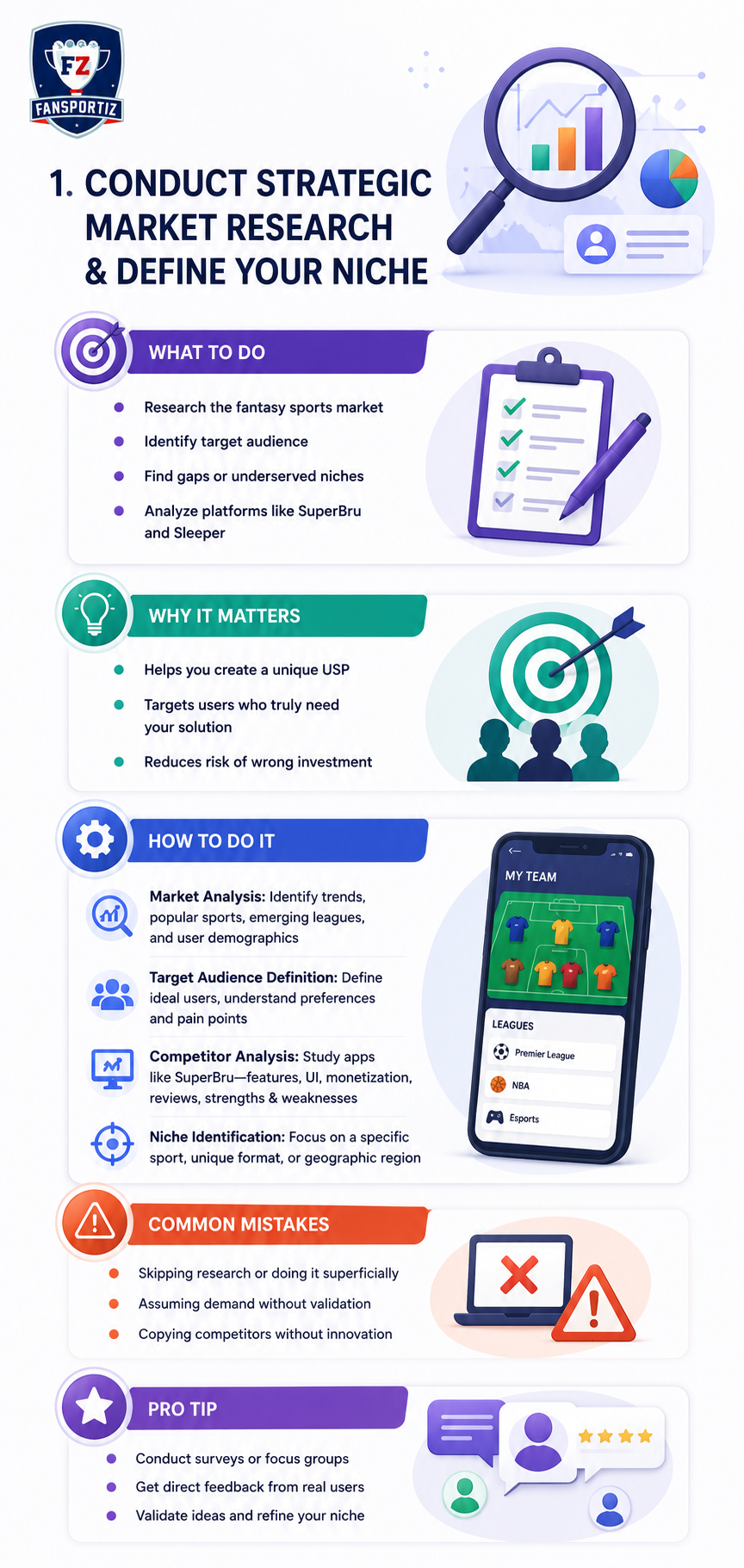
Step 1 begins with something most people are tempted to rush through, but it actually decides how successful your fantasy sports app will be in the long run.
Before writing a single line of code, you need to understand the landscape you are stepping into. The fantasy sports market is already packed with established players, so your first job is to study it closely and find where you can actually fit in. Look at platforms like SuperBru and Sleeper, not just to admire what they have built, but to understand what makes them work and where they might be falling short.
The real goal here is to avoid building yet another generic app. Instead, you want to discover a clear space where your idea feels necessary rather than repetitive. That is where your unique selling point starts taking shape.
This process starts with market research. Pay attention to current trends, the sports people are most engaged with, and how user behavior is shifting. Then move on to defining your audience more clearly. Are you building for casual fans who play occasionally, or serious players who enjoy deep strategy and competition? Each group behaves differently and expects different features.
Once you understand your users, the next step is competitor analysis. Go beyond surface level observations. Study how apps like SuperBru structure their experience, how they keep users engaged, how they make money, and what users complain about in reviews. Those complaints often reveal opportunities.
After that, you narrow everything down into a niche. This is where your app starts to take a real shape. You might focus on a single sport, a specific region, or even something emerging like esports predictions. In fact, in areas like Esports App Development, choosing a focused audience early can make your product far more competitive and engaging.
A common mistake at this stage is skipping research entirely or assuming you already know what users want. Another is simply copying what already exists without adding anything meaningful. Both approaches usually lead to apps that struggle to stand out.
If you want to strengthen this step further, talk to real users. Surveys or small focus groups can reveal insights you will not find in data alone. Sometimes you will even discover unexpected demand, like users showing more interest in niche formats such as esports fantasy leagues, which can completely shape your direction.
Step 2: Design a Compelling User Experience and Feature Set
Step 2 is where your fantasy sports app really starts to feel real, because this is the point where ideas turn into an actual experience users can interact with.
At this stage, you are not just listing features anymore. You are shaping how people will feel when they open your app, how easily they can move through it, and whether they will enjoy coming back.
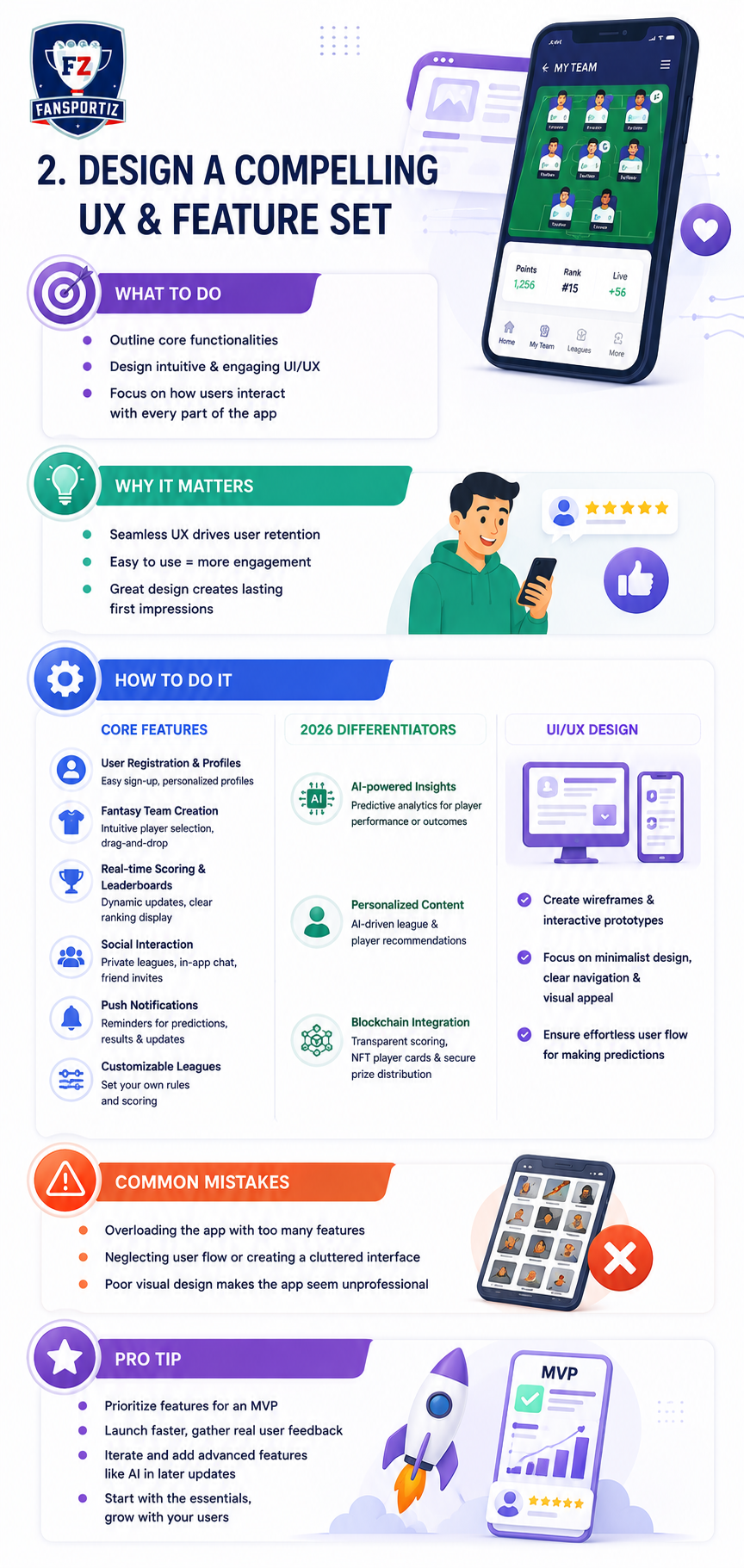
You begin by defining the core functionality. The basics still matter a lot here. Users should be able to register quickly and set up a profile without friction. Once inside, they should be able to create their fantasy teams in a way that feels natural, almost like a game itself. Simple things like drag and drop player selection can make a big difference in keeping the experience smooth.
From there, the engagement layer becomes important. Real time scoring and leaderboards are what keep users hooked during live matches. People want to see instant updates and understand exactly where they stand. Social features like private leagues, chat options, and friend invites turn the experience from a solo activity into something more competitive and community driven. Add in push notifications and you ensure users never feel disconnected from what is happening.
As you move into 2026 expectations, the baseline is no longer enough on its own. Many apps are now experimenting with AI driven insights that predict player performance or suggest smarter picks. Personalized recommendations are also becoming more common, helping users discover leagues or players they might actually enjoy. Some platforms are even exploring blockchain based systems for transparent scoring and digital ownership of rewards or collectibles.
But none of this matters if the design is confusing. UI and UX are what hold everything together. You need clean wireframes and simple user flows that guide people without overwhelming them. The goal is to make every action feel obvious, especially when users are creating teams or checking results.
A common mistake here is trying to include too much from the beginning. When an app is overloaded with features, it often becomes harder to use rather than better. Another issue is ignoring user flow, which leads to friction that slowly pushes users away even if the features themselves are strong.
The smarter approach is to start with a minimum viable product. Focus only on the essential features that deliver the core experience, launch early, and then refine based on real feedback. Once the foundation is stable, you can gradually introduce advanced capabilities like AI driven tools and deeper personalization.
In the end, building a fantasy app like SuperBru is not about adding everything at once. It is about designing an experience that feels simple, engaging, and rewarding from the very first interaction.
Step 3: Architect a Scalable and Future-Proof Technology Stack
Step 3 is where things shift from design and planning into something more structural, almost like laying the foundation of a building that needs to support thousands or even millions of users at once.
At this point, your decisions are no longer just about what the app should do, but about how it will actually perform in the real world when users start flooding in, especially during live sports events when traffic spikes are at its highest.
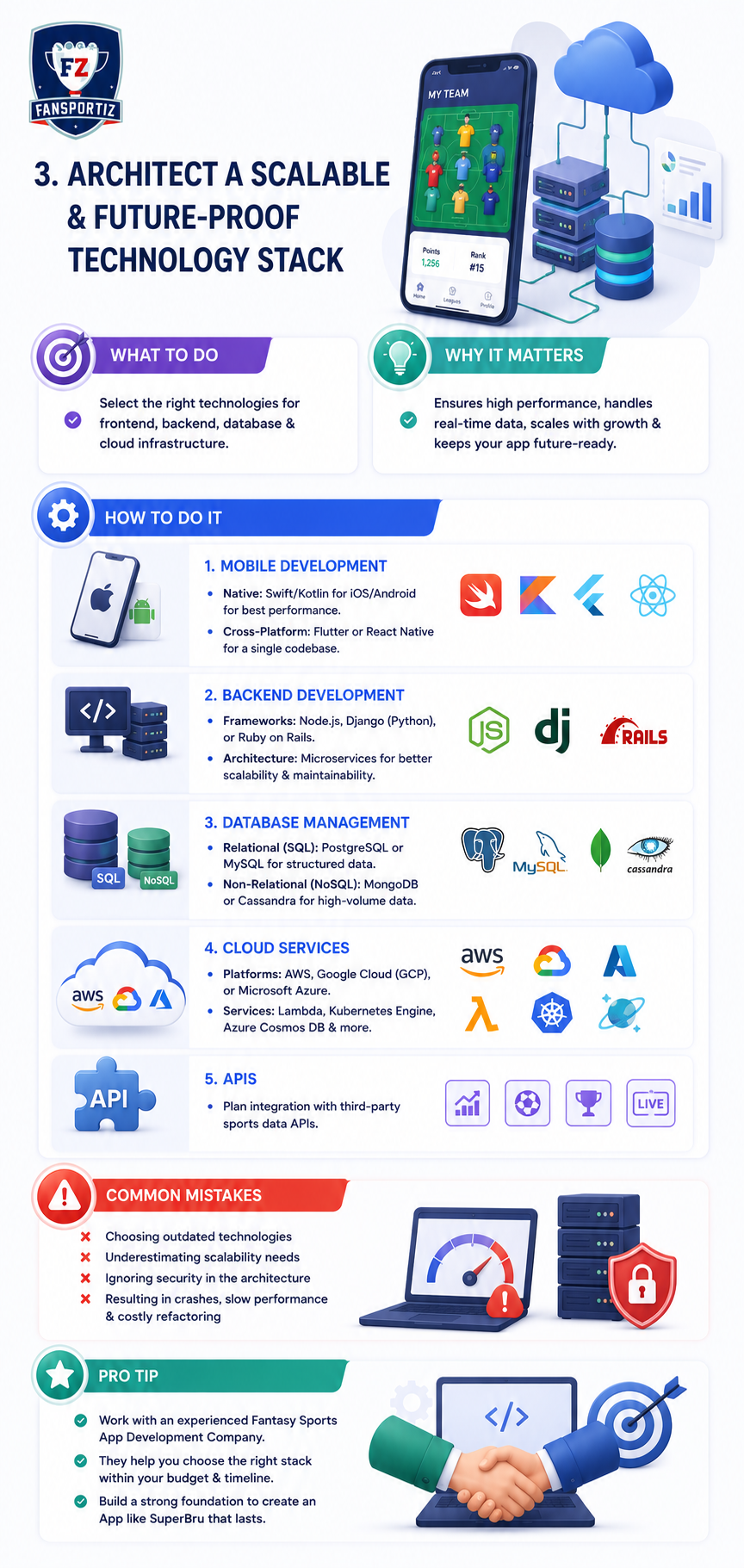
You start with the mobile development approach. Some teams prefer native development using Swift for iOS and Kotlin for Android because it gives the best performance and full access to platform features. Others choose cross platform frameworks like Flutter or React Native, which allow them to build faster using a single codebase for both platforms. The right choice usually depends on your budget, timeline, and long term goals.
Next comes the backend, which is essentially the engine of your entire app. Technologies like Node.js are often chosen for real time capabilities, especially important in fantasy sports where live updates matter. Python based frameworks like Django or Ruby on Rails are also common depending on the complexity of the system. Many modern apps also move toward microservices architecture, which breaks the system into smaller independent parts so it becomes easier to scale and maintain over time.
Then you move to databases, which handle everything from user profiles to live match data. Structured data like user accounts and league standings usually sit in relational databases such as PostgreSQL or MySQL. On the other hand, fast moving and unstructured data like real time scores or activity logs often rely on NoSQL solutions like MongoDB or Cassandra.
Cloud infrastructure is another critical layer. Platforms like AWS, Google Cloud, and Microsoft Azure give you the flexibility to scale as your user base grows. You can also use services like serverless functions, container orchestration, and global databases to handle spikes in traffic without breaking the system or slowing it down.
At the same time, you need to plan for external integrations. Fantasy apps rely heavily on third party sports data APIs to deliver live scores and match updates, so your system must be built to integrate smoothly with those feeds.
A common mistake at this stage is choosing technology based on popularity instead of suitability. Another is ignoring scalability and security until it becomes a problem later, which often leads to expensive rebuilds and performance issues when the app starts growing.
A better approach is to bring in experienced fantasy sports development company early in the process. They can help you choose a technology stack that not only fits your current needs but also supports long term growth. This is what ensures your app is not just functional at launch, but stable and competitive as it scales.
Step 4: Integrate Real-time Data and Advanced Prediction Models
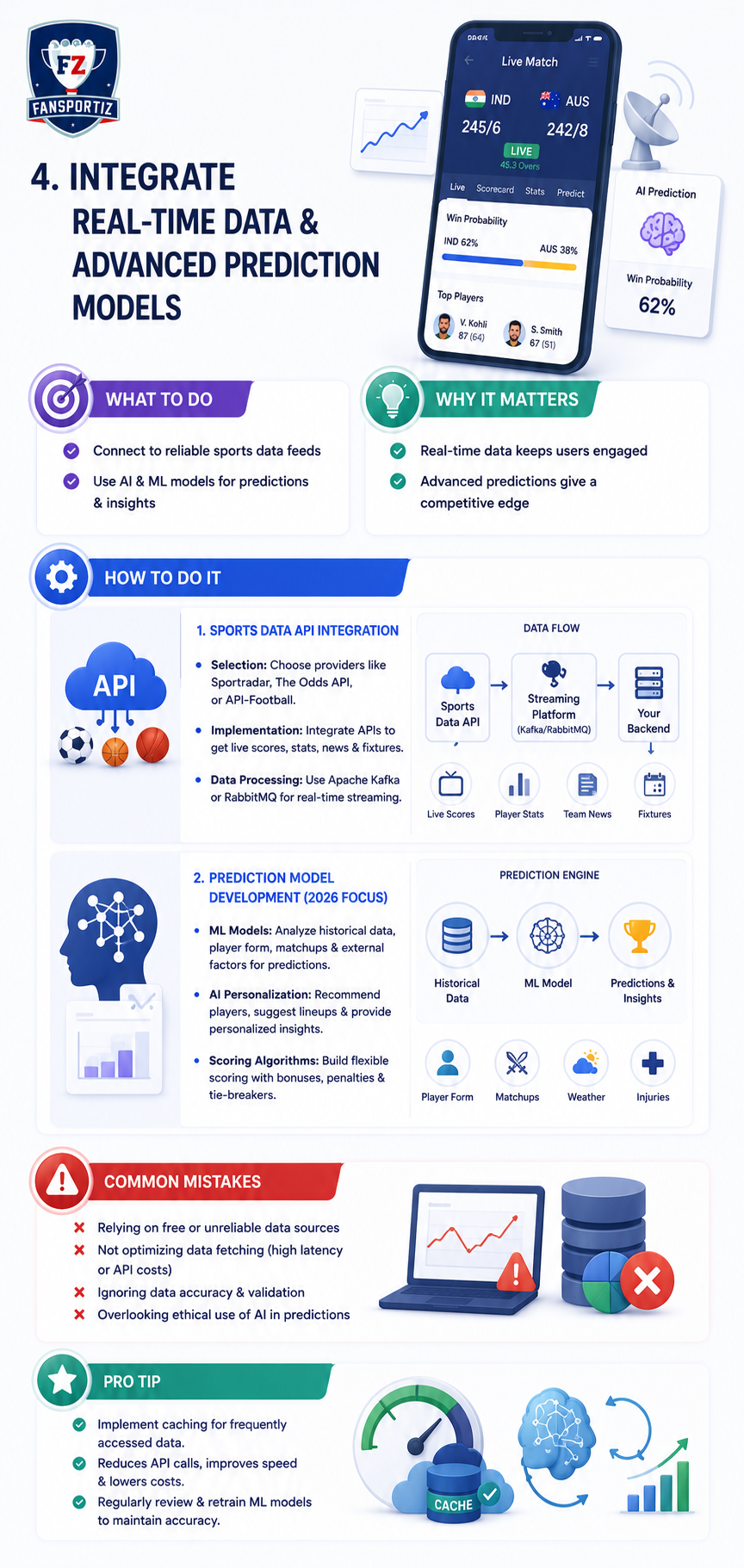
Step 4 is where your fantasy sports app starts feeling truly alive, because this is the moment it begins reacting to real world sports as they happen.
At this stage, everything depends on data that moves fast and updates constantly. If your app cannot keep up with live matches, scores, and player performance, users will lose interest very quickly. Real time information is not just a feature here, it is the core experience.
The first step is connecting your platform to reliable sports data sources. Providers like Sportradar, The Odds API, or API Football are commonly used because they offer structured access to live scores, fixtures, and player statistics. Choosing the right provider matters a lot since you need data that is accurate, fast, and consistent. Once selected, these feeds are integrated into your backend so your system can continuously pull in live updates like match scores, team news, and player stats.
But simply fetching data is not enough. You also need a way to handle large volumes of information flowing in at the same time, especially during ongoing matches. This is where data streaming systems come in. Tools like Apache Kafka or RabbitMQ help process and distribute real time updates efficiently without slowing down the app.
On top of live data, modern fantasy apps in 2026 are expected to offer something more intelligent. This is where prediction models and AI driven insights come into play. By using machine learning, your system can analyze historical performance, player form, team matchups, and even external factors like injuries or weather conditions to generate useful predictions.
AI also plays a big role in personalization. Instead of showing the same information to every user, the app can suggest players, recommend lineups, or highlight insights based on individual user behavior and past choices. This makes the experience feel more tailored and engaging.
Another important part of this step is designing your scoring system. It needs to be flexible enough to support different sports and league formats. You may include bonus points, penalties, or special rules depending on how each competition is structured.
A common mistake at this stage is depending on low quality or free data sources, which often leads to delays or incorrect information. Another issue is not optimizing how frequently data is fetched, which can increase costs or slow down performance. It is also important to think carefully about how AI predictions are used, since accuracy and fairness both matter for user trust.
A smart practice is to introduce caching for frequently used data so your system does not repeatedly call external APIs unnecessarily. This improves speed and reduces operational costs. It is also important to continuously update and retrain your prediction models so they stay relevant as player performance and match dynamics evolve over time.
Step 5: Implement Robust Security, Compliance, and Monetization
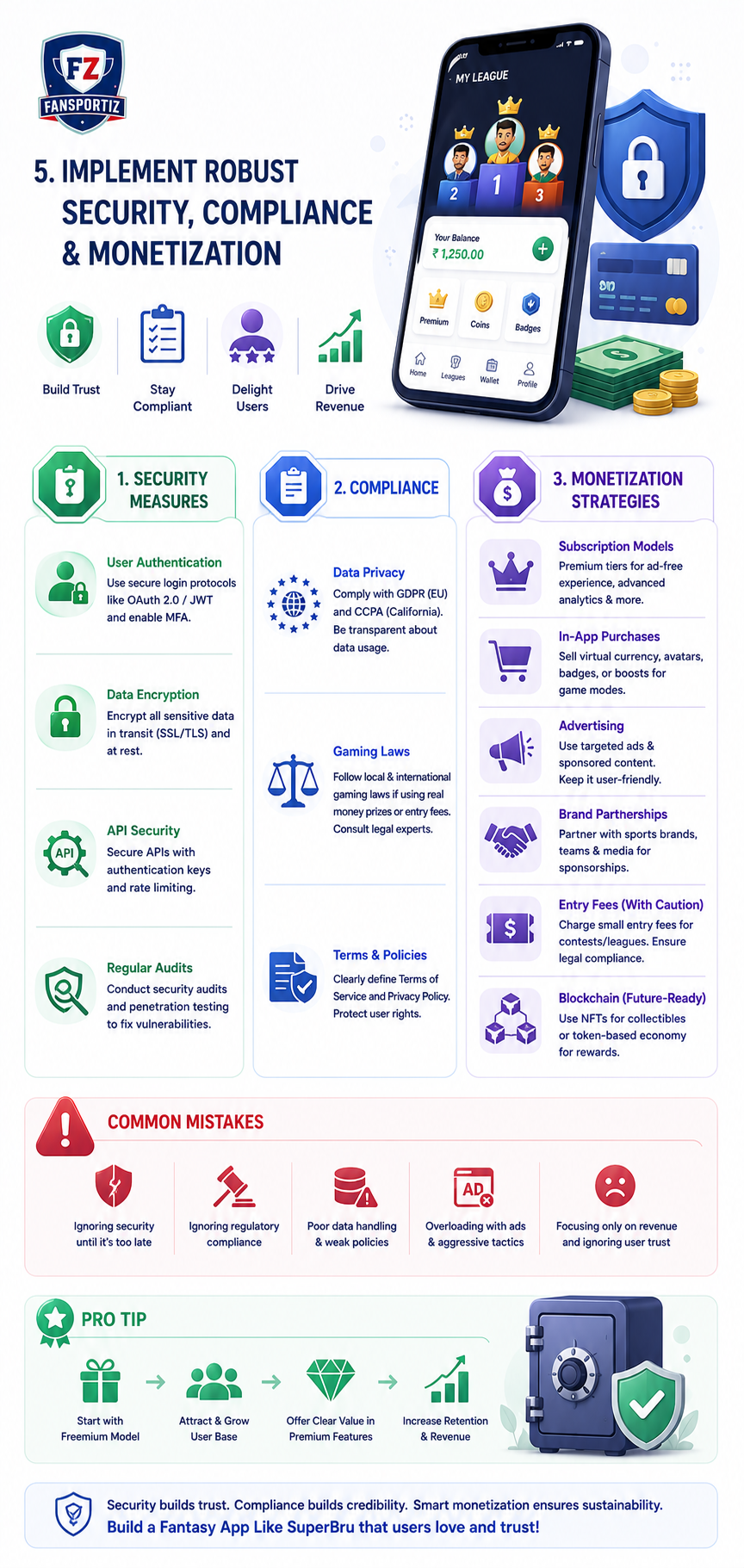
Step 5 is where your fantasy sports app moves beyond just being a product and starts becoming a real, trustworthy platform that people feel safe using and willing to spend money on.
At this stage, you are dealing with three important pillars at the same time: security, compliance, and monetization. Each one plays a different role, but together they decide whether your app can survive and grow in the long run.
You start with security, because nothing else matters if user data is not protected. Every login and interaction should be handled through secure authentication systems like OAuth 2.0 or JWT, and in many cases, adding multi factor authentication gives an extra layer of protection. All sensitive information needs to be encrypted, whether it is being transmitted through the network or stored in your database. Your APIs also need protection through proper authentication keys and rate limiting so they are not exposed to misuse. On top of that, regular security audits and penetration testing help you catch vulnerabilities before they become real problems.
Once security is in place, you need to think about compliance. This is where many apps underestimate complexity. Depending on your target regions, you may need to follow regulations like GDPR in Europe or CCPA in California, which govern how user data is collected and used. If your app includes real money contests or entry based competitions, you also need to carefully understand gambling laws in different jurisdictions. This often requires legal consultation to avoid risks. Clear terms of service and privacy policies are also essential so users understand exactly how their data is handled and what rules govern the platform.
After trust and legality are covered, the focus shifts to monetization. This is how your app sustains itself. One common approach is subscription based models where users pay for premium features like advanced analytics, ad free experiences, or exclusive leagues. In app purchases also work well, offering virtual currencies, avatars, or special rewards. Advertising can be another revenue stream, but it needs to be balanced carefully so it does not interrupt the user experience. Brand partnerships and sponsorships with sports related companies can also add strong value if done well.
Some platforms explore entry based contests where users pay small fees to join leagues, with a commission taken from the pool, although this must always be handled carefully due to legal constraints. More experimental approaches like blockchain based rewards or token systems are also emerging, especially for digital collectibles and engagement driven economies.
A common mistake at this stage is ignoring security until something goes wrong, which can be extremely damaging. Another is overlooking legal compliance, which can lead to serious penalties. On the business side, being too aggressive with monetization often pushes users away instead of encouraging them to stay.
A better approach is to start with a freemium model. Give users a strong free experience first so they can understand the value of your app. Once they are engaged, you can gradually introduce premium features that feel genuinely useful rather than forced. This balance helps build both trust and long term revenue, which is essential when you are trying to make a fantasy app like SuperBru that lasts beyond its launch phase.
Step 6: Develop, Test, and Optimize for Performance
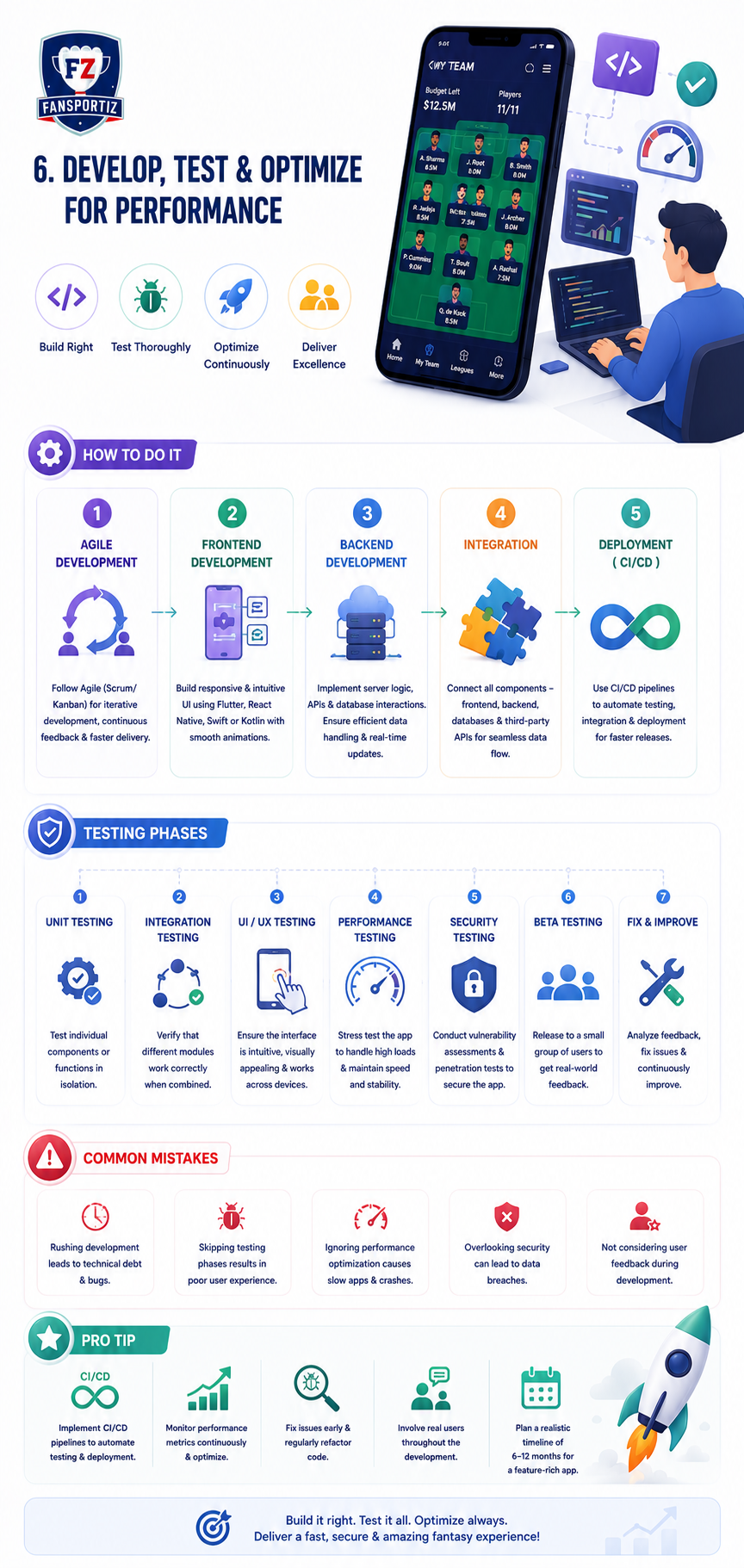
Step 6 is the point where everything you have planned finally turns into a real working product. It is where design sketches, architecture decisions, and feature lists start coming together as a live fantasy sports app that users can actually interact with.
This stage is less about ideas and more about execution. Every feature you envisioned now has to work smoothly, and every system has to communicate without breaking under pressure.
Most teams approach this phase using an Agile development style. Instead of trying to build everything at once, the work is broken into smaller cycles. Each cycle delivers a working part of the app, which can be tested, improved, and refined based on feedback. This makes the process more flexible and helps avoid major surprises at the end.
On the frontend side, developers focus on building the actual user experience using frameworks like Flutter, React Native, Swift, or Kotlin. The priority here is responsiveness, smooth navigation, and clean interactions. In a fantasy sports app, even small delays or clunky animations can affect how users perceive the platform.
On the backend, the focus shifts to logic and structure. This is where APIs are built, databases are connected, and real time systems are handled. Everything needs to be efficient because fantasy apps often deal with live updates and large spikes in traffic during matches.
Once both sides are in place, integration becomes the next big step. This is where frontend, backend, databases, and third party APIs are connected into a single working system. The goal is to ensure that data flows seamlessly across the entire application without delays or inconsistencies.
After development, testing becomes extremely important. Each layer of the app needs to be validated carefully. Unit testing checks individual components, integration testing ensures different modules work together, and UI testing focuses on whether the experience feels smooth and intuitive across devices.
Performance testing plays a key role because the app must handle heavy loads, especially during live sporting events. Security testing ensures there are no vulnerabilities that could put user data at risk. Beta testing is also crucial, as real users often uncover issues that internal testing misses, giving you valuable feedback before a full launch.
A common mistake at this stage is rushing through development just to reach launch faster. This often leads to technical debt and unstable performance later on. Skipping proper testing can also result in bugs that damage user trust, especially in a competitive space like fantasy sports.
Another issue is ignoring performance optimization, which can cause slow loading times or even crashes when traffic increases. These problems usually become most visible at peak match moments, which is exactly when your app needs to perform best.
A strong approach is to introduce CI CD pipelines, which automate testing and deployment. This reduces manual errors and allows your team to release updates faster and more reliably. With proper planning, a well built fantasy sports app typically takes around six to twelve months to develop, depending on complexity and feature depth.
Step 7: Strategize Launch, Marketing, and Post-Launch Growth
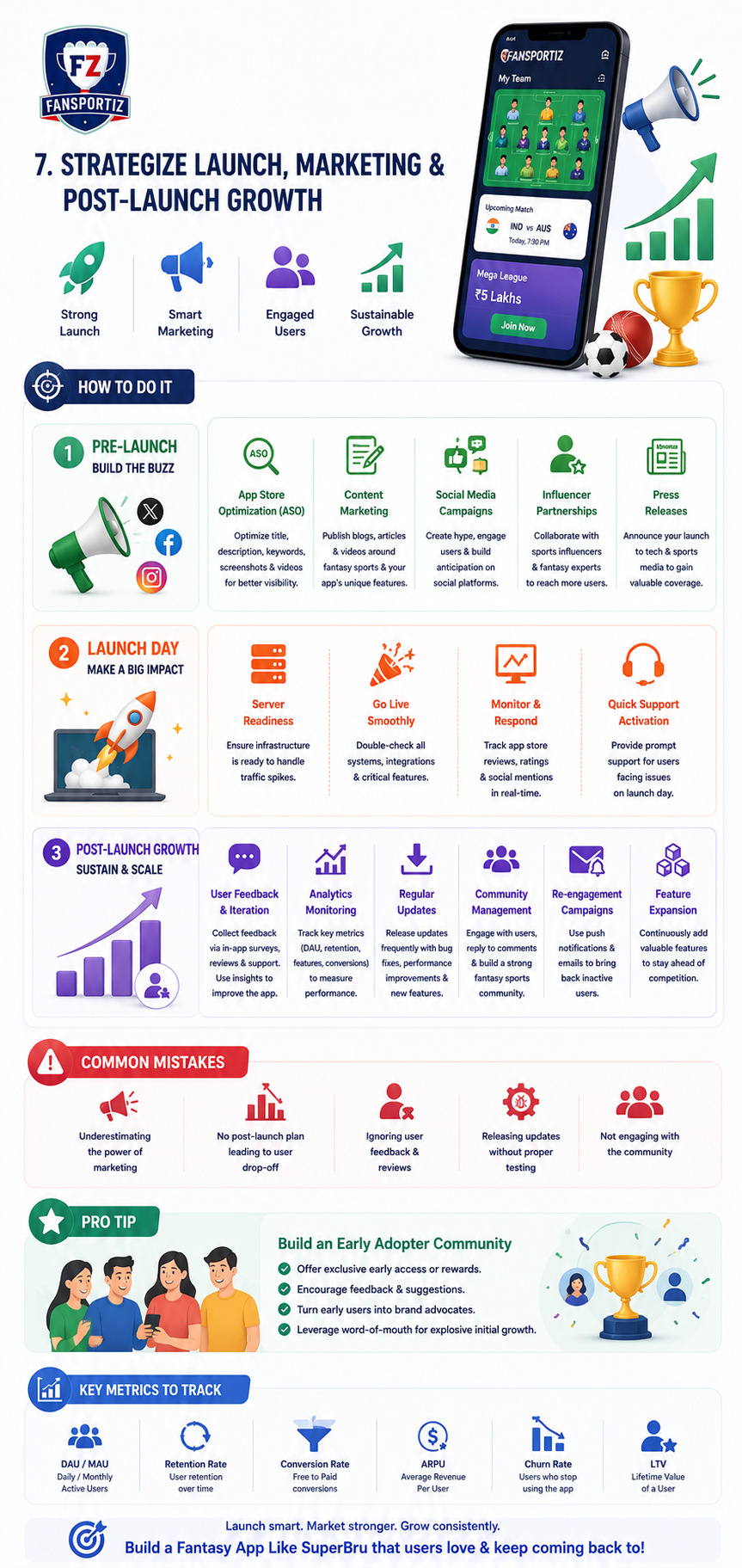
Up until now, the focus has been on building, designing, and refining. But at this stage, success depends on how well you introduce your product to users and how effectively you keep them engaged after the first wave of downloads.
The launch does not start on release day. It actually begins much earlier with App Store Optimization. This is where you fine tune your app listing so people can actually find you. Your title, description, keywords, screenshots, and preview videos all work together to create that first impression before someone even downloads the app. If this part is weak, even a great product can go unnoticed.
Before the official launch, marketing plays a huge role in building anticipation. Content marketing helps you tell your story through blogs, videos, and educational content around fantasy sports. Social media platforms like X, Facebook, and Instagram become your stage for building excitement and community. At the same time, influencer collaborations can bring credibility and instant visibility, especially when sports creators or fantasy experts talk about your app. Press releases also help you reach tech and sports media outlets and build early awareness.
When launch day finally arrives, preparation becomes critical. Your servers need to be ready for sudden traffic spikes, especially if your marketing has worked well. It is also important to closely monitor app store reviews and social media conversations because early feedback can shape your reputation very quickly.
After launch, the real work begins. Growth depends on how well you listen and adapt. Collecting user feedback through surveys, reviews, and support channels helps you understand what is working and what needs improvement. Analytics become your best tool here, showing you patterns in user behavior such as daily active users, retention rates, and feature usage.
Regular updates are essential to keep the app fresh. Bug fixes, performance improvements, and new features show users that the product is actively evolving. At the same time, community management plays a big role in building loyalty. Responding to users, engaging in discussions, and creating a sense of belonging can significantly improve long term retention.
Re engagement strategies also matter. Push notifications and email campaigns help bring inactive users back into the app and remind them of ongoing matches or new features they might have missed.
A common mistake at this stage is underestimating marketing and assuming the product will grow on its own. Another is ignoring user feedback, which often leads to slow decline in engagement after the initial excitement fades.
A stronger approach is to build an early adopter community even before launch. Offering early access or special rewards can create a group of users who are genuinely invested in your app. Their feedback and word of mouth can become one of your most powerful growth engines and can significantly increase your chances of building a fantasy app like SuperBru that sustains long term success.
Tips for Success
To truly succeed in the fantasy sports space, the app itself is only part of the story. The real difference comes from the community you build around it and how alive that ecosystem feels once users start joining.
A strong fantasy app is not just a platform for predictions or team building. It becomes a place where users compete with friends, share their wins, and stay engaged through friendly rivalry. Encouraging user generated content, discussions, and private competitions can turn casual users into loyal ones. When people feel like they are part of a community rather than just using an app, engagement naturally grows.
At the same time, flexibility is essential. User expectations in 2026 evolve quickly, and what feels exciting today might feel outdated in a few months. That is why staying agile and continuously refining your features based on real feedback is so important. The most successful apps are the ones that listen closely to their users and adapt without hesitation.
Another key factor is infrastructure. If the foundation is weak, growth becomes a problem instead of an opportunity. From day one, your system should be designed to scale smoothly so that increasing user traffic does not lead to crashes, delays, or performance issues. A stable backbone allows your app to grow without friction.
Looking forward, innovation plays a major role in staying competitive. Technologies like AI are becoming essential for creating personalized user experiences, from smarter predictions to tailored recommendations. Blockchain is also being explored for transparency in scoring systems and secure reward distribution. While not every technology needs to be adopted immediately, staying open to these advancements ensures your app does not fall behind as the market evolves.
In the end, long term success comes from a balance of three things: a strong community, a system that can scale reliably, and a willingness to keep evolving with new technology and user expectations.
Troubleshooting Common Issues
When you start running a fantasy sports app in the real world, issues are not just possible, they are expected. What separates a stable platform from a frustrating one is how quickly and effectively you respond when problems show up.
One of the most common challenges is slow performance or lagging updates. In a fantasy app, even a few seconds of delay can ruin the experience because users are constantly tracking live matches. The first thing to look at is your backend efficiency. Poorly optimized queries or an unbalanced database structure can easily slow things down. Introducing caching for frequently accessed data can make a big difference because it reduces repeated load on your system. In many cases, using a CDN for static assets also helps improve speed for users across different regions. And when traffic spikes during live events, scaling your cloud infrastructure becomes essential to keep everything running smoothly.
Another issue many apps face is low engagement or a high churn rate. This usually signals that users are not finding enough value or excitement to keep coming back. In such cases, the focus should shift back to user experience. Even small UX friction points can push users away over time. Adding gamification elements like daily challenges, streak rewards, or loyalty programs can make the experience more addictive in a positive way. Push notifications also play a big role here, but they need to be smart and personalized rather than generic reminders. On top of that, user feedback should guide your improvements so you are always fixing real problems instead of guessing.
A third major issue is data inaccuracies or inconsistent scoring, which can seriously damage user trust. Fantasy sports depend heavily on real time accuracy, so even small errors can create frustration. This is why it is important to work only with reliable sports data APIs and continuously monitor their latency and consistency. On your backend, data validation checks help ensure that incorrect or duplicate information does not affect scoring. For critical situations, having a manual review process can help resolve disputes quickly. At the same time, your scoring system should be thoroughly tested and transparent so users clearly understand how points are calculated.
In the end, most problems in a fantasy sports app come down to three areas: performance, engagement, and data reliability. If you keep these three under control and continuously improve them, your app will stay stable even as it scales and evolves.
Conclusion
In 2026, building a fantasy app like SuperBru is no longer just a bold idea, it is a realistic opportunity if approached with the right mindset and structure. Throughout this journey, the focus has been on more than just development. It has been about understanding the market, shaping a strong product vision, choosing the right technology, and planning for long term growth from the very beginning.
You have seen how important it is to define a clear niche instead of trying to appeal to everyone. You have also learned how thoughtful UX design can shape user behavior, and how the right technology stack ensures your platform can handle growth without breaking. On top of that, real time data integration, AI driven insights, strong security practices, and smart monetization strategies all work together to create a complete and competitive product.
When all these pieces come together, the result is not just another fantasy sports app. It becomes a platform that feels engaging, responsive, and rewarding for users. A well built system can attract a loyal audience, support competitive gameplay, and generate sustainable revenue over time.
As you move forward, there is still room to go beyond the basics. Advanced technologies like augmented reality could create more immersive experiences, while expansion into new sports or regions can open additional growth opportunities. The key is to keep evolving rather than staying static.
This is not a journey you have to take alone. Working with an experienced fantasy sports development team can help turn ideas into a stable, scalable product much faster and with fewer risks. With the right execution, your vision can grow into a strong, market ready fantasy platform that genuinely changes how fans engage with sports.
Frequently Asked Questions:
1. How much does it cost to develop an app like SuperBru?
When people first think about building a fantasy sports app like SuperBru, the first question that usually comes up is the budget. And the truth is, there is no single fixed number because it really depends on how ambitious your idea is.
If you are starting small with a basic MVP, the cost can begin somewhere around $20,000 to $50,000. This would usually cover essential features and a simple working version of the app. But as you start adding more advanced capabilities like real time data processing, AI driven insights, or blockchain based features, the investment naturally increases. A fully featured, scalable platform can easily go beyond $150,000 and sometimes even reach $500,000 or more.
A big part of the cost comes from how complex your system becomes, especially when you need live updates, strong security layers, and smooth performance under heavy traffic.
2. What are the essential features to develop an app like SuperBru?
At its core, a fantasy sports app is all about making the experience simple, interactive, and engaging for users.
The foundation usually starts with user registration and profile creation, followed by fantasy team building where users can pick and manage their squads. Real time scoring and leaderboards bring the excitement alive as matches progress, while social features like private leagues and chat help users compete with friends and build communities.
Push notifications also play a key role in keeping users connected with ongoing matches and updates.
As the industry evolves in 2026, many apps are going a step further by adding AI powered insights, personalized recommendations, and even exploring blockchain based features for transparency and digital ownership. These additions are not just trends anymore, they are becoming expectations in a competitive market.
3. Why should I develop an app like SuperBru in 2026?
2026 is actually a very interesting time for fantasy sports. The audience is already massive, and users are more engaged than ever before. People are not just looking for entertainment anymore, they want smarter, more interactive experiences.
This is where a well built fantasy app can really stand out. If you approach it with proper planning and integrate modern technologies like AI or advanced analytics, you are not just building another app, you are creating a platform that feels personalized and competitive.
The real opportunity lies in finding the right niche and offering something that existing platforms are not fully addressing. That is where strong growth and monetization potential come in.
4. What technology stack is recommended for a scalable fantasy sports app?
Choosing the right technology stack is one of those decisions that quietly decides how far your app can go.
On the mobile side, you can go with native development using Swift for iOS and Kotlin for Android if you want maximum performance. If speed of development and shared codebase is more important, cross platform tools like Flutter or React Native are commonly used.
For the backend, frameworks like Node.js, Django, or Ruby on Rails are often chosen depending on the system requirements. Since fantasy apps deal with different types of data, a combination of PostgreSQL for structured data and MongoDB for flexible, real time data works well.
And then comes the cloud layer, which is essential. Platforms like AWS, Google Cloud, or Azure provide the scalability needed to handle spikes in traffic during live matches and keep everything running smoothly.
5. How long does it typically take to build a fantasy sports application?
Building a fantasy sports app is not an overnight process. Even for a solid MVP, you are usually looking at a timeline of around 2 to 6 months.
That includes everything from research and design to development, API integration, testing, and deployment. Each stage takes time because everything needs to work together smoothly, especially when real time data is involved.
If you are aiming for a more advanced platform with AI features, blockchain integration, and high scalability, the timeline can easily extend to 6 to 12 months or even longer depending on complexity and team size.
6. What are the key monetization strategies for a fantasy sports app?
Once the app is live and users start engaging, monetization becomes the next big focus, but it needs to be handled carefully so it does not hurt user experience.
A common approach is subscription based models where users pay for premium features like deeper analytics or an ad free experience. In app purchases also work well, especially for things like virtual currency, customization options, or special features.
Advertising and brand partnerships can also bring in steady revenue when done in a balanced way that does not interrupt gameplay.
Some platforms also explore entry based contests, where users pay to join leagues and a small commission is taken, although this always needs to be handled within legal boundaries.
The key idea is simple. Start with value first, then monetize in a way that feels natural rather than forced.
