
Published on - May 22nd, 2026
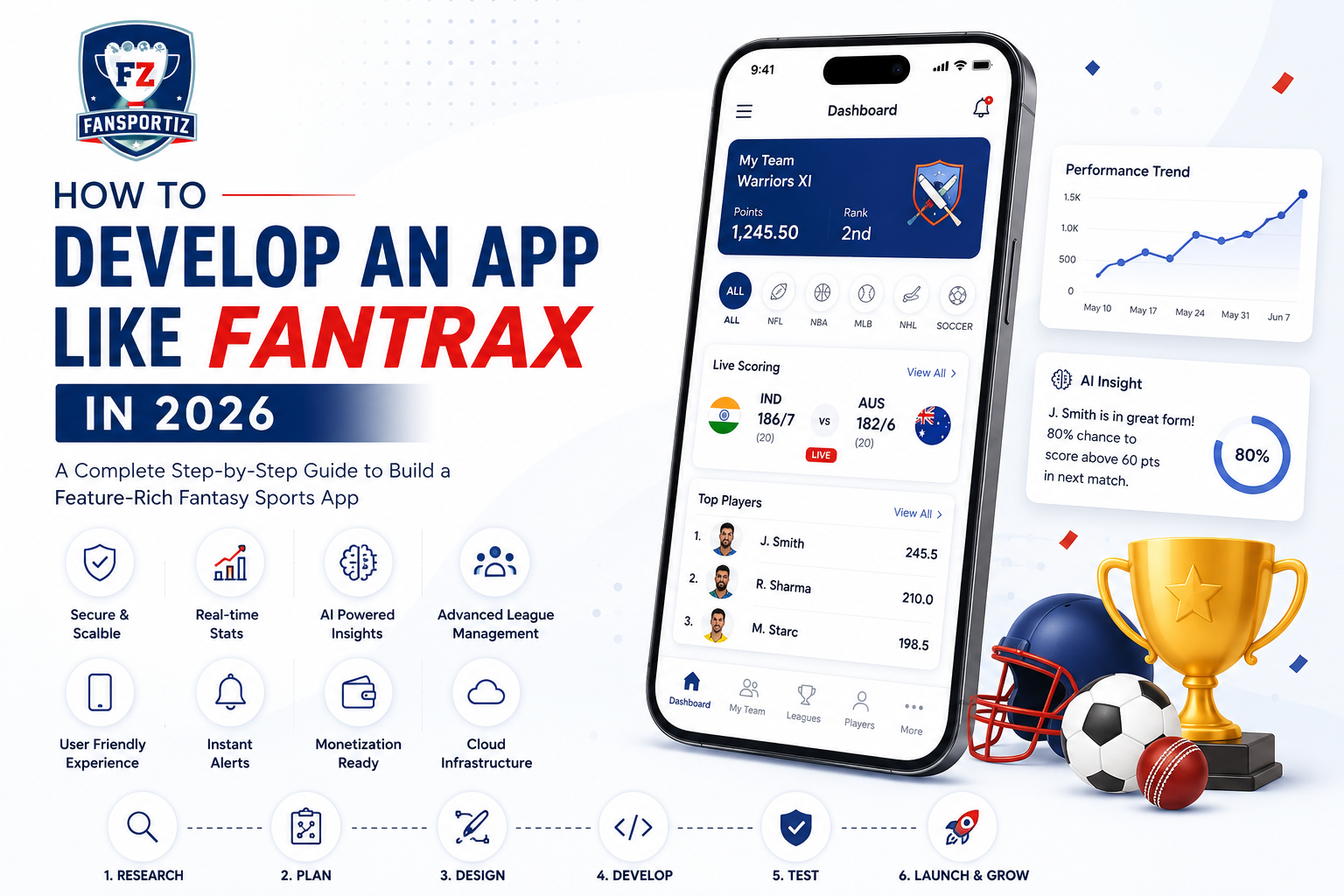
The fantasy sports market in 2026 is expanding rapidly, with millions of users actively participating in leagues and competitions across different platforms. This growing demand is creating a strong opportunity for businesses that want to enter or scale in this space. Apps like Fantrax show how powerful a well structured fantasy platform can become when it is built with the right strategy.
But as many teams quickly realize, building something like this is not just about development. It requires careful thinking from the very beginning.
“A fantasy sports app is not just built, it is planned step by step before a single feature is written.”
To develop an app like Fantrax, you need to approach it in a structured way that balances technology, user expectations, and long term scalability.
What this guide will help you understand
Before diving into execution, it is important to know what areas you will need to focus on. This includes:
- Market analysis to understand the current competition and user demand
- Feature prioritization to decide what your app should actually include
- Technology selection to ensure the platform is stable and scalable
- Monetization strategies to make the app financially sustainable
Each of these steps plays a key role in shaping the final product.
Why this approach matters
Developing a fantasy sports app like Fantrax is not just about building features. It is about creating a system that can handle:
- Large user activity during live matches
- Continuous real time interactions
- Evolving user expectations over time
Without a structured approach, even a good idea can struggle to perform in a competitive market.
The mindset behind the build
The key difference between a basic app and a Fantrax level platform is planning. Every decision, from features to technology, directly impacts user experience and long term success.
That is why this process requires:
- Clear planning before development
- Strong understanding of user behavior
- A focus on long term stability rather than quick launch
What comes next
In the following steps, we will go deeper into how each part of the system is built and why each decision matters when creating a scalable fantasy sports platform.
Step 1: Define Your Niche and Target Audience
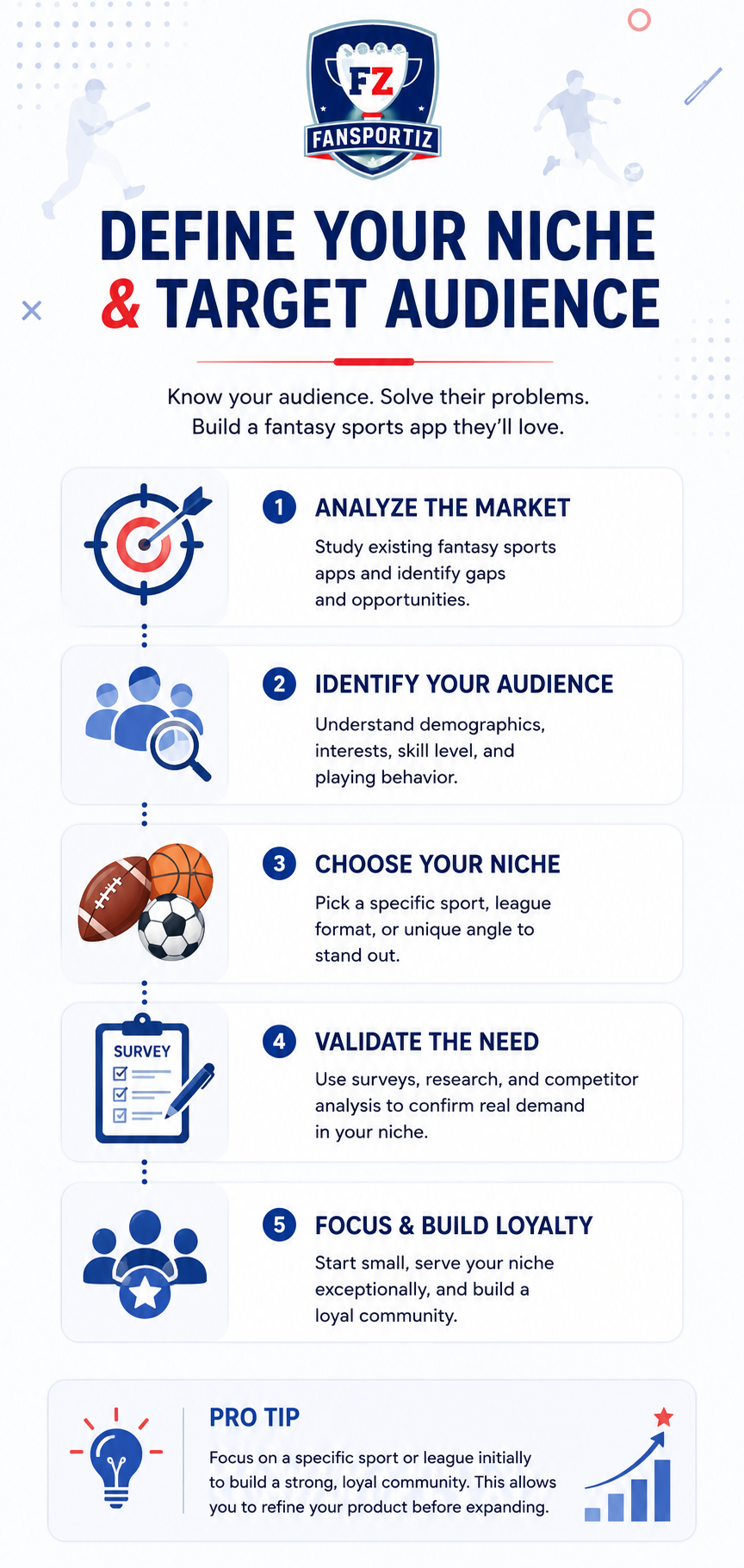
Before you even begin to develop an app like Fantrax, the first real decision happens outside of code and design. It is about understanding exactly who you are building for and what space you want to own in the fantasy sports world.
This step is less about technology and more about clarity.
“If you try to build for everyone, you often end up connecting with no one.”
Where the process starts
You begin by looking at the fantasy sports landscape and asking a simple question:
- Do I want to focus on a single sport
- Or do I want to build a multi sport platform
This decision shapes everything that follows, from features to user experience.
For example, some businesses exploring fantasy football app development focus deeply on football audiences because user behavior and engagement patterns are easier to understand when the niche is narrow.
Understanding your audience
Once the sport direction is clear, the next layer is identifying who your users actually are.
You can break this down into key segments:
- Casual players who prefer simple gameplay and quick participation
- Intermediate users who enjoy competition but not too much complexity
- Hardcore fantasy enthusiasts who expect advanced analytics, live stats, and real time insights
Along with experience level, you also need to consider:
- Age group
- Geographic region
- Level of fantasy sports involvement
Each of these directly affects how your app should feel and function.
Market validation before building
At this stage, assumptions are not enough. You need to validate your direction through real input.
Common methods include:
- Running user surveys
- Studying competitor audiences
- Analyzing gaps in existing fantasy platforms
This is where you start noticing patterns, such as:
- Users wanting simpler league formats
- Interest in more specialized or less common sports
- Demand for deeper analytics in certain user groups
A simple way to think about it
| Focus Area | What you decide | Why it matters |
|---|---|---|
| Sport selection | Single sport or multi sport | Defines product complexity |
| Audience type | Casual vs hardcore users | Shapes feature depth |
| Market gap | What is missing today | Creates differentiation |
Common mistake to avoid
A frequent mistake at this stage is trying to serve too many types of users at once. When that happens, the product becomes unclear and loses direction. Another mistake is ignoring smaller niche markets that can actually provide a very loyal early user base.
Pro tip
Start narrow, not wide.
Focus on a specific sport or league first, build a strong and loyal community around it, and then expand gradually once your product is stable and well understood by your users.
Step 2: Outline Core Features and User Experience
Once you have a clear understanding of your audience, the next step naturally shifts toward what your app will actually offer them and how they will experience it. This is where your idea starts taking a more practical shape, because features and user experience together define how people feel while using your platform.
To develop an app like Fantrax, you need to balance two things at the same time: functionality that delivers value and an experience that feels smooth and engaging.
“Users may forgive missing features, but they rarely forgive a confusing experience.”
Start with MVP level core features
At the beginning, the focus should always be on must have features that form the foundation of your platform. These are the elements that allow your app to function as a complete fantasy sports experience.
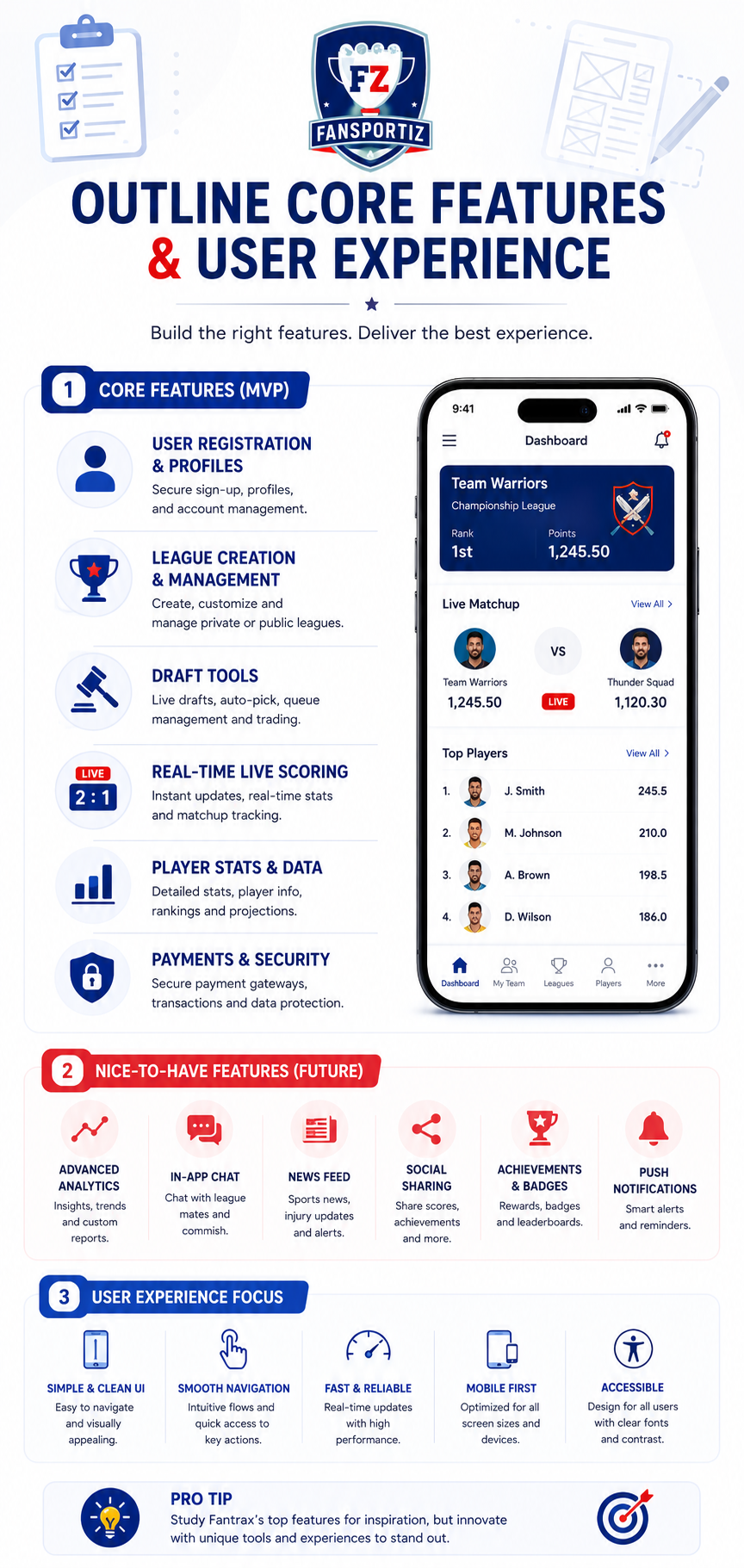
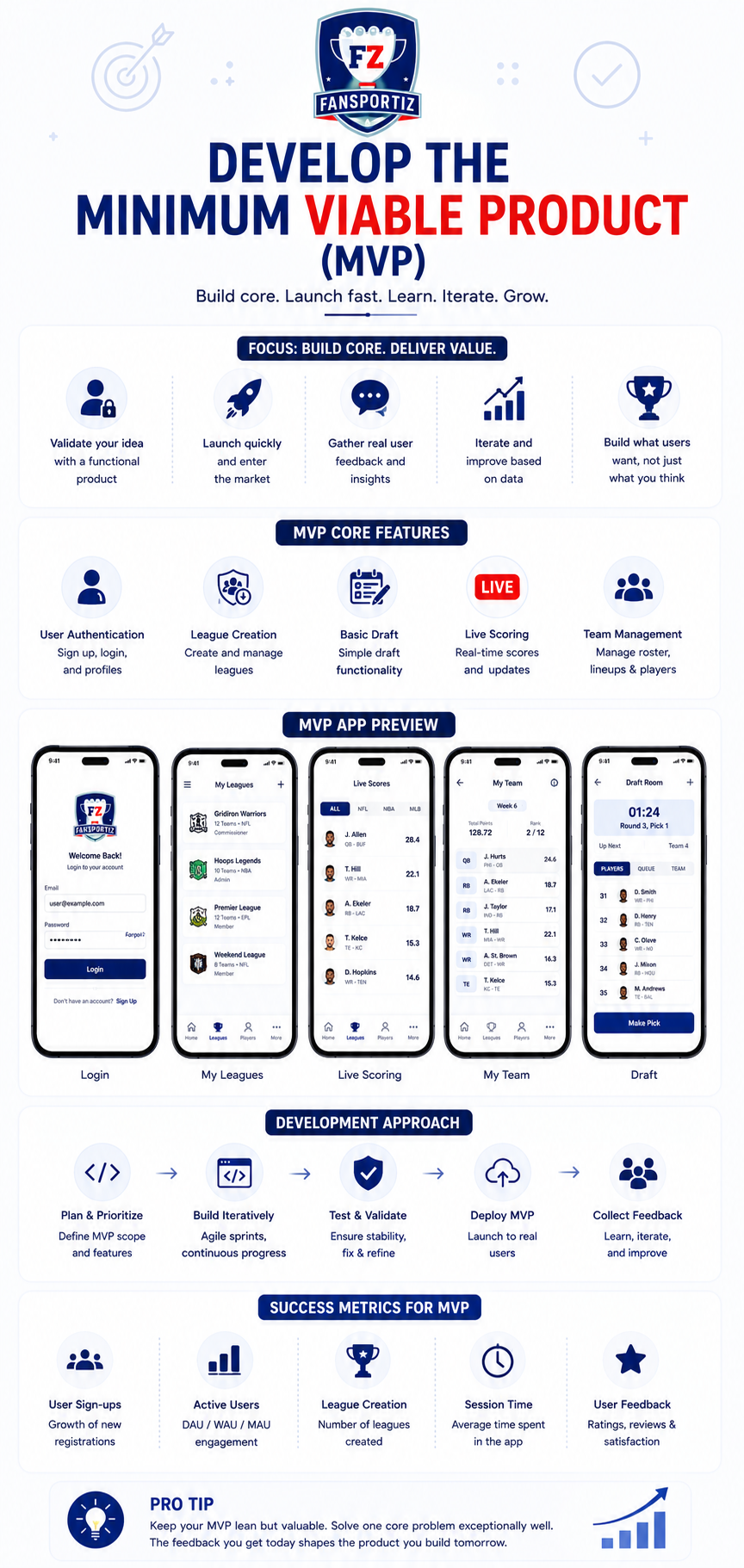
Core MVP features include:
- User registration and profile creation
- League creation and league management
- Draft tools for team selection
- Real time live scoring updates
- Player statistics and performance data
- Secure payment gateway integration
These features represent the minimum structure required to run a functional fantasy sports app.
Fantrax style flexibility factor
One important thing to understand is that platforms like Fantrax are not just feature rich, they are highly flexible.
So while building your app, you should also think about:
- Custom league settings
- Adjustable scoring systems
- User controlled game formats
This level of flexibility is what keeps advanced users engaged over time.
Future enhancements (do not overload early)
After defining your MVP, the next step is to identify features that can be added later as your product evolves.
Nice to have features include:
- Advanced analytics dashboards
- In app chat or messaging
- Social sharing features
- Sports news and updates feed
These are valuable, but they should not slow down your initial development phase.
UX design approach
Alongside features, user experience plays a major role in retention. This is where wireframes and user flows become important.
A simple way to structure UX planning is:
- Map the user journey from login to team creation
- Simplify navigation between leagues, stats, and drafts
- Ensure key actions like joining a league or checking scores are easy to access
The goal is to avoid clutter and keep interactions smooth, especially during high activity moments like live matches.
Common mistake to avoid
One of the most common mistakes at this stage is trying to include too many features in the first version. This often leads to:
- Cluttered interface
- Slower development cycles
- Confusing user experience
A better approach is to build a clean MVP first, then expand gradually based on real user feedback.
Pro tip
Use Fantrax as a reference point for understanding what works, but do not replicate it blindly. Instead, identify its strongest features and think about how you can introduce a small but meaningful innovation that gives your app its own identity.
Step 3: Select a Robust Technology Stack and Data APIs
Step 3: Select a Robust Technology Stack and Data APIs
Once your features and user experience are defined, the next step quietly becomes one of the most important decisions in the entire journey. This is where you decide what your app is actually built on, and how it will handle real users, real traffic, and real time sports activity.
To develop an app like Fantrax, your technology stack is not just a backend choice. It directly influences speed, stability, and how well your platform performs when thousands of users are active at the same time.
“A fantasy sports app is only as strong as the system handling its live data.”
Backend foundation
The backend is where most of the heavy lifting happens. It manages users, leagues, scoring logic, and real time updates.
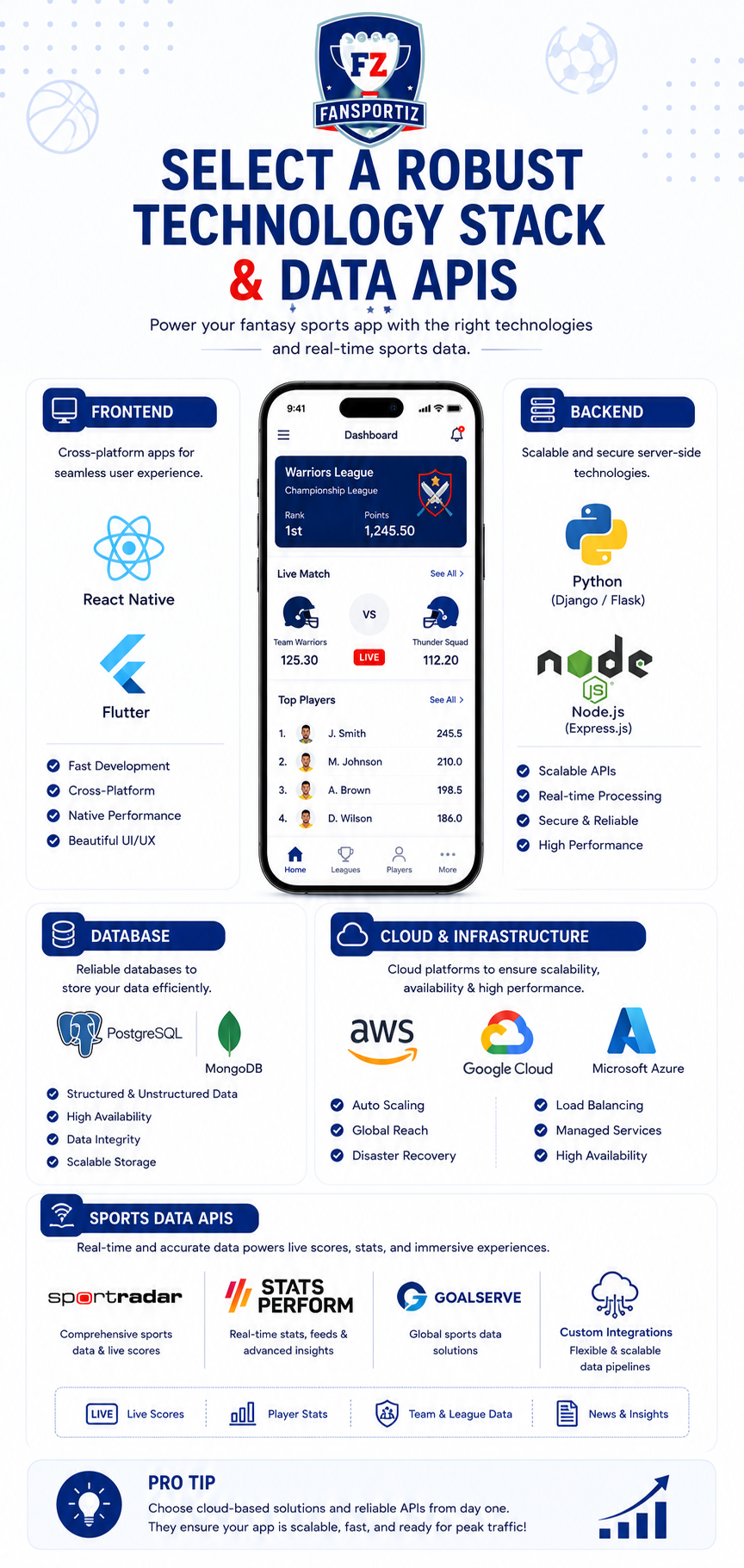
Common choices include:
- Python with Django or Flask
- Node.js with Express.js
Both are widely used because they support scalability and have strong ecosystems that make development faster and more reliable.
Frontend development approach
On the user side, the focus is on creating a smooth and consistent experience across devices. Since most fantasy users access apps on mobile, cross platform development is often preferred.
Popular options include:
- React Native
- Flutter
These allow you to build once and deploy across multiple platforms, which helps reduce development time without sacrificing usability.
Database selection
Your database decides how efficiently your app stores and retrieves information, especially during live match updates.
You typically choose based on data structure:
- PostgreSQL for structured data like users, leagues, and transactions
- MongoDB for flexible or rapidly changing data like live stats and activity logs
The key is not just storing data, but ensuring it can be accessed quickly during peak usage.
Sports data API integration
This is one of the most critical parts of a fantasy sports app because everything depends on accurate and real time data.
You need to integrate reliable providers such as:
- Sportradar
- Stats Perform
- GoalServe
When evaluating APIs, focus on:
- Data accuracy
- Real time delivery speed
- Coverage of your target sports
- System uptime reliability
A weak API choice can directly affect user trust because even small delays or incorrect scores can impact the entire experience.
Common mistake to avoid
A frequent issue at this stage is underestimating how much real time data your app will process. When user activity increases during live matches, poor architecture can quickly lead to:
- Slow updates
- System bottlenecks
- Performance drops
This is often discovered too late if scalability is not planned early.
Pro tip
Use cloud based infrastructure from the beginning instead of treating it as a later upgrade. Platforms like AWS, Google Cloud Platform, or Microsoft Azure provide:
- Scalable computing power
- Managed services for easier maintenance
- Global infrastructure for better performance during peak traffic
This ensures your app remains stable even during high intensity match periods when user activity spikes suddenly.
Step 4: Design the UI/UX for Engagement
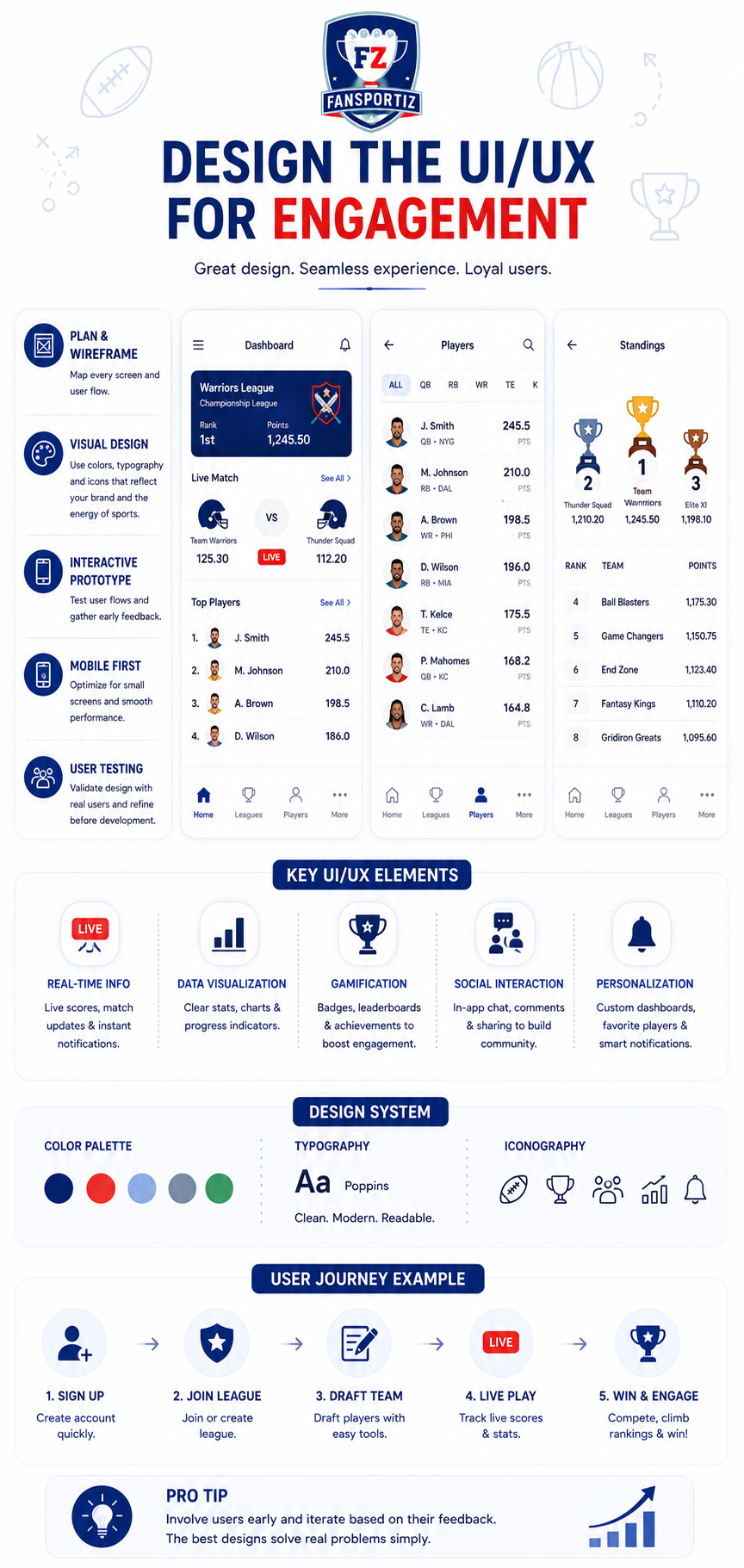
After the structure and technology are in place, the next layer is where your app starts to feel real to the user. This is the stage where design is no longer just about visuals, but about how comfortably someone can move through your app without thinking too much.
To develop an app like Fantrax, UI and UX work together as one system. The UI makes it visually appealing, while UX ensures it actually feels effortless to use.
“Good design is when users stop noticing the interface and just enjoy the experience.”
Start with wireframes before anything else
Before colors, branding, or styling, the first step is to map the structure.
You begin by creating wireframes and mockups that define:
- Every screen in the app
- How users move from one screen to another
- Where key information appears
At this stage, the focus is purely on clarity, not aesthetics.
Prioritize what users need most
In fantasy sports apps, users constantly look for live updates and competitive information. That means your layout should always make the most important data easy to find.
Core elements that should always be visible or easy to access:
- Live scores
- Player statistics
- League standings
If users have to search for these repeatedly, engagement drops quickly.
Build a design identity
Once structure is clear, you move into visual design. This includes:
- Color palette selection
- Typography style
- Icon design system
The goal is to match the energy of sports while still keeping the interface clean and readable. A strong visual identity also helps your app feel more memorable over time.
Add interaction through prototypes
Instead of jumping directly into development, interactive prototypes help simulate real usage. This allows you to:
- Test user journeys step by step
- Identify friction points early
- Validate whether navigation feels natural
This phase often reveals issues that are not obvious in static designs.
Engagement through gamification
To keep users active, engagement elements can be integrated into the experience.
Some commonly used elements include:
- Badges for achievements
- Leaderboards for competition tracking
- Personalized notifications for updates and events
These features help create a sense of progress and community rather than just passive usage.
Common design mistake to avoid
A frequent issue is overloading the interface with too many elements at once. When everything is highlighted, nothing feels important. Another mistake is inconsistent design patterns, which can confuse users and reduce trust in the app experience.
Pro tip
Introduce a small group of real users during the design phase itself. Let them interact with prototypes and observe how they behave. This early feedback loop often reveals usability issues that would otherwise become expensive to fix later in development.
Step 5: Develop the Minimum Viable Product (MVP)
Step 6: Implement Monetization Strategies
Once your MVP is stable and users are actually engaging with the platform, the next natural question becomes how the app will sustain itself in the long run. This is where monetization is introduced, but it needs to feel like a natural extension of the experience, not something forced into it.
To develop an app like Fantrax, monetization is not about choosing one method. It is about combining different revenue streams in a way that fits user behavior.
“The best monetization strategy is the one users accept without feeling interrupted.”
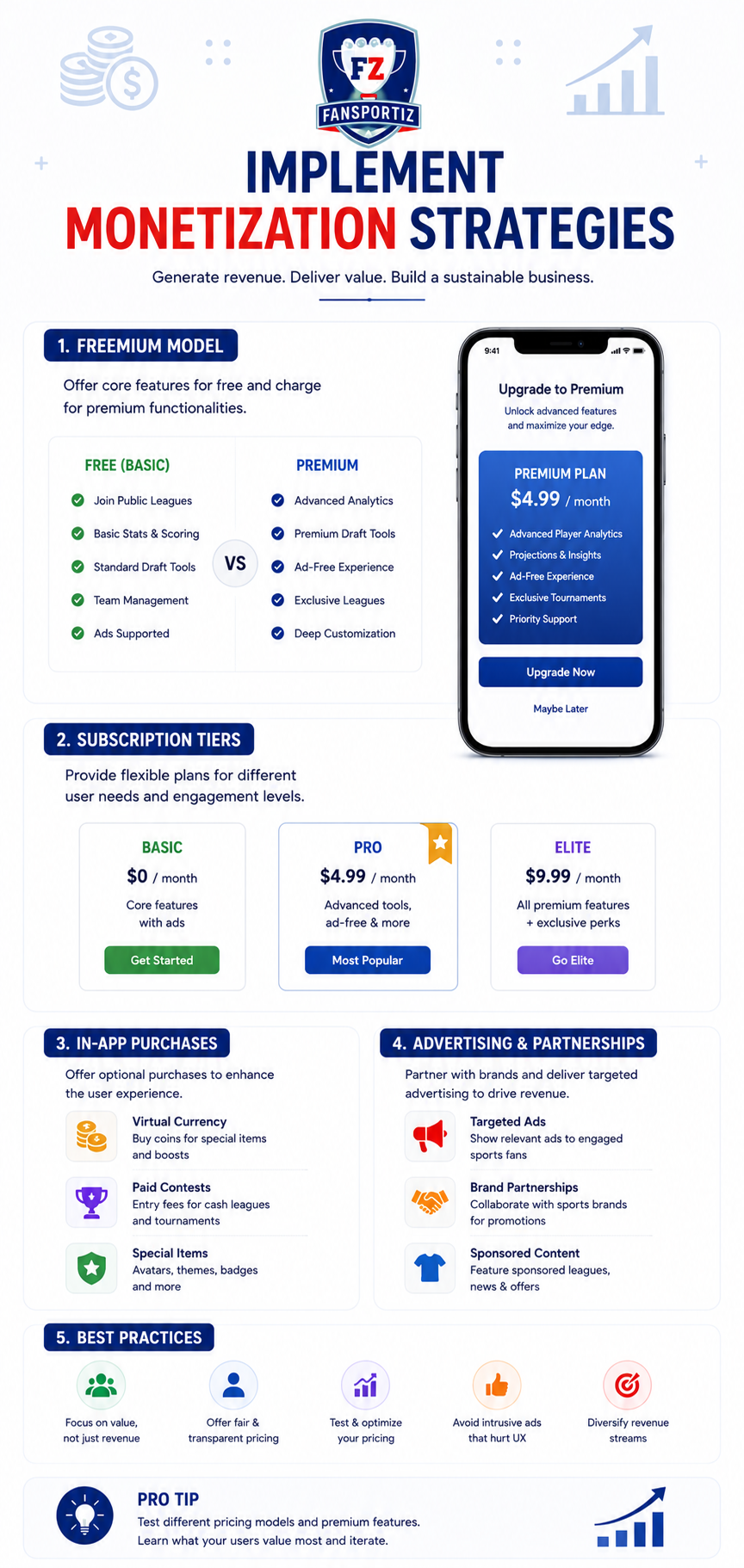
Start with a freemium foundation
Most successful fantasy platforms begin with a freemium model because it lowers the barrier to entry while still creating room for revenue later.
Typical structure:
- Free access to core fantasy features
- Paid access for advanced tools and enhancements
Premium offerings can include:
- Advanced player analytics
- Ad free experience
- Access to exclusive leagues
- Customization options for deeper control
This model works because users can first experience value before making any financial commitment.
Subscription based tiers
Instead of offering everything in a single premium plan, many platforms use tiered subscriptions to match different user types.
| Tier | What users get |
|---|---|
| Basic | Core gameplay experience |
| Standard | Extra analytics and features |
| Premium | Full access including advanced tools and exclusives |
This structure allows users to choose based on how deeply they engage with fantasy sports.
In app purchases and contest based revenue
Another common approach is in app purchases, which can include:
- Virtual currency systems
- Entry fees for paid contests or tournaments
- Special in game items or upgrades
This works particularly well for users who prefer flexible, usage based spending rather than subscriptions.
Advertising and brand partnerships
Advertising can also become a steady revenue stream if handled carefully. Instead of overwhelming users with ads, the focus should be on relevance and balance.
Common options include:
- Targeted in app ads
- Sponsored content or leagues
- Partnerships with sports related brands
The key is to ensure monetization does not disrupt the user experience.
Common mistake to avoid
A major mistake at this stage is depending on only one revenue source. Another is introducing aggressive monetization too early, which can reduce user trust and retention.
Pro tip
Spend time understanding what your users are actually willing to pay for instead of guessing.
A practical approach is to:
- Test different pricing models
- Run A B experiments on premium features
- Analyze conversion behavior of engaged users
This helps you fine tune monetization so it aligns with real user expectations rather than assumptions.
Step 7: Rigorous Testing and Quality Assurance
Before your fantasy sports app goes live, this is the stage where everything is quietly put under pressure. It is not about adding new features anymore. It is about making sure nothing breaks when real users start using the platform in unpredictable ways.
To develop an app like Fantrax, testing is not a final checkbox. It is more like a filter that decides whether your product is truly ready for the real world.
“A fantasy app is only as strong as its worst bug during a live match.”
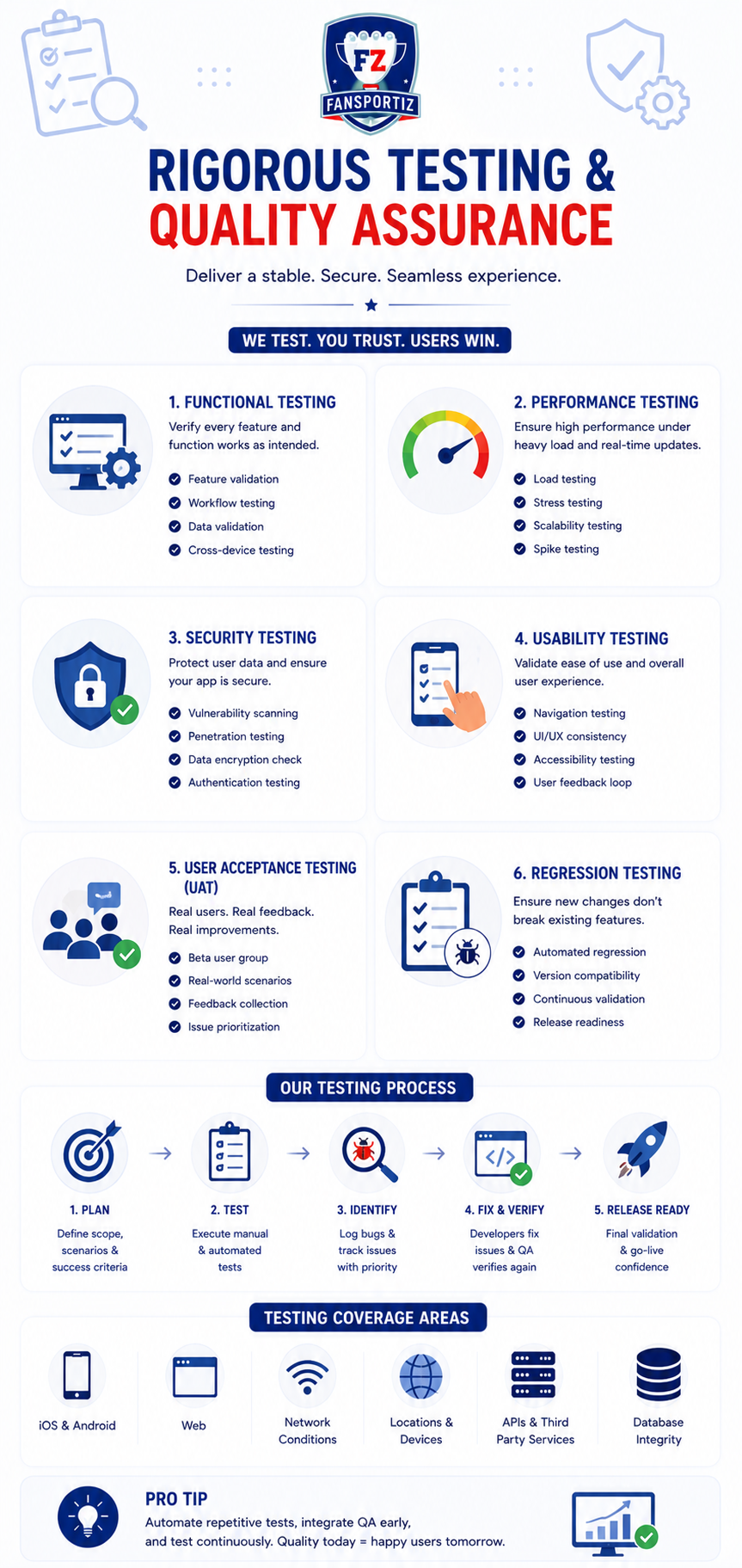
Start with functional testing
The first step is to make sure every feature behaves exactly the way it was designed.
This includes checking:
- User registration and login flows
- League creation and management
- Draft functionality
- Live scoring updates
- Payment and transaction flows
Each feature is tested individually to ensure it works in isolation before checking how everything connects together.
Performance testing under real pressure
Fantasy sports apps are heavily dependent on timing, especially during live games. This is where performance testing becomes critical.
Key areas to test:
- Load testing for high user traffic
- Stress testing during peak match hours
- Response time for live score updates
The goal is simple: the app should remain stable even when thousands or millions of users are active at the same time.
Security testing for user trust
Since the app handles user data and possibly payments, security testing is a non negotiable step.
This involves checking:
- Data protection mechanisms
- Vulnerability points in the system
- Unauthorized access risks
A single security flaw can damage user trust far more than a minor UI bug.
User Acceptance Testing (UAT)
Once internal testing is complete, the next step is to bring real users into the process.
A beta testing group is used to:
- Explore the app in real conditions
- Report usability issues
- Share feedback on overall experience
This stage often reveals issues that internal teams miss because real users behave differently than testers.
Common mistake to avoid
One of the biggest mistakes at this stage is rushing testing just to meet a launch deadline. Skipping or shortening QA often results in:
- Bugs appearing during live usage
- Poor user reviews at launch
- Loss of early user trust
Fixing these issues after launch is always harder than preventing them early.
Pro tip
Introduce automated testing for repetitive and predictable test cases.
This helps by:
- Reducing manual workload
- Increasing test coverage
- Allowing QA teams to focus on complex edge cases
Automation does not replace manual testing, but it makes the entire QA process faster and more reliable.
Step 8: Launch, Market, and Iterate
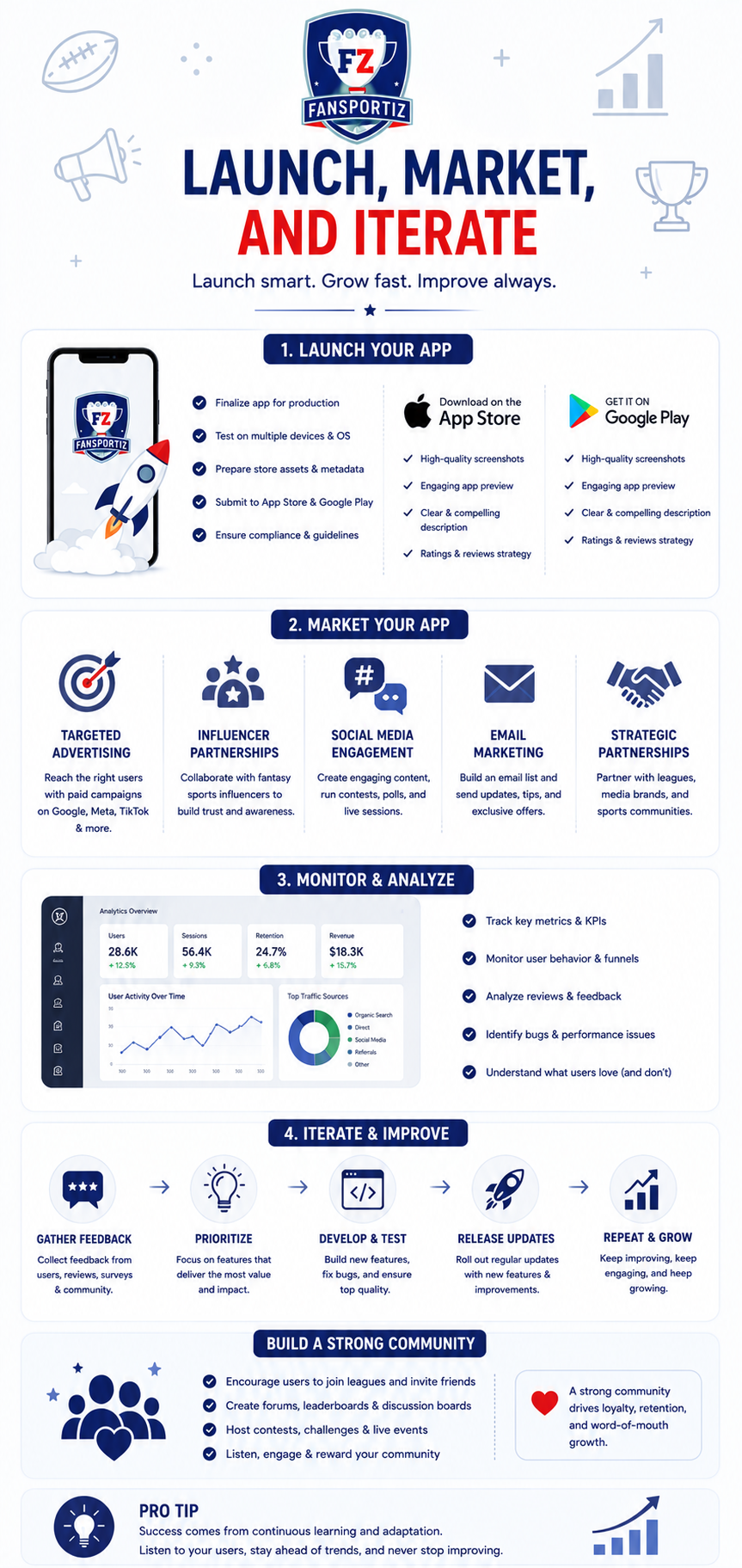
This is the moment where everything you have built finally steps out into the real world. After all the planning, design, development, and testing, the launch is not an ending, it is the first time your app actually meets real users at scale.
To develop an app like Fantrax, this stage is less about finishing the product and more about starting a continuous cycle of learning, improving, and growing.
“A launch does not prove your app is complete. It proves your assumptions are ready to be tested.”
Preparing for launch
Before going live, the first step is getting your app ready for distribution on major platforms like:
- Apple App Store
- Google Play Store
This is where App Store Optimization becomes important because visibility directly impacts downloads.
Key ASO elements include:
- Keyword optimized app title and description
- Clear and attractive screenshots
- Engaging preview visuals or videos
These elements help users understand your app before they even install it.
Marketing the launch
Once the app is ready, the focus shifts to attracting users and building awareness.
A structured marketing approach usually includes:
- Social media campaigns across relevant platforms
- Collaborations with fantasy sports influencers
- Targeted digital advertising campaigns
Each channel plays a different role, from building excitement to driving direct installs.
What happens after launch
After the app goes live, the real learning begins. At this stage, everything depends on how users interact with your platform in real conditions.
You need to continuously monitor:
- User analytics and behavior patterns
- Feedback from reviews and support channels
- Performance issues or bottlenecks
This data becomes the foundation for your next improvements.
Iteration and continuous improvement
A successful fantasy sports app evolves constantly. Based on real usage, you should plan regular updates that include:
- Bug fixes
- Performance improvements
- New feature additions
Ignoring feedback or delaying updates can quickly lead to declining user engagement, even if the initial launch is strong.
Common mistake to avoid
One of the most common mistakes at this stage is treating launch as the final milestone. In reality, an app that is not actively updated or improved slowly loses relevance in a competitive market.
Pro tip
Build a community around your app early and keep it active even after launch.
Encourage users to:
- Share feedback regularly
- Participate in discussions or forums
- Engage with updates and announcements
This creates a feedback loop where users feel involved, and you gain constant insight into what should be improved next.
Tips for Success
Building a fantasy sports app is one thing, but sustaining it in a competitive market is where the real challenge begins. Once your platform is live, success depends less on what you initially built and more on how quickly you adapt to users, trends, and technology shifts.
To develop an app like Fantrax and actually make it stand out, you need to treat it as a constantly evolving product rather than a finished release.
“In fantasy sports, the strongest apps are not the ones that launch perfectly, but the ones that keep improving faster than their users expect.”
1. Keep user feedback at the center
User feedback is not just support data, it is your product roadmap in disguise. The more you listen, the clearer your next steps become.
Focus on:
- Reviews and ratings patterns
- Feature requests from active users
- Drop off points in user journeys
- Complaints about usability or performance
A simple way teams often structure this is:
| Feedback Source | What it tells you |
|---|---|
| App reviews | Overall satisfaction |
| In app behavior | Real usage problems |
| Surveys | Direct expectations |
2. Stay aligned with sports and tech trends
Fantasy sports apps live at the intersection of sports culture and technology. If either one shifts, your product needs to adjust with it.
You should consistently track:
- Changing sports seasons and formats
- Emerging user engagement patterns
- New technology capabilities that improve experience
Staying updated ensures your app does not feel outdated even if it is technically stable.
3. Use smart shortcuts to speed up development
Not everything needs to be built from scratch. One of the smartest ways to move faster is by using pre built modules for common systems like:
- User authentication
- Payment processing
- Notification systems
This allows your team to focus more on the unique parts of your product instead of reinventing basic infrastructure.
4. Work with experienced teams when needed
Fantasy sports platforms can become complex quickly, especially when scaling or adding advanced features. Working with experienced developers or specialized teams can reduce trial and error and improve execution speed.
They often bring:
- Better architecture decisions
- Faster implementation cycles
- Reduced risk in scaling systems
5. Build around what actually differentiates you
At a strategic level, the strongest apps are not the ones with the most features, but the ones with the right differentiators.
Key areas to focus on:
- Community driven features that keep users engaged
- AI powered insights for predictions and personalization
- Features that make users feel more involved in the game
These elements help your app stand out in a crowded market instead of blending in.
Final thought
Success in fantasy sports is not a single milestone. It is a continuous loop of listening, improving, and evolving with your users and the sports ecosystem.
Troubleshooting Common Issues
Even after careful planning and development, fantasy sports apps often reveal their real challenges only when real users start interacting with them at scale. This is completely normal, especially in a system that depends heavily on real time data and peak traffic events.
What matters most is not avoiding issues completely, but knowing how to respond quickly and effectively when they appear.
Problem 1: Slow Performance During Peak Times
This is one of the most common issues in fantasy sports platforms, especially during live matches when thousands of users are active at the same time.
When users experience lag or delayed updates, it directly affects their trust and engagement.
Solution approach:
- Optimize database queries so the system is not overloaded unnecessarily
- Implement caching mechanisms for frequently accessed data
- Use CDNs to deliver static assets faster across regions
- Ensure your infrastructure can scale automatically during traffic spikes
In simple terms, the goal is to make sure the system does not slow down just because more users are joining at the same time.
Problem 2: Inaccurate or Delayed Live Scoring Data
In fantasy sports, even a small delay or incorrect score can completely change user experience. This makes data accuracy one of the most sensitive areas of the entire system.
Solution approach:
- Check the reliability and update frequency of your sports data APIs
- Add proper error handling for failed or delayed data feeds
- Introduce fallback mechanisms to avoid complete data breakdown
- Use multiple API sources for cross verification when possible
This ensures that even if one data source fails or lags, the system continues to provide reliable updates.
Problem 3: Low User Engagement Post Launch
It is common to see strong initial downloads followed by a drop in user activity if engagement is not continuously nurtured.
Solution approach:
- Analyze user behavior to identify where users are dropping off
- Introduce new contests or interactive challenges
- Improve UI and UX based on real feedback
- Strengthen social features to encourage interaction between users
The focus here is to understand why users are leaving and then actively redesign parts of the experience to bring them back.
Final perspective
Most issues in fantasy sports apps fall into three core areas:
- Performance under load
- Accuracy of live data
- Long term user engagement
If these three are continuously monitored and improved, the platform remains stable even as it scales and evolves over time.
Conclusion
Developing an app like Fantrax is not a small task, but when you break it down into structured steps, it becomes a very achievable journey. What starts as an idea gradually turns into a complete product when each phase is handled with clarity and purpose.
Across this guide, the process has been shaped around a simple progression. First, you understand your audience and define the niche. Then you move into feature planning, followed by choosing the right technology, designing for engagement, and building a strong monetization approach. Each step builds on the previous one, and skipping any part usually creates challenges later.
If we look at the bigger picture, the most important takeaway is consistency between planning and execution.
| Phase | Focus |
|---|---|
| Discovery | Audience and niche clarity |
| Planning | Features and user experience |
| Engineering | Technology and architecture |
| Product build | MVP development and testing |
| Growth | Monetization and scaling |
A strong approach always begins with an MVP, followed by rigorous testing and continuous iteration based on real user behavior. That is what turns a basic product into a competitive platform.
The fantasy sports industry itself continues to grow, which means opportunities are still expanding for well built, user focused platforms. Apps that succeed are usually the ones that stay simple at the start, listen closely to users, and evolve steadily over time.
“A fantasy sports app does not win at launch, it wins through everything that happens after launch.”
If you are serious about turning this idea into reality, working with an experienced Fantasy Sports App Development Company can help you avoid early mistakes and speed up the path from concept to a stable, scalable product.
FAQs
1. How long does it typically take to develop an app like Fantrax?
Developing an app like Fantrax can vary significantly in duration, primarily depending on the scope of features and the development team’s size. A Minimum Viable Product (MVP) with core functionalities might take 1–2 months. A full-fledged platform with advanced features, extensive customization, and robust scalability could extend to 3–4 months or even longer. Factors like real-time data integration, complex league management, and cross-platform compatibility all influence the timeline.
2. What are the essential features I need to develop an app like Fantrax for an MVP?
To develop an app like Fantrax as an MVP, focus on core functionalities that deliver immediate value. These typically include user registration and profiles, league creation and management, basic draft tools, real-time live scoring, comprehensive player statistics, and secure payment gateways. Prioritizing these “must-have” features allows for a quicker launch, enabling you to gather user feedback and iterate effectively before investing in advanced functionalities.
3. How much does it cost to develop an app like Fantrax?
The cost to develop an app like Fantrax can range widely, typically from $10,000 for a basic MVP to over $250,000 for a feature-rich, scalable platform. This variation depends on factors such as the complexity of features, choice of technology stack, number of supported sports, development team’s location and expertise, and the platforms (iOS, Android, Web) you target. Investing in a detailed discovery phase can help provide a more accurate estimate for your specific project.
4. What technology stack is recommended to develop an app like Fantrax for scalability?
For building a scalable app like Fantrax, a robust technology stack is crucial. For the backend, Python (Django/Flask) or Node.js (Express.js) are excellent choices due to their performance and extensive ecosystems. Front-end development can leverage React Native or Flutter for efficient cross-platform compatibility. PostgreSQL or MongoDB are popular database options, while cloud providers like AWS, Google Cloud Platform, or Microsoft Azure offer scalable infrastructure and managed services essential for handling peak user loads.
5. How can I ensure my fantasy sports app stands out in a competitive market?
To make your fantasy sports app stand out, focus on differentiation. This could involve targeting a specific niche (e.g., a less common sport or unique league format), offering unparalleled customization options, integrating innovative features like AI-driven analytics or predictive insights, or building a strong, engaged community through social features and gamification. Continuous iteration based on user feedback and staying ahead of sports trends are also vital.
6. What are the primary monetization strategies for a fantasy sports app?
Effective monetization strategies for a fantasy sports app often include a freemium model, where basic features are free, and premium features (e.g., advanced analytics, ad-free experience, exclusive leagues) are paid. Subscription tiers, in-app purchases for virtual currency or contest entries, and partnerships with sports brands for targeted advertising or sponsored content are also popular and successful revenue streams. Diversifying your monetization approach can enhance long-term sustainability.
7. Why is real-time data integration so critical for a fantasy sports app?
Real-time data integration is paramount for a fantasy sports app because users expect immediate updates on live scores, player statistics, and league standings. Accurate and instantaneous data feeds from reliable sports APIs (like Sportradar or Stats Perform) ensure that users can make informed decisions, track their teams, and engage actively during games. Delays or inaccuracies can severely impact user experience and trust, leading to disengagement.
8. What role does UI/UX design play in user retention for fantasy sports apps?
UI/UX design is critical for user retention in fantasy sports apps. An intuitive, clean, and visually appealing interface ensures users can easily navigate, find information, and enjoy their experience. A well-designed UX minimizes frustration, makes complex features accessible, and encourages repeated use. Incorporating gamification elements, personalized dashboards, and responsive design for mobile devices further enhances engagement and keeps users coming back.
9. How important is rigorous testing before launching a fantasy sports app?
Rigorous testing and quality assurance are non-negotiable before launching a fantasy sports app. Comprehensive functional, performance, security, and user acceptance testing (UAT) ensure the app is stable, reliable, and bug-free. Given the high concurrency during live games and drafts, performance testing is especially crucial. A thorough testing phase prevents a buggy launch, which can lead to negative reviews, user churn, and damage to your brand reputation.
10. What are common challenges faced during fantasy sports app development?
Common challenges in fantasy sports app development include managing vast amounts of real-time data, ensuring high scalability to handle peak traffic, maintaining robust security for user data and transactions, and navigating complex legal and regulatory landscapes (especially concerning paid contests). Additionally, fostering strong user engagement in a competitive market and continuously updating the app with new features and trends can also be significant hurdles.
