
Published on - Sep 22nd, 2026
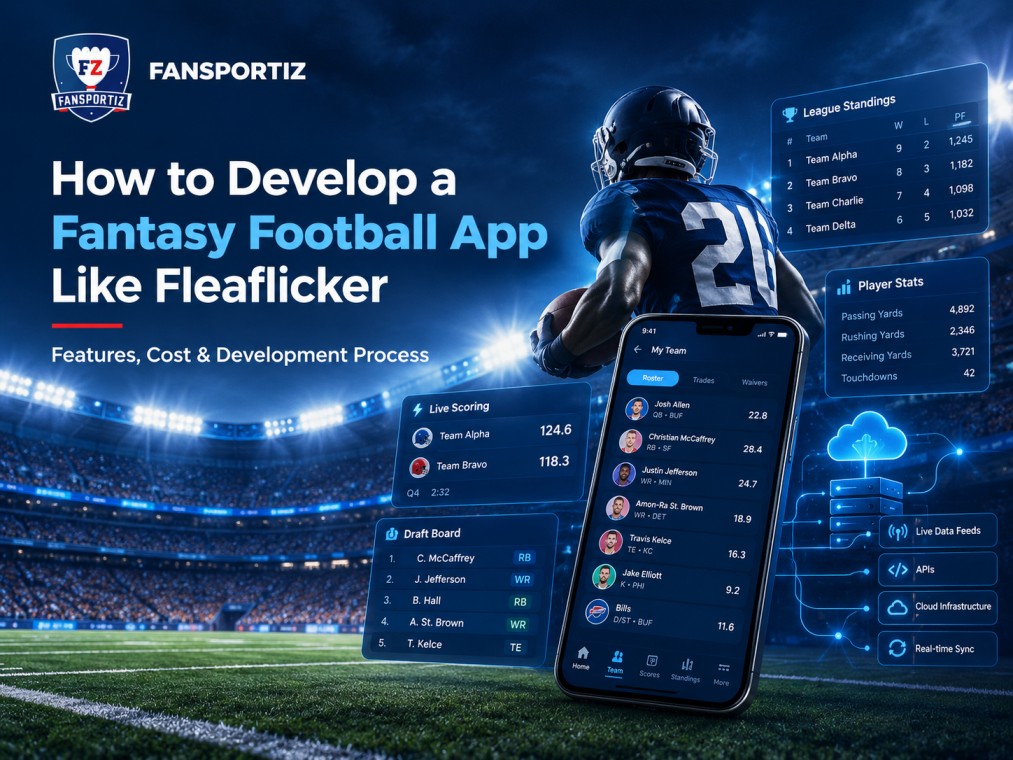
Why Develop a Fantasy Football App Like Fleaflicker?
Ask anyone who runs a fantasy football league and they will tell you the same thing. It stopped being a case of picking a few NFL players and checking the score once on Sunday a long time ago. Today it is drafts, waivers, trades, custom scoring, live stats ticking over play-by-play, league trash talk, playoffs, dynasty keepers, and a commissioner quietly holding the whole thing together. For a growing number of people, it has become a year-round ritual rather than a weekly one.
That shift is exactly why fantasy football is such fertile ground for product builders. The audience is enormous and loyal. According to the Fantasy Sports and Gaming Association, roughly 57 million people played fantasy sports across the U.S. and Canada in the past year, and gridiron football is the single most popular format, played by around 78 percent of participants. Platforms like Fleaflicker, which has hosted leagues since the 2005 NFL season, have set the bar for what good really looks like.
Here is the catch. Building something like Fleaflicker is not about copying the buttons you can see. Under the hood you need an architecture that can juggle live sports-data feeds, scoring calculations, configurable league rules, transactions, and real-time updates without falling over on game day. That is where a specialist fantasy sports app development company like FanSportiz earns its keep, turning a product idea into something that actually holds up under a Sunday-afternoon traffic spike.
Fleaflicker at a Glance
| Metric | Current published figure |
|---|---|
| Operating since | 2005 |
| League size | 4 to 24 teams |
| Scoring rules | 137 |
| Keepers per team | Up to 40 |
| Live scoring | Up to the second |
| Platforms | Web, iOS, Android |
Sources: Fleaflicker Commissioner page, Wikipedia
What Is a Fleaflicker-Style Fantasy Football App?
Strip away the sports theme and what you have is a digital league-management ecosystem. It is the software that runs an entire competitive community across a whole season.
Practically, that means it has to handle league creation, player drafts, roster management, live scoring, waivers, free agency, trades, playoffs, dynasty and keeper formats, commissioner controls, and league communication, all of them talking to each other. Change one thing and three others react.
It also has to flex. Fleaflicker supports three major formats — head-to-head, total points, and roto — and league sizes from 4 to 24 teams, including odd-numbered ones. A ten-person redraft league and a 24-team dynasty behemoth are wildly different animals, yet the same product has to serve both.
And that is precisely why fantasy football app development is a very different job from building a simple sports scoreboard. A scoreboard reports what happened. A fantasy platform interprets what happened against a set of rules that every league writes for itself.
How Does a Fantasy Football App Like Fleaflicker Work?
Follow a single user through a season and the flow looks like this. They register, create or join a league, configure the rules, draft, build a roster, set a weekly lineup, track live scores, make transactions, reach the playoffs, and then do it all over again next season.
To make it concrete, look at a standard fantasy football roster: 1 QB, 1 RB, 2 WR, 1 TE, a flex, 1 K, 1 D/ST, and a bench, with dedicated slots for injured reserve and taxi-squad players layered on top. That is the default. Fleaflicker lets commissioners bend almost all of it, and real leagues run everything from 13-starter superflex setups to deep dynasty rosters stretching past 25 spots.
Here is the part developers need to take to heart. Every action changes persistent, shared data. When an owner swaps a running back into their starting lineup, that is not a cosmetic screen event. It touches roster state, position eligibility, live scoring, transaction history, and possibly the outcome of that week’s matchup. Multiply that across thousands of concurrent users on a Sunday and you start to see why the architecture matters even more than the interface.
Key Features to Include in Fantasy Football App Development
This is the heart of the build. Get these right and you have a product. Get them mostly right and users will notice within a week.
User registration and profiles
Email and social sign-in, a profile, a team name and logo, notification preferences, and account settings. It sounds routine, but account and invitation management is genuinely core here. Fleaflicker requires users to have accounts before joining private leagues, which makes invitations, permissions, and onboarding first-class features rather than afterthoughts.
League creation and customisation
Commissioners need to configure league size, scoring, rosters, draft rules, waivers, trade rules, playoffs, and tiebreakers. Fleaflicker supports 4 to 24 owners and advertises 137 scoring rules, everything from yards after catch to tackles for loss. The engineering lesson writes itself: build a rules engine, not a hundred hard-coded league templates. The moment you start special-casing formats, you have already lost.
Fantasy draft system
Live drafts, a draft timer, a draft queue, commissioner overrides, draft history, offline and imported drafts, and draft-pick trading. Fleaflicker’s live draft timer can be set anywhere from 30 seconds up to 15 minutes per pick, and it supports live, email, and offline draft styles. Technically this is the trickiest room in the house — real-time, concurrent, and unforgiving. WebSockets, race-condition handling, and clean conflict resolution when two things happen at once are non-negotiable. Fleaflicker itself famously rebuilt its draft room away from an old Java browser plugin into a modern web-based experience precisely because the real-time draft moment is so make-or-break.
Live scoring
This one deserves its own spotlight. Live player stats, fantasy point calculation, matchup updates, a scoreboard, box scores, and, crucially, stat corrections. Fleaflicker promotes up-to-the-second live scoring across rosters, free-agent listings, scoreboards, and box scores. The blunt truth is that if your scoring engine is even slightly slow or slightly wrong, users spot it instantly and trust evaporates. Nobody forgives a fantasy app that tells them they lost when they actually won.
Waivers and free agency
Waiver priority, FAAB (free-agent acquisition budget) bidding, free-agent pickups, waiver processing, transaction history, and transaction limits. Real leagues configure these very differently — one public Fleaflicker league might run a 24-hour waiver period with a weekly priority reset, while another will not. The takeaway is to let commissioners set these values themselves. Do not force one waiver philosophy on every league on your platform.
Trading
Player-for-player trades, future draft-pick trades, multi-team blockbusters, trade review windows, commissioner intervention, and a trade history. Fleaflicker supports multi-team trades and future draft-pick trading, which is table stakes for any serious dynasty crowd.
Dynasty and keeper leagues
Keepers, future picks, taxi squads, multi-season history, and long-term player ownership. Fleaflicker advertises support for up to 40 keepers per team. Dynasty is where your data model really gets tested, because ownership and history have to survive across seasons rather than resetting each year.
Commissioner dashboard
The command centre. Edit rosters, modify scoring, manage drafts, edit waiver orders, configure playoffs, manage IR and taxi squads, and resolve disputes. Fleaflicker specifically gives commissioners control over rosters, box scores, draft and waiver orders, flex positions, and playoff reseeding. A weak commissioner experience is the quiet reason leagues abandon a platform, because the commissioner is the very person who chose it in the first place.
For a fuller walkthrough of the feature landscape, FanSportiz has a detailed breakdown on the power and potential of fantasy football app development.
Sports Data API: The Backbone of Fantasy Football App Development
Everything above rests on one thing, and that is reliable data. The pipeline looks roughly like this: a sports-data provider feeds an API layer, which feeds data processing, which feeds the scoring engine, which writes to a database and cache, which finally serves the mobile and web apps.
Because Fleaflicker delivers live scoring across player stats and box scores, a comparable product needs a genuinely real-time data pipeline, not a feed that refreshes every couple of minutes and hopes nobody notices. And when leagues can carry 19 roster spots with 11 starters, or configure something entirely their own, the scoring engine has to read each league’s rules and apply them, not run a single hard-coded system.
The moving parts you are integrating and hardening include player statistics, in-game events, injuries, starting status, schedules, stat corrections, API rate limits, caching, WebSockets, failover, and data normalisation across providers. FanSportiz builds around real-time fantasy sports data feeds and live scoring as a core capability rather than a bolt-on.
When a few seconds can change whether a matchup feels accurate, sports-data architecture stops being plumbing and becomes a headline product feature. Treat it that way from day one.
Recommended Technology Stack for a Fleaflicker-Like App
There is no single correct stack, but here is a practical, battle-tested shape.
- Frontend: React and Next.js for web, React Native or Flutter for mobile.
- Backend: Node.js or NestJS, with Java or Spring Boot for heavier services and Python for select data work.
- Database: PostgreSQL or MySQL.
- Real-time: WebSockets and Socket.IO for drafts and live scoring.
- Performance: Redis caching, a CDN, and load balancing for game-day surges.
- Cloud: AWS, Google Cloud, or Azure.
- Notifications: Firebase Cloud Messaging and APNs.
- Data and analytics: sports APIs plus event and product analytics.
For a concrete reference point, Fleaflicker historically leaned on a Java-based server stack and later moved its live-draft experience into a modern, browser-based, real-time client. That is a useful reminder that the draft and scoring layers are where teams spend the most engineering sweat. The right stack for your app depends on expected users, real-time traffic, number of leagues, sports-data volume, and whether you are launching web-first or everywhere at once. A specialist team can size those choices to your reality rather than defaulting to whatever happens to be trendy. FanSportiz’s published packages span Android, iOS, and web builds.
Step-by-Step Fantasy Football App Development Process
Product discovery
Nail down audience, geography, league formats, sports, monetisation, and platforms. A Fleaflicker-style product has to accommodate structures ranging from casual redraft to hardcore dynasty. Remember, three formats and leagues of 4 to 24 teams, so this stage is what prevents expensive mid-build surprises.
MVP planning
Ship the essentials first: registration, league creation, drafting, rosters, scoring, standings, and basic commissioner controls. Push the ambitious material — dynasty, advanced trading, taxi squads, deeper analytics, league chat, and import tools — into Phase 2. Fleaflicker’s platform includes year-round access, dynasty support, taxi squads, future picks, and league imports, but you do not need all of it on launch day.
UI and UX design
Design the home dashboard, league dashboard, draft room, player pages, team management, waiver centre, trade centre, and commissioner panel. Since a comparable product spans web plus Android and iOS, cross-platform consistency belongs in the design phase, not as a late patch. FanSportiz’s fantasy sports development guide digs deeper into this stage.
Backend development
Build the services: user, league, roster, draft, scoring engine, waivers, trading, and notifications. Keeping these modular is what lets you scale one hot service, such as scoring, without redeploying the whole world.
API integration
Wire in the sports-data feeds and build validation layers so a bad upstream payload does not corrupt live matchups.
QA and load testing
Test concurrent drafts, game-day traffic, scoring accuracy, API failures, stat corrections, transactions, and security. This is where you find out whether your app survives the first Sunday of the NFL season, and it is far better to find out now than in front of your users.
Deployment and monitoring
Cloud infrastructure, CI/CD, and error, database, and API monitoring. Fantasy apps live and die on game day, so observability is not optional.
A specialist fantasy sports app development company can carry this from planning through UI and UX, development, integrations, QA, and deployment, freeing your team to focus on the league experience and the business model rather than the pipes. FanSportiz publicly describes work across platform development, data feeds, third-party integrations, and admin functionality.
How Much Does It Cost to Develop a Fantasy Football App Like Fleaflicker?
The honest answer to how much is that it depends, and anyone quoting a single flat number before understanding your scope is guessing. What actually drives the cost is which components you take on and how demanding each one is.
| Development component | Cost impact |
|---|---|
| Web app | Medium |
| iOS and Android | High |
| Real-time scoring | High |
| Custom scoring engine | High |
| Draft system | Medium to High |
| Dynasty functionality | High |
| Commissioner dashboard | Medium to High |
| Sports API | Ongoing |
| Cloud infrastructure | Ongoing |
| Analytics | Medium |
For a sense of published pricing, FanSportiz lists packaged tiers for its fantasy sports platform offerings.
FanSportiz Published Packages
| Package | Setup | Monthly |
|---|---|---|
| Startup | 3 lakh plus GST | 25,000 plus GST |
| Professional | 5 lakh plus GST | 30,000 plus GST |
| Enterprise | 9.5 lakh plus GST | 35,000 plus GST |
One important caveat, stated plainly: these are FanSportiz’s currently published package prices for its fantasy sports platform offerings, not a guaranteed quote for a custom Fleaflicker-style build. A bespoke product with a custom scoring engine, dynasty support, and real-time infrastructure needs a scope-based quotation. Treat the packages as a starting reference, then talk specifics.
Monetisation Models for a Fantasy Football App
A great app still needs a way to pay for itself. The common models are these.
- Freemium. Free basic leagues, with advanced functionality behind a paywall.
- Subscription. Premium analytics, advanced commissioner tools, and enhanced research.
- Advertising. Display ads for free-tier users.
- B2B and white label. Branded fantasy platforms offered to media brands, leagues, or organisations.
- Premium add-ons. Advanced stats, AI insights, and research tools.
Fleaflicker itself blends approaches, offering an ad-free upgrade and additional research through its EDGE tier. At the higher end, FanSportiz’s enterprise offering advertises AI-powered analytics and multi-sport support, a good example of how advanced capabilities can anchor a premium tier rather than being given away.
Challenges in Fantasy Football App Development
None of this is trivial. The hard parts are hard for a reason.
Real-time scoring. Fleaflicker sets an up-to-the-second expectation, and once users experience that, anything slower simply feels broken.
Complex rules. With 137 configurable scoring rules on Fleaflicker, scoring is clearly not a simple points table. It is a system that has to evaluate whatever a commissioner can dream up.
League scalability. Supporting leagues of 4 to 24 teams, including odd sizes, demands genuinely flexible league architecture, not a handful of size presets.
Draft concurrency. With live-draft timers running from 30 seconds to 15 minutes per pick, real-time synchronisation across everyone in the room is critical, and merciless when it fails.
Long-term data. Dynasty leagues retain players and draft assets across many seasons, which means your database needs a serious historical model from the outset, not something bolted on later.
Why Choose FanSportiz for Fantasy Football App Development?
Building a Fleaflicker-style product asks for more than a standard sports app. You need league logic, a scoring infrastructure, sports-data integration, real-time updates, and a commissioner experience that can absorb genuinely complex rules. That is a specialist’s job.
FanSportiz positions itself squarely as a fantasy sports app development company, with published support across football and NFL, cricket, basketball, kabaddi, and baseball. Its stack is built around real-time data feeds and live scoring, its Professional package spans Android, iOS, and web, and its Enterprise tier advertises AI-powered analytics with real-time player statistics, predictive performance models, and personalised recommendations. For teams benchmarking against other platforms, FanSportiz also publishes build guides for products like Fantrax and LaLiga Fantasy, which is a handy way to see how different fantasy models translate into scope.
Planning a fantasy football app? Talk to FanSportiz about your product requirements, feature roadmap, and development scope, ideally before a single line of code gets written.
Conclusion
A successful fantasy football app was never just a digital draft room. It is a living combination of real-time sports data, configurable scoring, league management, transactions, player statistics, social interaction, and long-term league history, all working in concert, and all under real pressure on game day.
The benchmarks tell the story: leagues of 4 to 24 teams, 137 scoring rules, up to 40 keepers, up-to-the-second scoring, and draft timers spanning 30 seconds to 15 minutes. Match those and you are playing in the right league.
If you are planning a Fleaflicker-inspired platform, FanSportiz can help turn the concept into a scalable fantasy football product, from UI and UX and backend development to sports-data integration, live scoring, mobile apps, and ongoing technical support.
FAQs
Q1. How much does it cost to develop a fantasy football app like Fleaflicker?
It depends entirely on scope. Real-time scoring, a custom scoring engine, dynasty support, and dual mobile platforms all push the cost up. FanSportiz publishes packaged tiers (Startup, Professional, Enterprise) as a starting reference, but a custom Fleaflicker-style build needs a scope-based quote.
Q2. How long does fantasy football app development take?
A focused MVP with registration, league creation, drafting, rosters, scoring, standings, and basic commissioner tools ships far faster than a full platform. Advanced dynasty features, analytics, and imports are best planned as a Phase 2, which extends the timeline accordingly.
Q3. What features should a fantasy football app include?
At minimum, drafts, live scoring, league creation and customisation, waivers and free agency, trades, commissioner tools, dynasty and keeper support, and notifications.
Q4. How does live scoring work in a fantasy football app?
Data flows from a sports API into a processing layer, through a scoring engine that applies each league’s rules, and out to users as a real-time update. The closer to instant it is, the more accurate it feels.
Q5. Can I create customised fantasy football scoring rules?
Yes, and customisation can go deep. Fleaflicker’s 137 scoring rules show just how granular league scoring can become, which is exactly why a configurable rules engine is essential.
Q6. Can FanSportiz develop a fantasy football app for iOS and Android?
Yes. FanSportiz’s published Professional package includes Android, iOS, and web applications.
Q7. Can I build a multi-sport fantasy platform?
Yes. FanSportiz advertises multi-sport support including football and NFL, cricket, basketball, kabaddi, and baseball.
